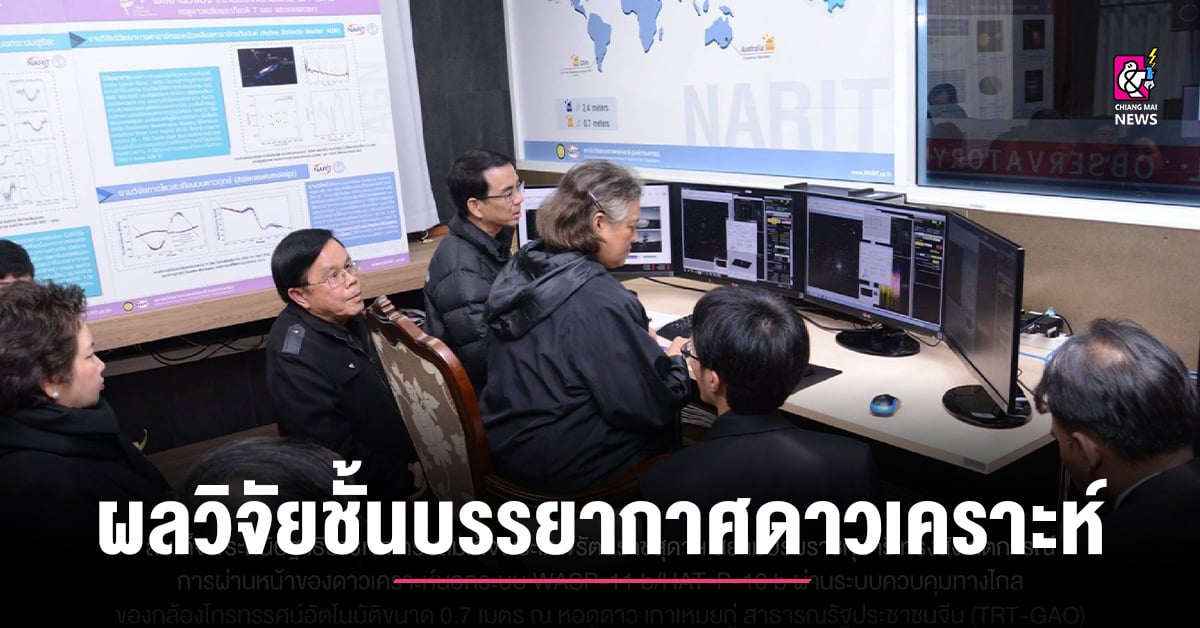
Thai Astronomers Unlock Secrets of Exoplanet Atmosphere After Decade-Long Study
In a landmark achievement for Southeast Asian astronomy, researchers at Thailand’s National Astronomical Research Institute of Thailand (NARIT) have revealed groundbreaking findings about the atmosphere of a distant exoplanet, WASP-11 b/HAT-P-10 b, after more than a decade of continuous observation. The study, which relied on data from Thailand’s own telescopes, marks a significant step forward in understanding the composition and behavior of “hot Jupiters”—gas giants orbiting close to their host stars.
The discovery, announced by NARIT earlier this month, provides compelling evidence that the exoplanet’s upper atmosphere is likely shrouded in thick clouds or haze, a finding that could reshape how scientists interpret the atmospheric properties of similar worlds. The research also confirmed the stability of the planet’s orbit, a critical detail for models of planetary formation and evolution. For a country still building its reputation in global astronomy, the achievement underscores Thailand’s growing capabilities in cutting-edge space research.
The Exoplanet: A “Hot Jupiter” with a Mysterious Atmosphere
WASP-11 b/HAT-P-10 b, located approximately 400 light-years from Earth in the constellation Perseus, is classified as a “hot Jupiter”—a gas giant with a mass and radius similar to Jupiter but orbiting far closer to its host star. This proximity subjects the planet to extreme temperatures, often exceeding 1,000 degrees Celsius (1,832 degrees Fahrenheit), which can dramatically alter its atmospheric composition and behavior.
The exoplanet was first identified in 2008 through the Wide Angle Search for Planets (WASP) project, a collaborative effort to detect exoplanets using the transit method. This technique involves observing the slight dimming of a star’s light as a planet passes in front of it, a phenomenon known as a “transit.” Over the years, WASP-11 b/HAT-P-10 b has become a prime target for atmospheric studies due to its relatively bright host star and the depth of its transits, which make it easier to analyze starlight filtering through its atmosphere.
A Decade of Data: How Thai Telescopes Made the Difference
The NARIT-led study, published in a yet-to-be-peer-reviewed preprint on the arXiv server, compiled data from 31 transit events observed between 2013 and 2023. The observations were conducted using a combination of Thailand’s 2.4-meter Thai National Telescope (TNT), located at the Doi Inthanon National Observatory in Chiang Mai, and smaller automated telescopes operated by NARIT across the country. The team also collaborated with international partners to supplement their data with observations from other ground-based telescopes.

Dr. Napaporn A-thano and Dr. Supachai Awiphan, the lead researchers on the project, emphasized the significance of the long-term data set. “By observing multiple transits over a decade, we were able to detect subtle changes in the planet’s atmosphere and confirm the stability of its orbit,” Dr. A-thano said in a statement released by NARIT. “This level of detail is only possible with sustained, high-precision observations, which our team has been able to achieve thanks to Thailand’s growing astronomical infrastructure.”
The study focused on analyzing the “transmission spectrum” of WASP-11 b/HAT-P-10 b—the way starlight is absorbed or scattered by the planet’s atmosphere as it passes through. The researchers found that the spectrum lacked the expected signatures of certain molecules, such as sodium and potassium, which are typically present in the atmospheres of hot Jupiters. Instead, the data suggested the presence of high-altitude clouds or haze, which could be scattering or blocking the starlight before it reaches observers on Earth.
Why This Discovery Matters for Exoplanet Science
The findings from the NARIT study contribute to a growing body of evidence that many hot Jupiters may have cloudy or hazy atmospheres, a phenomenon that has been observed in other exoplanets like HD 189733 b and WASP-12 b. These clouds or hazes can obscure the signatures of underlying atmospheric molecules, making it challenging for astronomers to determine the exact composition of these distant worlds. Understanding the prevalence and properties of such atmospheric features is crucial for interpreting data from future missions, such as NASA’s James Webb Space Telescope (JWST), which is designed to study exoplanet atmospheres in unprecedented detail.
“This research demonstrates the importance of long-term monitoring in exoplanet science,” said Dr. Awiphan. “Although space telescopes like JWST can provide stunning snapshots of exoplanet atmospheres, ground-based observatories like ours play a vital role in tracking changes over time. The combination of both approaches will be key to unlocking the mysteries of these distant worlds.”
The study also confirmed that WASP-11 b/HAT-P-10 b’s orbit has remained stable over the past decade, with no detectable variations in its transit timing. This stability suggests that the planet is not experiencing significant gravitational interactions with other bodies in its system, a finding that aligns with current models of hot Jupiter formation. However, the researchers noted that further observations would be needed to rule out the presence of smaller, undetected planets or other dynamic influences.
Thailand’s Rising Role in Global Astronomy
The success of the NARIT study highlights Thailand’s emergence as a significant player in international astronomy. Over the past decade, the country has invested heavily in its astronomical infrastructure, including the construction of the Thai National Telescope in 2013 and the establishment of regional observatories in Nakhon Ratchasima, Songkhla, and Chachoengsao. These facilities have enabled Thai astronomers to participate in global research collaborations and contribute to high-impact studies.
NARIT, which operates under the Ministry of Higher Education, Science, Research and Innovation, has also prioritized public engagement and education. In 2019, the institute launched a campaign to name an exoplanet and its host star, GJ 3470 b and GJ 3470, as part of the International Astronomical Union’s (IAU) NameExoWorlds project. The winning names, “Kaewkosin” for the star and “Phailinsiam” for the planet, were selected through a public vote and reflect Thai cultural heritage.
“Our goal is not only to advance scientific research but also to inspire the next generation of Thai scientists and astronomers,” said Dr. Saran Poshyachinda, NARIT’s executive director, in a 2023 interview. “By making astronomy accessible and engaging, we hope to foster a culture of curiosity and innovation in Thailand.”
What’s Next for the Study of WASP-11 b/HAT-P-10 b?
While the NARIT study has provided valuable insights into the atmosphere of WASP-11 b/HAT-P-10 b, many questions remain unanswered. The researchers plan to continue monitoring the exoplanet to track any long-term changes in its atmosphere or orbit. They also hope to collaborate with international teams to conduct follow-up observations using larger telescopes, such as the Very Large Telescope (VLT) in Chile or the upcoming Extremely Large Telescope (ELT), which could provide even higher-resolution data.

In the meantime, the NARIT team is turning its attention to other exoplanets in its observational pipeline. “We have several ongoing projects targeting different types of exoplanets, including super-Earths and mini-Neptunes,” said Dr. A-thano. “Each of these worlds offers a unique opportunity to test our understanding of planetary formation and atmospheric chemistry. The next decade of exoplanet research promises to be even more exciting as novel telescopes and technologies come online.”
Key Takeaways from the NARIT Study
- Decade-Long Observation: The study compiled data from 31 transit events of WASP-11 b/HAT-P-10 b observed between 2013 and 2023 using Thailand’s telescopes.
- Atmospheric Findings: The exoplanet’s atmosphere appears to be shrouded in thick clouds or haze, obscuring the signatures of molecules like sodium and potassium.
- Orbital Stability: The planet’s orbit has remained stable over the past decade, with no detectable variations in its transit timing.
- Thailand’s Growing Role: The study highlights Thailand’s increasing capabilities in exoplanet research and its contributions to global astronomy.
- Future Observations: Researchers plan to continue monitoring WASP-11 b/HAT-P-10 b and expand their operate to other exoplanets.
Why This Research Matters for You
While the study of exoplanets like WASP-11 b/HAT-P-10 b may seem distant from everyday life, it has profound implications for our understanding of the universe and our place in it. Discoveries like these aid scientists refine models of planetary formation and evolution, which could one day answer one of humanity’s most enduring questions: Are we alone in the universe?
For Thailand, the success of the NARIT study is a testament to the country’s scientific progress and its ability to contribute to global research. As more nations invest in astronomical infrastructure, the collaborative nature of exoplanet science ensures that discoveries are shared and celebrated worldwide. Whether you’re a student, an amateur astronomer, or simply someone fascinated by the cosmos, this research serves as a reminder of the wonders that lie beyond our solar system—and the dedication of the scientists working to uncover them.
For the latest updates on NARIT’s research and other astronomical discoveries, follow the institute’s official website or its Facebook page. The next major announcement from the team is expected later this year, with further details on their ongoing exoplanet studies.
What do you think about Thailand’s growing role in space research? Share your thoughts in the comments below and join the conversation about the future of astronomy in Southeast Asia.
Related reading