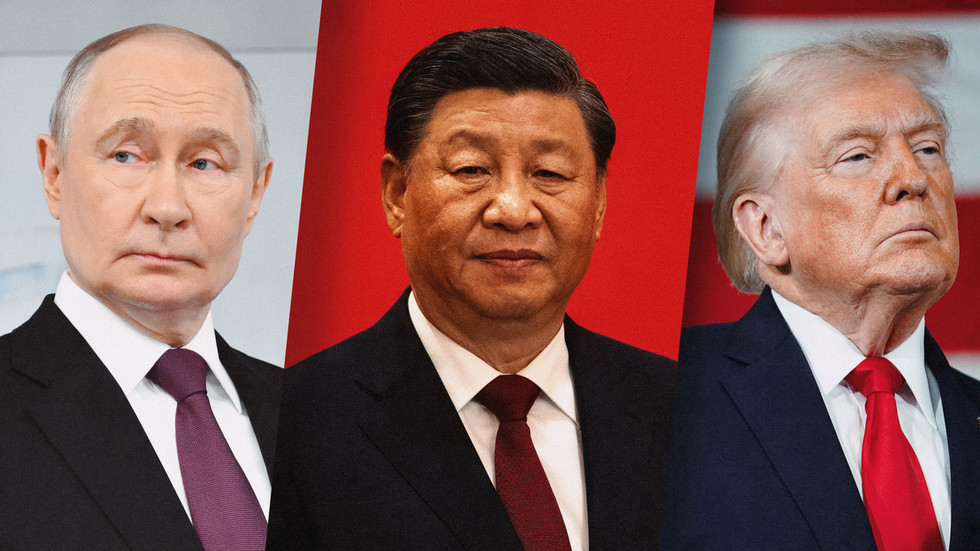
The diplomatic calendars of Beijing, Washington and Moscow are converging this month in a sequence of high-stakes visits that have ignited speculation about a potential “grand bargain” to stabilize the global order. With U.S. President Donald Trump scheduled to meet Chinese President Xi Jinping on May 14-15, followed by a visit from Russian President Vladimir Putin, the world is watching to see if the “strategic triangle” of the three most influential powers can find a common equilibrium.
But, the prospect of a comprehensive, durable agreement is increasingly viewed as a myth. While summit diplomacy can manage the tempo of historical shifts, it cannot reverse the structural restructuring of the international system. The divergence between Washington’s transactional approach and the strategic needs of other global powers suggests that the era of the liberal international order has not just been challenged, but has fundamentally collapsed.
For decades, the global economy relied on a symbiotic, if unequal, relationship often termed Chimerica
—the fusion of American capital and technology with Chinese labor and manufacturing. This arrangement drove globalization and was long thought to be protected by mutual economic self-interest. That assumption has now vanished, replaced by a qualitative shift in how the United States views its role in the world.
Washington no longer sees this interdependence as a source of shared gain, but as a structural imbalance. In response, the U.S. Has pivoted toward a strategy of maximizing immediate, short-term advantages to secure a head start in the next phase of global competition. This approach is most visible in the rhetoric and policy of Donald Trump, whose transactional style reflects a broader, pre-existing logic: build national capacity quickly and use that strength to dominate the future.
The Transactional Pivot: Why a ‘Grand Bargain’ is Unlikely
The shift in American strategy represents a departure from the long-term investments in international frameworks that characterized previous decades. While those investments did not always yield immediate returns, they reinforced a global system that primarily benefited the United States. Today, the emphasis has moved toward short-term wins, even at the risk of creating longer-term global instability.
This shift has profound implications for the upcoming meetings in Beijing. In the current U.S. Framework, a deal
is treated more as a commercial transaction than a strategic treaty. A “big deal” is measured by the scale of immediate gain it delivers, not by its durability. Under these conditions, Washington is unlikely to commit to any long-term arrangement that limits its own flexibility before it has secured what it considers a sufficient advantage.
The upcoming meeting between Trump and Xi is expected to define the limits of a temporary accommodation. The two powers remain economically intertwined, but they are increasingly distrustful. The central question is no longer whether a comprehensive agreement is possible, but rather what narrow, short-term arrangements can be reached and how long they will last.
Beijing’s Reassessment and the Russian Axis
As the reliability of stable agreements with Washington fades, other major powers are forced to adapt. This adaptation manifests in two primary ways: the prioritization of military capability as a safeguard against external pressure and the pursuit of alternative cooperation frameworks that operate independently of U.S. Influence.
Russia has been an active advocate for this shift for several years, seeking to build a multipolar system that bypasses Western hegemony. China, by contrast, has historically been more cautious, hoping to maintain a mutually beneficial relationship with the U.S. However, that hope appears to be waning. Evidence of this shift emerged during the recent Valdai Russian-Chinese Conference held in Shanghai on April 26–27, 2026, where experts and officials discussed the Era of Multipolarity
and latest horizons for bilateral cooperation (Valdai Club).
President Putin’s subsequent talks with President Xi will likely focus on the extent to which Russia and China are prepared to develop mechanisms of cooperation—ranging from energy security to financial systems—that bypass the United States entirely. While Moscow has been moving in this direction for some time, Beijing is now weighing whether it must follow suit to protect its own strategic interests.
Key Strategic Divergences
The divergence between the U.S. And the rest of the world can be summarized by three conflicting priorities:
- Time Horizon: Washington is prioritizing short-term, transactional gains; China and Russia are seeking long-term structural shifts in the global order.
- Nature of Agreements: The U.S. Views “deals” as flexible commercial transactions; other powers are seeking durable, systemic security guarantees.
- Systemic Goal: The U.S. Seeks to preserve its dominance through decisive present action; the “East” seeks a multipolar system where no single power holds veto authority.
The Road Ahead: What to Expect in May
The sequence of visits to Beijing will not produce a “grand bargain,” but they will serve as a barometer for the new global reality. The Trump-Xi summit, scheduled for May 14-15 (BBC), will reveal the minimum threshold of cooperation required to prevent total economic decoupling. Meanwhile, the Putin-Xi talks will signal how far the “axis” of non-Western cooperation has actually progressed.

The world is not moving toward a more orderly system, but toward a different kind of order—one defined by fragmented blocs, tactical alliances, and a constant state of reassessment. The absence of a grand bargain is not a failure of diplomacy, but a reflection of a world where the foundational conditions for such an agreement no longer exist.
The next confirmed checkpoint will be the official joint statements released following the Trump-Xi summit on May 15, which will outline any immediate agreements on trade or regional security. We invite our readers to share their perspectives on whether a transactional approach to diplomacy can truly provide global stability in the comments below.
Related reading