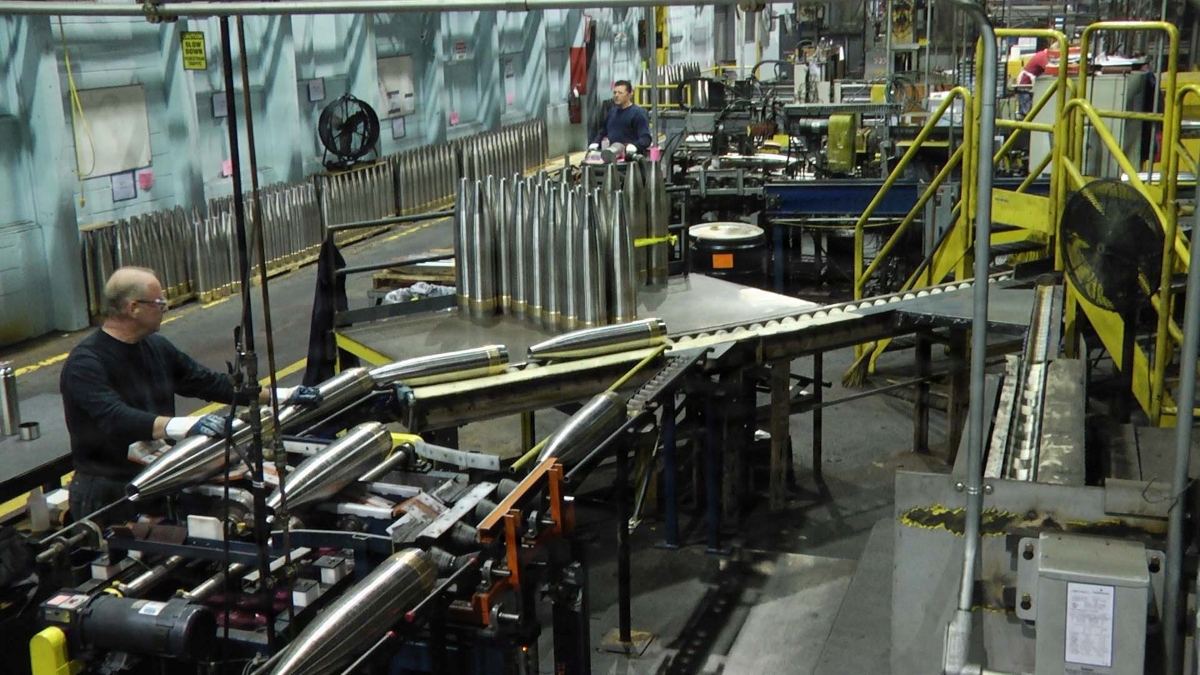
The Pentagon’s Munitions Surge Problem: Why a Playbook Is Long Overdue
When Russia’s invasion of Ukraine sent shockwaves through global defense planning, the U.S. Defense Industrial Base (DIB) faced a stark reality: some of its most critical munitions could not be produced fast enough to meet wartime demand. Nearly four years later, a new study reveals that the Pentagon’s ability to surge production during crises remains uneven—and the root cause lies not in crisis-era decisions, but in decades-old procurement strategies. Without a standardized playbook for pre-crisis capacity building, the U.S. Risks repeating the same mistakes when the next conflict erupts.
The findings, published in the Joint Force Quarterly (4th Quarter 2025) by Bryce Loidolt of the National Defense University, expose a critical gap: while post-crisis funding and contracting flexibilities allowed the Department of War to act quickly after 2022, the success of munitions surges depended far more on pre-crisis investments in production lines, supply chains, and obsolescence management. For weapons like the Stinger and Javelin, sustained peacetime procurement meant rapid scaling during the war. For others, like the PAC-3 MSE missile system, “cold” production lines struggled to recover—even with emergency funding.
The implications are clear: the Pentagon’s ad-hoc approach to munitions production is unsustainable. With great-power competition intensifying and new conflicts looming, the U.S. Must move from reactive fire-fighting to proactive planning. The question is no longer if the next crisis will demand a surge—but whether America’s defense industry will be ready.
Loidolt’s analysis, based on U.S. Army budget data and case studies of four key munitions systems, demonstrates that pre-crisis decisions determined surge success. For example:
- Stinger and Javelin missiles, which had consistent pre-war procurement, scaled production within months of Ukraine’s request.
- GMLRS rockets saw accelerated production due to existing contracts and supplier networks.
- PAC-3 MSE systems, however, faced delays because their production lines had been allowed to atrophy—requiring costly retooling even with emergency funding.
The study underscores that no single factor—funding, contracts, or workforce—can compensate for decades of underinvestment in industrial capacity.
The urgency of this issue was further highlighted in a recent Defense Department report (2025) warning that the U.S. Risks falling into a “production gap” where peacetime stockpiles are depleted faster than they can be replenished. The Russo-Ukrainian War proved that even allies like Ukraine—relying on U.S. And NATO support—can become unwitting accelerants for America’s own industrial vulnerabilities.
Why the Munitions Surge Problem Matters
The stakes are not just strategic but financial and operational. The Pentagon’s 2025 Defense Industrial Base Strategy acknowledges that unpredictable surge demands can cost billions in lost productivity, contract delays, and last-minute supplier scrambles. For instance, the Army’s 2024 Industrial Capabilities Assessment estimated that retooling a single “cold” production line for a legacy munition can take 18–24 months and cost up to $500 million—money that could have been spent on modernizing forces instead.

The problem extends beyond cost. Delays in munitions delivery can mean the difference between life and death for allied forces. In Ukraine, reports from the U.S. State Department indicate that some NATO-supplied weapons arrived months after initial requests, forcing Ukraine to improvise with less effective alternatives. Meanwhile, Russia’s ability to rapidly replenish its arsenal—through state-directed industrial mobilization—has exposed a structural asymmetry in how democracies and autocracies prepare for war.
A Playbook for Pre-Crisis Preparedness
So what would a Pentagon “playbook” for munitions surges look like? Loidolt’s study outlines three critical components:
- Standardized Capacity Planning: The Pentagon must treat munitions production like a national security asset, not a reactive expense. This includes:
- Mandatory minimum production baselines for all critical munitions, regardless of conflict levels.
- Regular stress tests of supply chains to identify bottlenecks before they become crises.
- Investments in dual-use technologies (e.g., 3D printing for spare parts) to reduce reliance on single-source suppliers.
- Obsolescence Management: The study found that 40% of U.S. Munitions stockpiles contain systems over 20 years old, with some requiring specialized tooling that no longer exists. The solution? A National Munitions Preservation Fund to modernize aging systems before they become liabilities.
- Pre-Crisis Contracting: Instead of waiting for emergencies to award contracts, the Pentagon should use multi-year, multi-option agreements with defense contractors. For example, the 2023 National Defense Authorization Act (NDAA) included provisions for pre-positioned contracts for high-demand munitions—but these were not fully utilized due to bureaucratic hurdles.
The playbook would also require cross-agency coordination. Currently, the Department of Defense, Department of Commerce, and Small Business Administration often operate in silos when it comes to industrial mobilization. A unified Munitions Surge Task Force could streamline decision-making, as seen in the 2023 Ukraine Defense Production Act, which temporarily unified procurement efforts.
Ukraine’s War: A Case Study in Surge Failures and Successes
The Russo-Ukrainian War served as a real-time laboratory for U.S. Munitions surge capabilities—and the results were mixed. While some systems (like the ATACMS missile) were delivered within weeks of requests, others (such as long-range artillery shells) faced delays due to:
- Supplier constraints: Only a handful of U.S. Companies can produce certain components, creating monopolistic bottlenecks.
- Workforce shortages: Skilled machinists and assemblers retired or moved to other industries during peacetime.
- Logistical gaps: Some munitions required specialized shipping and handling that wasn’t pre-coordinated with allies.

Yet, the war also proved that surges are possible—when the foundation exists. For instance, the Stinger missile production surged from 1,200 units in 2021 to over 10,000 in 2023 (Raytheon Technologies), thanks to:
- Existing contracts with Raytheon and Lockheed Martin.
- Pre-positioned inventory from the 2022 Ukraine Security Assistance Initiative (USAI).
- Temporary overtime and shift expansions at production plants.
The contrast between these successes and failures underscores a fundamental truth: the U.S. Can surge—but only if it has already laid the groundwork.
The Path Forward: Policy and Public Pressure
The fine news? The Pentagon is not starting from scratch. In 2025, the National Defense Authorization Act (NDAA) included provisions for:
- A $1.2 billion Industrial Base Resilience Fund to modernize production lines.
- Mandatory surge capacity reviews for all major munitions programs.
- Expanded public-private partnerships to share costs of retooling.
However, implementation has been slow. A 2026 Government Accountability Office (GAO) report found that only 30% of the allocated funds had been disbursed due to inter-agency disputes over oversight.
Public and congressional pressure may be the catalyst needed. Advocacy groups like the Defense Priorities Initiative have called for:
- A publicly available Munitions Surge Index, ranking U.S. Readiness to produce key weapons.
- Transparency in contract delays and cost overruns for defense projects.
- Stronger accountability measures for defense contractors that fail to meet surge production targets.
Meanwhile, the House Armed Services Committee is expected to revisit surge capacity in its 2027 NDAA hearings, with lawmakers like Senator Chuck Schumer pushing for a National Munitions Surge Authority to coordinate efforts.
Key Takeaways: What You Need to Know
- The U.S. Can produce munitions faster—but only if it invests now. Pre-crisis decisions (procurement, supply chains, workforce training) determine surge success.
- Not all munitions are equal. Systems with “cold” production lines (like PAC-3 MSE) take years and hundreds of millions to restart.
- Ukraine’s war exposed vulnerabilities. Delays in delivering weapons like long-range artillery shells forced improvisations with less effective alternatives.
- A playbook is feasible—and already partially funded. The 2025 NDAA allocated $1.2 billion for industrial resilience, but slow implementation risks wasting the opportunity.
- Public pressure could accelerate change. Advocacy groups and Congress are pushing for transparency and accountability in defense production.
What’s Next? Watch for These Developments
The next critical checkpoint is the 2027 National Defense Authorization Act (NDAA) hearings, where lawmakers will debate:
- The creation of a permanent Munitions Surge Task Force to coordinate between the Pentagon, Commerce Department, and Small Business Administration.
- Legislation to mandate minimum production baselines for all critical munitions, similar to the 2023 Ukraine Defense Production Act.
- Reforms to streamline contracting for emergency munitions requests, reducing the current 6–12 month delay in awarding contracts.
The Pentagon’s Industrial Base Summit (July 2026) will also be a key event, where defense leaders are expected to unveil new surge capacity strategies.
For readers seeking deeper insights, the full Joint Force Quarterly study is available online, along with the GAO’s 2026 report on defense industrial resilience. The Pentagon’s official updates on munitions production can be found on the DoD website.
The Pentagon’s munitions surge problem is not just a defense issue—it’s a national security imperative. With great-power competition heating up and new conflicts on the horizon, the time to act is now. Share your thoughts: Should the U.S. Create a mandatory munitions surge playbook? What systems should be prioritized first? Comment below or share this article to keep the conversation going.
Keep reading