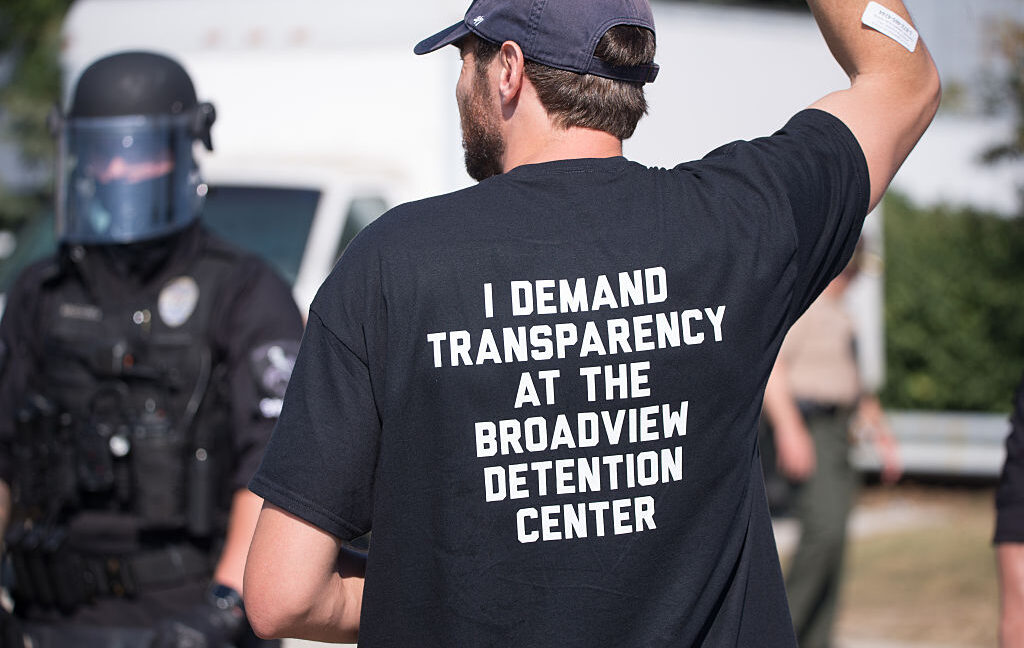
A legal battle is unfolding in an Illinois district court as four protesters move to block the U.S. Government from building what they describe as a permanent genetic archive of political dissidents. The DHS DNA database lawsuit alleges that federal agents seized DNA samples from American citizens arrested during peaceful demonstrations, subsequently uploading their genetic profiles into government databases without proper legal justification.
The complaint, filed on Wednesday, targets both the Department of Homeland Security (DHS) and the Federal Bureau of Investigation (FBI). The plaintiffs argue that the seizure of their biological data represents a profound overreach of federal authority, transforming routine law enforcement arrests into a mechanism for lifelong genetic surveillance.
At the heart of the dispute is a series of arrests conducted at the Broadview ICE facility during a federal surge known as “Operation Midway Blitz.” During this operation, thousands of federal agents flooded Chicago, leading to a wave of detentions that the plaintiffs claim were designed to stifle dissent rather than maintain public order.
As a technology editor with a background in computer science, I find the implications of this case particularly alarming. We are no longer talking about simple fingerprints or photographs; the permanent storage of genetic profiles allows the state to not only track an individual but potentially uncover familial relationships and predispositions, creating a level of biological transparency that the Fourth Amendment was specifically designed to prevent.
The Broadview Arrests and ‘Operation Midway Blitz’
The controversy stems from the federal government’s conduct during “Operation Midway Blitz” in Chicago. According to the court filing, federal agents conducted 92 non-immigration arrests at the Broadview ICE facility. The plaintiffs allege that these arrests were used as a pretext to collect DNA samples from peaceful protesters.
The statistics presented in the lawsuit highlight a stark disparity between the number of arrests and the number of actual crimes committed. Of the 92 individuals detained, only one person was convicted. Notably, that single conviction was not related to the protests at Broadview; instead, it was based on a guilty plea regarding the concealment of a prior felony charge.
The plaintiffs themselves represent a cross-section of those detained. Two of the four protesters faced minor charges for allegedly impeding a federal officer—specifically for slapping a phone out of an agent’s hand—but those charges were quickly dropped. The remaining two plaintiffs were charged with no crimes at all, yet their DNA was still seized, and stored.
Constitutional Violations and the Administrative Procedure Act
The lawsuit seeks an immediate injunction to stop the government from continuing these practices, citing violations of the First and Fourth Amendments to the U.S. Constitution. The First Amendment protects the right to peaceful assembly and free speech, while the Fourth Amendment guards against “unreasonable searches and seizures.”

The plaintiffs argue that the government has “wrongfully arrested peaceful protesters” to facilitate the collection of DNA, which is then stored “permanently” in federal labs. By linking the collection of genetic data to the act of protesting, the plaintiffs claim the government is creating a chilling effect on political speech, effectively penalizing critics of Immigration and Customs Enforcement (ICE) with a lifetime of biological monitoring.
Beyond the Constitution, the complaint invokes the Administrative Procedure Act (APA). This legal challenge suggests that the DHS and FBI may have bypassed necessary regulatory steps or exceeded their statutory authority when implementing the DNA collection protocols used during Operation Midway Blitz.
The Technical Danger of Permanent Genetic Profiling
To understand why this lawsuit is critical, one must understand the difference between a temporary forensic sample and a permanent genetic profile. When DNA is “uploaded to government databases,” it is typically converted into a digital string of markers. This digital profile can be used for “familial searching,” a process where investigators look for partial matches to identify relatives of a suspect, even if the relative has never been arrested.
When the government stores these samples permanently in federal labs, they are essentially creating a biological ledger of individuals who have come into conflict with the state. For those arrested during peaceful protests, this means their most intimate biological data is now accessible to federal agencies regardless of whether they were ever convicted of a crime.
This shift toward genetic surveillance represents a significant escalation in state capability. Unlike a password or a credit card, DNA cannot be changed. Once a genetic profile is entered into a federal database, the individual is permanently “known” to the system, creating a permanent digital tether between the citizen and the government.
Clashing with Supreme Court Precedent
The federal government has historically relied on specific legal frameworks to justify DNA collection from arrestees. The plaintiffs’ legal team argues that the government is misapplying these precedents to justify the broad collection seen in Chicago.
The lawsuit specifically references a 2013 Supreme Court case—likely Maryland v. King—which held that the state may collect DNA from individuals arrested for “serious crimes” without violating the Fourth Amendment. The Court reasoned in that instance that DNA is a legitimate booking identifier, similar to fingerprints.
However, the protesters argue that this precedent does not extend to peaceful demonstrators or individuals accused of minor, non-violent misdemeanors. By applying a standard meant for serious felons to peaceful critics of government policy, the plaintiffs contend that the DHS and FBI have vastly exceeded their legal authority.
What This Means for Civil Liberties
If the court finds in favor of the government, it could set a precedent that allows federal agencies to use “booking procedures” as a loophole to build a genetic database of political activists. This would effectively decouple DNA collection from the commission of serious crimes and attach it instead to the act of government interaction.

The stakeholders in this case extend far beyond the four plaintiffs in Illinois. It affects every American citizen who exercises their right to protest. The core question is whether the government can treat the biological data of a peaceful protester as a “booking identifier” in the same way it treats the data of a violent offender.
The implications for the “right to be forgotten” are also severe. If the DNA of individuals who were never convicted of a crime is stored permanently, the government is maintaining a database of “innocent” genetic profiles, which could be repurposed for future surveillance or used in ways not currently disclosed to the public.
Next Steps in the Legal Process
The Illinois district court must now decide whether to grant the requested injunction. An injunction would force the DHS and FBI to stop the collection and potentially destroy the DNA samples seized during Operation Midway Blitz while the broader merits of the case are litigated.
The next confirmed checkpoint will be the court’s ruling on the motion for a preliminary injunction. This decision will determine whether the government can continue to store these samples while the legal battle over the First and Fourth Amendments continues.
Do you believe the government should have the right to store DNA samples of individuals who are never convicted of a crime? Share your thoughts in the comments below and share this article to join the conversation on digital and biological privacy.