
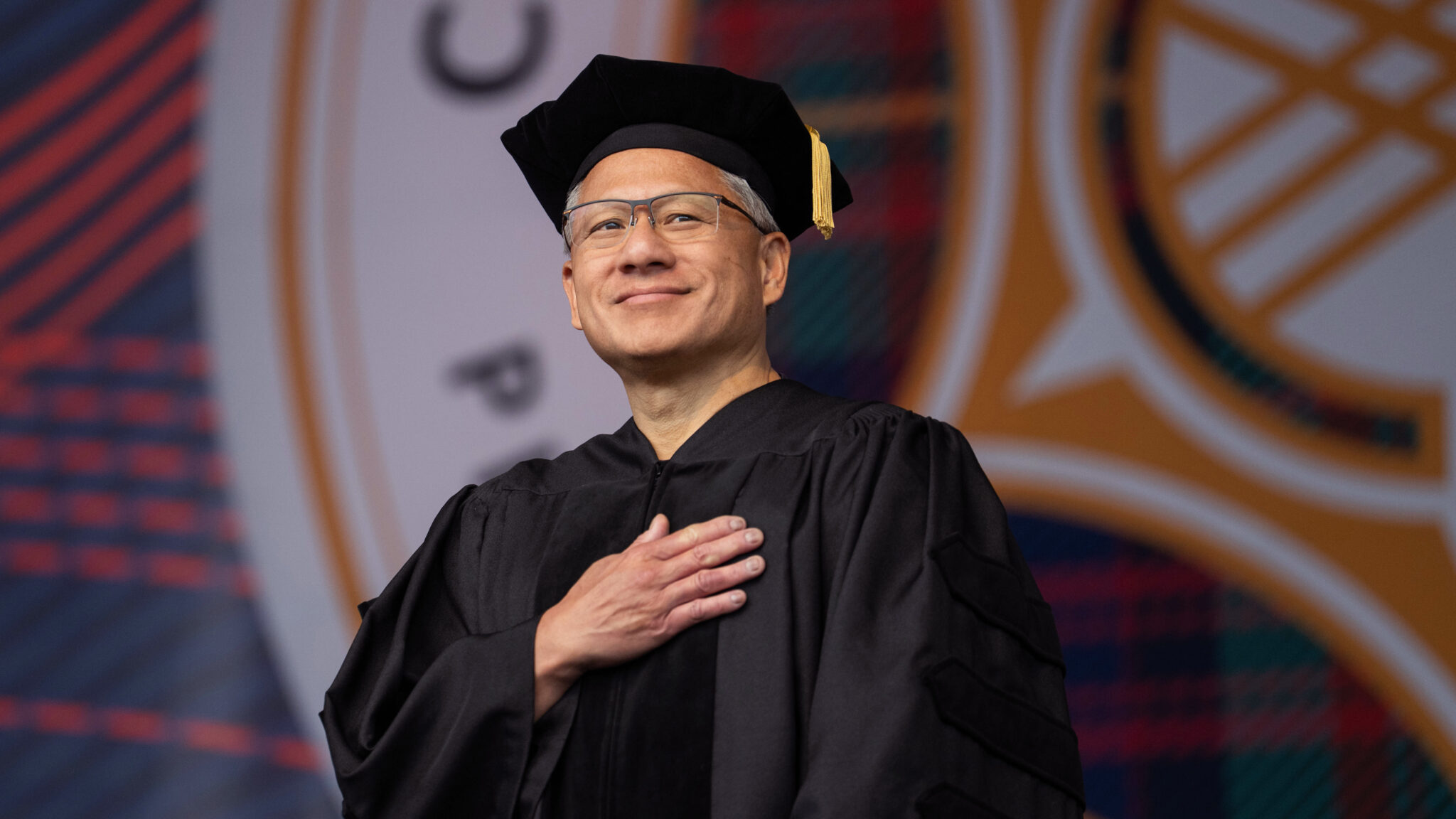
On a rain-swept Sunday morning at Gesling Stadium, thousands of graduates gathered for Carnegie Mellon University’s 128th commencement ceremony, but the weather did little to dampen the atmosphere of anticipation. The occasion was marked by a keynote address from NVIDIA founder and CEO Jensen Huang, who presented a vision of the future where the current generation of graduates is not merely entering a job market, but is standing at the threshold of a fundamental shift in human civilization.
Addressing the assembled crowd in academic regalia, Huang framed the present moment as a historical mirror to the dawn of the personal computer. He argued that while previous shifts—including the rise of the internet, mobile computing, and the cloud—were transformative, the current AI revolution is qualitatively different because intelligence is foundational to every existing industry. For the Class of 2026, this means their professional journeys begin at the exact moment a new industrial era is being born.
Huang, who received an Honorary Doctor of Science and Technology from CMU President Farnam Jahanian, emphasized that the tools now available to graduates are more powerful than any previous generation has possessed. He described the current state of technology as a “starting line,” urging the graduates to help shape the trajectory of artificial intelligence rather than simply reacting to its implementation.
A New Industrial Era: Beyond Computing
A central theme of Huang’s address was the distinction between the previous computing revolutions and the current AI trajectory. He noted that while the PC and mobile eras changed how we access information and communicate, AI is driving what he described as the largest technology infrastructure buildout in human history. According to Huang, this shift represents a “once-in-a-generation opportunity to reindustrialize America and restore the nation’s capacity to build.”
This vision of reindustrialization extends beyond the software engineering labs of Silicon Valley. Huang underscored that the AI revolution is not restricted to “tech” jobs, but will fundamentally alter the roles of electricians, plumbers, ironworkers, and technicians. By making intelligence broadly accessible, he argued that AI could close the technology divide, providing high-level capabilities to those in traditional trades, and construction.
The core of this transition is the shift from computing—which processes data—to intelligence—which generates insights and automates complex reasoning. Huang suggested that because intelligence is the bedrock of all industry, no sector will remain untouched. This systemic change, he noted, creates a unique advantage for the present graduating class, who are “primed” to lead this transition across diverse fields of study.
Automating Tasks, Elevating Purpose
Addressing the inevitable anxiety surrounding workforce displacement, Huang offered a nuanced distinction between the “task” of a job and the “purpose” of a profession. He argued that while AI is designed to automate specific tasks, it serves to elevate the human purpose behind the work.
To illustrate this, Huang pointed to the field of radiology. He explained that while AI can automate the task of reading medical scans with high precision, the purpose of a radiologist is not merely to identify patterns in an image, but to provide comprehensive care for a patient. By removing the rote burden of scan reading, AI allows the medical professional to focus more deeply on the human element of healthcare.
This philosophy suggests that the path forward is not to compete with AI, but to engage with it deeply. Huang posited that when society engages with technology openly and optimistically, the result is an expansion of human potential rather than a diminution of it. He encouraged graduates to view AI as a collaborator that handles the mechanical aspects of their roles, freeing them to pursue higher-order problem solving and creative innovation.
The Mandate for Responsible Advancement
Despite his optimism, Huang warned that the “great promise” of AI can only be realized through a “clear-eyed” approach to its inherent risks. He called for a collective responsibility shared between engineers, scientists, and policymakers to ensure that AI is advanced wisely and safely.
Huang outlined a four-part framework for meeting the moment of the AI revolution:
- Advance safely: Ensuring that AI capabilities and AI safety are developed in tandem.
- Create thoughtful policies: Calling on policymakers to establish guardrails that protect society without stifling discovery and progress.
- Make AI broadly accessible: Preventing the concentration of intelligence tools within a select few entities.
- Encourage universal engagement: Urging all citizens to interact with and learn the tools of AI.
He cautioned against the instinct to retreat from technology out of fear. “History shows that societies that retreat from technology do not stop progress,” Huang remarked, noting that such retreats only result in the surrender of the opportunity to shape the technology and benefit from it. Instead, he urged the graduates to guide the future responsibly, ensuring the benefits of intelligence reach as many people as possible.
Carnegie Mellon as the Cradle of AI
The choice of venue for these remarks was deeply symbolic. Huang acknowledged Carnegie Mellon University as “one of the true birthplaces of artificial intelligence and robotics,” linking the current revolution to the university’s storied academic history. He specifically cited the creation of the Logic Theorist in the 1950s—widely regarded as the first AI computer program—and the 1979 establishment of the CMU Robotics Institute, the first academic institute dedicated entirely to robotics.
Before the ceremony, Huang visited the Robotics Institute to meet with students and members of the robotics club, observing firsthand how current research is being applied to solve real-world challenges. This connection between theoretical academic foundations and practical industrial application mirrored Huang’s own career trajectory at NVIDIA.
On a personal note, Huang shared his experience as a first-generation immigrant, reflecting on his view of the United States as a land that offers “not a guarantee, but a chance.” He credited his parents’ belief in the American dream for providing him with the opportunity to innovate, adding a layer of personal gratitude to his professional exhortation to the graduates.
Closing his address, Huang invoked the university’s motto, “My heart is in the work,” urging the graduates to apply the same passion to their own contributions. He challenged them to build something worthy of their education and the potential of those who believed in them before the rest of the world did.
As the AI revolution continues to accelerate, the industry now looks toward the next phase of integration, with upcoming quarterly earnings and developer conferences expected to reveal how these theoretical “industrial era” shifts are being translated into hardware and software deployments. The global tech community remains focused on the balance between rapid scaling and the safety guardrails Huang emphasized during his address.
What are your thoughts on the distinction between “task” and “purpose” in the age of AI? Share your perspective in the comments below.