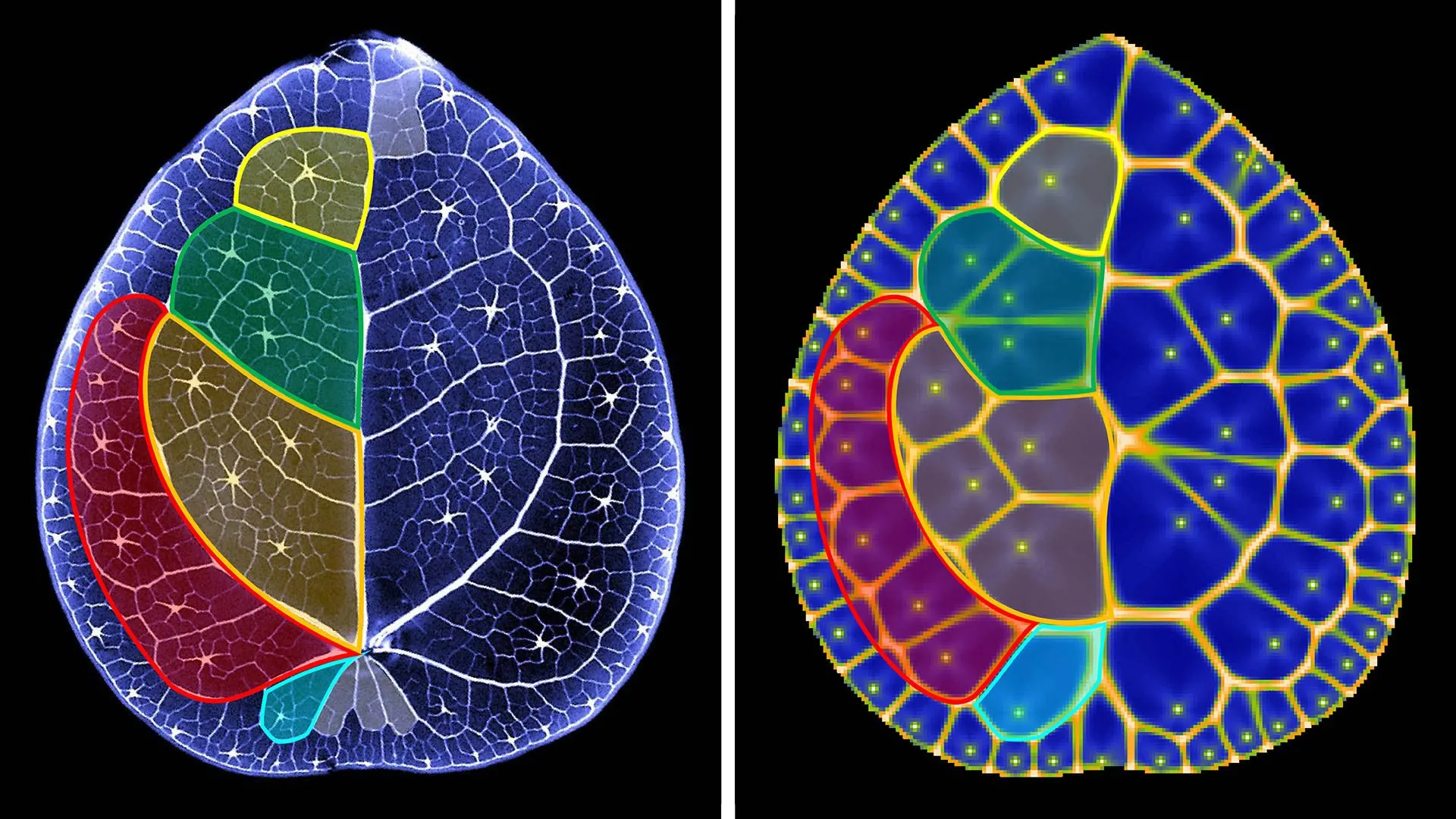
May 14, 2026 — In a discovery that blurs the line between biology and mathematics, scientists have uncovered an unexpected geometric pattern in the leaves of the popular houseplant Pilea peperomioides, commonly known as the Chinese money plant. Using advanced imaging techniques, researchers from Cold Spring Harbor Laboratory (CSHL) found that the plant’s leaf structure follows a mathematical framework called a Voronoi diagram—a spatial organization system typically associated with urban planning, computer networks, and logistics optimization.
The discovery suggests that plants may use sophisticated spatial logic to organize their internal structures without conscious measurement, raising intriguing questions about how natural systems solve complex problems that humans have only recently begun to model computationally.
This isn’t the first time nature has surprised scientists with its mathematical sophistication. From the Fibonacci sequence in sunflower seed arrangements to the fractal patterns of ferns, mathematical principles often underlie biological structures. But the identification of a Voronoi diagram—a pattern where space is divided into regions based on proximity to specific points—is particularly striking because it mirrors human-designed systems used for everything from school district boundaries to wireless network coverage.
How the Chinese Money Plant’s Leaves Reveal Hidden Geometry
The research, published in recent findings from CSHL, focused on mapping the microscopic pores and vein structures in the plant’s leaves. By analyzing these elements, the team led by Associate Professor Saket Navlakha discovered that the plant’s internal organization follows Voronoi principles: each region of the leaf is defined by its closest central point, whether that’s a pore responsible for water regulation or a vein transporting nutrients.
Pilea peperomioides, with its distinctive round leaves and glossy surface, has long been a favorite among plant enthusiasts for its ornamental qualities. But this study reveals an additional layer of complexity: the plant’s leaves appear to optimize space and resource distribution using mathematical rules that humans have only recently formalized in computer algorithms.
The implications of this discovery extend beyond botany. Voronoi diagrams are fundamental in fields like computer science, operations research, and urban planning. Finding them in nature suggests that evolutionary processes may have independently arrived at solutions to similar spatial optimization problems that humans have only recently begun to solve through engineering.
What Is a Voronoi Diagram?
A Voronoi diagram is a geometric construct that divides a plane into regions based on distance to a specified set of points. Each region contains all points closer to one generating point than to any other. In practical terms:

- City planning: Used to determine service areas for schools, hospitals, or police stations
- Computer science: Fundamental in computational geometry and spatial indexing
- Network design: Helps optimize signal coverage in wireless networks
- Biology: Now observed in plant leaf structures and potentially other natural systems
The discovery challenges our understanding of how plants grow and develop. While humans consciously apply these mathematical principles to solve problems, the Chinese money plant appears to use them instinctively through its biological processes.
The Research Process: From Plant to Algorithm
The CSHL team used high-resolution imaging to map the microscopic features of the plant’s leaves. By analyzing the distribution of hydathodes (specialized pores) and the network of veins, they identified the Voronoi pattern emerging from these natural structures. The research suggests that this organization may help the plant optimize water transport and gas exchange across its leaf surface.
What makes this finding particularly interesting is that the plant achieves this organization without any apparent “measurement” process. Unlike human engineers who use rulers and calculators, the plant seems to follow these mathematical rules through its genetic programming and growth processes.
Broader Implications: Nature as Mathematician
This discovery adds to a growing body of evidence that mathematical principles are deeply embedded in natural systems. Similar patterns have been found in:

- Phyllotaxis in sunflowers (Fibonacci sequence)
- Branch patterns in trees (fractal geometry)
- Animal movement patterns (Lévy flights)
- Coral growth structures (hyperbolic geometry)
Dr. Navlakha and his team suggest that studying these natural mathematical systems could provide new insights for engineers and computer scientists. “Nature has been solving optimization problems for millions of years,” Navlakha has noted in previous interviews. “By understanding how plants organize themselves, we might discover more efficient ways to solve problems in our own designed systems.”
What’s Next for This Research?
The CSHL team plans to expand their research to other plant species to determine how widespread these mathematical patterns are in the plant kingdom. They’re also exploring whether similar principles govern other aspects of plant physiology, such as root systems or flower arrangements.
For plant enthusiasts, this discovery adds a new layer of appreciation for houseplants like the Chinese money plant. What was once admired primarily for its aesthetic qualities now reveals a sophisticated internal organization that mirrors human mathematical thinking.
Practical Implications: Could This Change How We Study Plants?
While the immediate practical applications of this discovery remain speculative, several potential areas emerge:
- Plant breeding: Understanding these natural optimization patterns could lead to more efficient crop designs
- Biomimicry: Engineers might draw inspiration from plant structures for new materials or designs
- Agricultural technology: Sensors that mimic plant optimization could improve irrigation and nutrient delivery
- Mathematical biology: New frameworks for studying how natural systems solve complex problems
The research also raises philosophical questions about the relationship between biology and mathematics. Are these mathematical patterns a result of evolutionary processes, or do they represent fundamental truths about how space and organization work at all scales?
How to Observe This Pattern in Your Own Plants
While you won’t need a high-powered microscope to appreciate your Chinese money plant, you can observe some of these patterns with careful examination:
- Look at the veins: Notice how they create distinct regions across the leaf surface
- Examine the leaf edges: The pattern becomes more visible in younger leaves
- Observe the glossy surface: The hydathodes (tiny pores) help create the spatial divisions
- Compare with other plants: Many houseplants show similar vein patterns
For those interested in diving deeper, the CSHL team has made some of their imaging data available through open science initiatives, allowing other researchers to explore these patterns in more detail.
Key Takeaways
- Scientists at Cold Spring Harbor Laboratory discovered Voronoi diagram patterns in Chinese money plant leaves
- This mathematical organization helps optimize water transport and gas exchange in the plant
- The discovery suggests plants use sophisticated spatial logic without conscious measurement
- Voronoi diagrams are typically used in urban planning, computer science, and network design
- Researchers plan to study other plant species to determine how widespread these patterns are
- The finding adds to evidence that mathematical principles are fundamental to natural systems
What Happens Next?
The research team has indicated they will be presenting these findings at upcoming botanical and computational biology conferences in the coming months. While no specific publication date has been announced for a peer-reviewed journal article, interested researchers can follow updates through Cold Spring Harbor Laboratory’s official communications channels.

For plant lovers, this discovery offers a new way to appreciate the complexity hidden within familiar houseplants. The next time you admire your Chinese money plant, remember: beneath its glossy leaves lies a sophisticated mathematical system that has been evolving for millennia.
We’d love to hear your thoughts on this discovery. Does it change how you view the plants in your home? Share your observations in the comments below, and don’t forget to share this fascinating finding with fellow plant enthusiasts.
Worth a look