
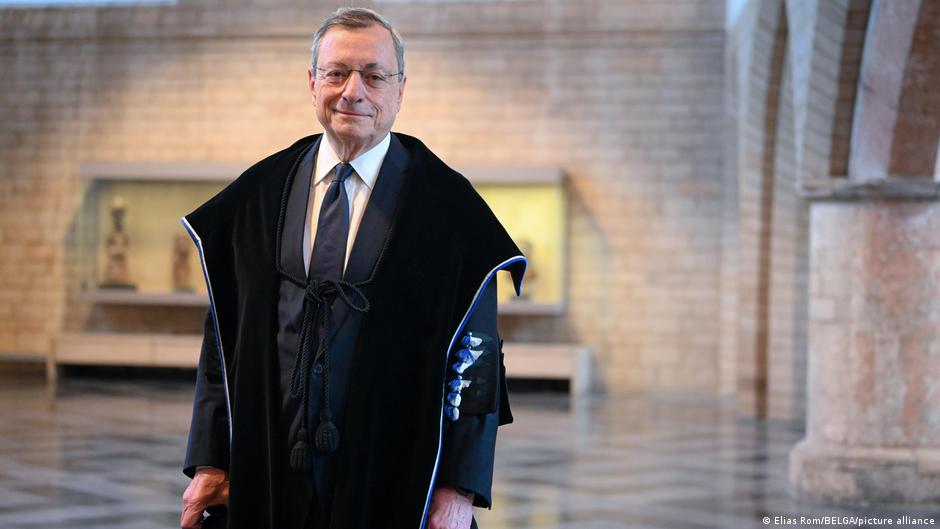
In the corridors of power across Brussels, Frankfurt, and Rome, few names command as much quiet reverence and strategic weight as Mario Draghi. To the casual observer, he is a career economist and a former head of state; to the architects of the modern European project, he is the man who effectively saved the Euro from collapse during its darkest hour.
While the Charlemagne Prize—the prestigious award honoring those who advance European unity—was awarded in 2024 to Ukrainian President Volodymyr Zelenskyy, the spirit of the prize is perhaps best embodied in the lifelong career of Mario Draghi. His trajectory from a PhD at MIT to the presidency of the European Central Bank (ECB) and the premiership of Italy represents a unique fusion of technocratic precision and political pragmatism.
Understanding who is Mario Draghi requires looking beyond the titles. It requires an analysis of a man who operated as the “lender of last resort” not just for banks, but for the very idea of a unified Europe. His legacy is defined by a willingness to act decisively when the traditional machinery of diplomacy and bureaucracy had stalled.
As a veteran observer of international affairs, I have watched Draghi navigate the volatile intersection of monetary policy and national sovereignty. His approach has always been characterized by a specific brand of “quiet authority”—a method of exerting immense influence without the need for populist rhetoric, relying instead on the sheer force of economic logic and institutional leverage.
The Architect of Stability: The ECB Years
Mario Draghi’s most enduring contribution to global economics occurred during his tenure as President of the European Central Bank from 2011 to 2019. He assumed leadership at a moment when the Eurozone was fracturing under the weight of the sovereign debt crisis. Markets were betting on the “redenomination risk”—the fear that countries like Italy or Spain would be forced to exit the Euro, potentially triggering a global financial meltdown.
The turning point came on July 26, 2012. In a speech in London that has since become legendary in financial history, Draghi uttered the phrase that shifted the trajectory of the continent: “Within our mandate, the ECB is ready to do whatever it takes to preserve the euro. And believe me, it will be enough.”
This was not merely a statement of intent; it was a psychological masterstroke. By signaling that the ECB would act as an unlimited backstop for struggling member states, Draghi calmed the markets without initially spending a single cent. He later formalized this commitment through the Outright Monetary Transactions (OMT) program, which allowed the ECB to buy the government bonds of distressed nations to lower their borrowing costs.
Through these actions, Draghi demonstrated a fundamental truth about European governance: in times of existential crisis, the centralized power of the central bank often outweighs the fragmented political will of individual member states. He didn’t just manage inflation; he managed the survival of a currency union.
The Reluctant Politician: Prime Minister of Italy
For years, Draghi avoided the direct theater of elective politics, preferring the insulated world of central banking and academia. However, in February 2021, Italy faced a governance vacuum amid a devastating COVID-19 pandemic and a stalling economy. He was called upon by President Sergio Mattarella to lead a national unity government.
His appointment as Prime Minister was a signal to the international community that Italy—the third-largest economy in the Eurozone—was in safe hands. Draghi’s premiership was characterized by a rigorous, data-driven approach to the NextGenerationEU recovery fund, ensuring that Italy utilized the billions of euros in grants and loans to modernize its infrastructure and digitize its public administration.
Unlike traditional Italian politicians, Draghi operated with a “technocratic” mandate. He focused on the “how” rather than the “who,” pushing through difficult reforms in justice and competition law that had been avoided for decades. However, the inherent instability of a coalition government—composed of parties with wildly different ideological goals—eventually took its toll. He resigned in October 2022, leaving behind a more stable economy but a political landscape as fragmented as ever.
Key Milestones in Mario Draghi’s Career
| Period | Role | Key Impact |
|---|---|---|
| 1970s-80s | Academic/Treasury | PhD from MIT; shaped Italy’s economic policy. |
| 2002-2006 | Governor, Bank of Italy | Led Italy’s transition into the Euro era. |
| 2011-2019 | President, ECB | Saved the Euro via “Whatever it takes” mandate. |
| 2021-2022 | Prime Minister of Italy | Managed pandemic recovery and EU fund implementation. |
The “Technocrat” Label and the European Ideal
To understand Draghi is to understand the concept of the “technocrat.” In the context of European politics, a technocrat is an expert appointed to a position of power based on technical skill rather than electoral popularity. While critics argue that this undermines democratic accountability, supporters suggest that in a complex, integrated economy, expertise is more valuable than ideology.
Draghi’s career serves as a case study in this tension. He possesses a rare ability to speak the language of the markets—the cold, hard numbers of bond yields and GDP growth—while simultaneously navigating the delicate diplomacy of the European Council. This duality is why he is often viewed as the “gold standard” for European leadership: he provides a bridge between the theoretical goals of European integration and the practical realities of economic survival.
His influence extends beyond his official roles. Even in retirement, Draghi remains a key advisor on the future of the European Union. He has frequently cautioned that Europe must innovate or risk becoming a “museum” in the face of the technological dominance of the United States and China. His focus has shifted toward “European competitiveness,” arguing that the EU needs a massive investment surge to keep pace with AI and green energy transitions.
Why His Legacy Matters Today
The relevance of Mario Draghi in the current geopolitical climate cannot be overstated. As Europe faces the dual pressures of the war in Ukraine and a volatile global energy market, the “Draghi method”—decisive action backed by institutional authority—is once again the blueprint for crisis management.
His work at the ECB taught the world that the Euro was more than just a currency; it was a political commitment. By stabilizing the bond markets, he prevented a domino effect that could have dismantled the European Union entirely. His time in Rome proved that even the most dysfunctional political systems can be temporarily steadied by a leader who prioritizes competence over charisma.
For a global audience, Mario Draghi represents the intersection of finance and statecraft. He is a reminder that in an era of loud populism, the most significant changes are often engineered by those who operate in the background, using the levers of monetary policy to ensure that the lights stay on and the currency remains viable.
Frequently Asked Questions About Mario Draghi
- Did Mario Draghi win the Charlemagne Prize? While he is frequently cited as a champion of European unity, the 2024 Charlemagne Prize was awarded to Volodymyr Zelenskyy. Draghi’s contributions to the EU are recognized globally, but he is not the current recipient of this specific award.
- What does “Whatever it takes” mean in economics? It refers to Draghi’s 2012 pledge that the ECB would do everything possible—including buying unlimited amounts of government debt—to prevent the Eurozone from collapsing.
- Why did he leave the Italian premiership? Draghi resigned in October 2022 after losing the support of key coalition partners in the Italian parliament, highlighting the difficulty of leading a multi-party government without a direct electoral mandate.
- Where did he get his education? Draghi holds a PhD in Economics from the Massachusetts Institute of Technology (MIT), which provided the academic foundation for his later roles in global finance.
The next major checkpoint for those following Draghi’s influence will be the ongoing discussions regarding the “Draghi Report” on European competitiveness, which is expected to shape the European Commission’s strategic priorities for the coming term. His insights into how Europe can reclaim its industrial edge will likely be the defining economic conversation of the next few years.
Do you believe the “technocratic” approach to leadership is the best way to manage the European Union, or should electoral mandates always take precedence? Share your thoughts in the comments below.