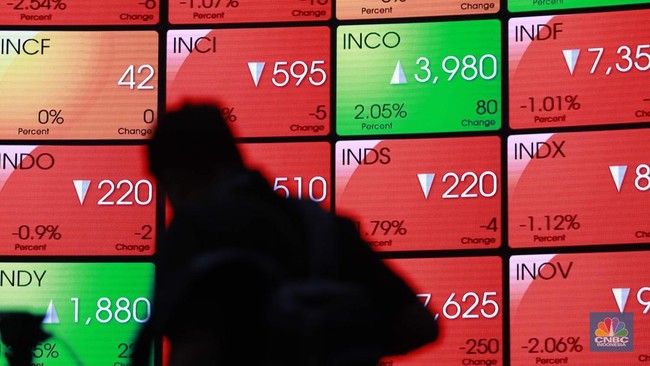
Indonesia Stock Market Plunges 3% as Profit-Taking and US-China Tensions Trigger Sell-Off
The Jakarta Composite Index (IHSG) suffered its sharpest decline in weeks on Tuesday, May 19, 2026, plunging 3.08% to close at 6,396.27—its lowest level since October 2025—as investors rushed to lock in gains and pivot toward safe-haven assets amid escalating global uncertainties. The sell-off, driven by broad-based profit-taking in conglomerate stocks and heightened US-China trade tensions, sent ripples through Southeast Asian markets and underscored growing investor caution ahead of key policy announcements.
Market analysts attributed the downturn primarily to profit-taking after a prolonged rally in Indonesian blue-chip stocks, with investors shifting allocations to gold and other safe-haven assets as geopolitical risks intensified. The IDX Composite’s year-to-date decline now stands at 26.03%, while its six-month performance has fallen 23.91%, reflecting broader regional market pressures.
Key drivers of the decline:
- Profit-taking in conglomerate stocks: Heavy selling pressure on stocks like PT Telekomunikasi Indonesia (TLKM.JK), PT Astra International (ASII.JK), and PT Bank Mandiri (BMRI.JK)—which had rallied sharply in recent months—triggered a cascading effect across the index.
- US-China trade tensions: Escalating rhetoric between Washington and Beijing has fueled global market volatility, prompting investors to reduce exposure to riskier assets.
- Shift to gold: Analysts noted a surge in demand for precious metals, with Goldman Sachs projecting gold prices could reach $5,000 per troy ounce in 2026 due to persistent geopolitical uncertainties.
Senior market analyst Nafan Aji Gusta of Mirae Asset Sekuritas explained that the sell-off was a deliberate strategy to rebalance portfolios amid heightened uncertainty. “The decline in conglomerate stocks signals a rotation into safer assets like gold and bonds,” he stated. “Investors are prioritizing capital preservation over short-term gains in an environment where global risks remain elevated.”
The IDX Composite’s sharp decline on May 19, 2026, marks its lowest close since October 2025. Source: Yahoo Finance
Technical Analysis: Elliott Wave Theory Suggests Prolonged Correction
Technical indicators suggest the IDX Composite is undergoing a bearish corrective phase, with Elliott Wave theory pointing to a potential five-wave impulse sequence. TradingView analysts highlighted that the index has completed a Wave 3 correction, with the current decline aligning with historical patterns of prolonged volatility.
While the index remains 10.43% below its 52-week high of 9,174.47, it has held above key support levels, including the 6,376.34 mark—a psychological barrier that has historically acted as a floor during downturns. However, analysts warn that sustained selling pressure could test this level in the coming sessions.
Sector Performance: Conglomerates Lead the Decline
The sell-off was most pronounced in conglomerate stocks, which had been key drivers of the index’s recovery in early 2026. As of the close on May 19:
- PT Telekomunikasi Indonesia (TLKM.JK): +0.65% (resilient amid sector-wide weakness)
- PT Astra International (ASII.JK): -0.83% (under pressure from automotive sector concerns)
- PT Bank Mandiri (BMRI.JK): +0.24% (relative stability amid financial sector caution)
- PT Bank Central Asia (BBCA.JK): -1.63% (sensitive to currency fluctuations)
- PT Bank Rakyat Indonesia (BBRI.JK): +0.33% (moderate gains)
In contrast, regional peers showed mixed performance, with the S&P/ASX 200 (Australia) rising 0.95% and the Nikkei 225 (Japan) declining 0.49%, reflecting divergent risk appetites across Asia-Pacific markets.
Global Risk Sentiment Fuels Safe-Haven Demand
The IDX Composite’s decline mirrors broader trends in emerging markets, where investors are increasingly favoring liquidity and stability. The CBOE Volatility Index (VIX) dropped 3.31% to 17.82, signaling reduced near-term panic but persistent underlying uncertainty. Meanwhile, the US Dollar Index (DXY) has strengthened against major currencies, including the Indonesian rupiah, which has tested Rp 17,680 per USD in recent intraday trading.
Goldman Sachs’ projection of $5,000 gold by year-end—driven by geopolitical risks—has spurred demand for precious metals, with spot gold prices trading near $2,450 per troy ounce as of May 19. This shift has diverted capital from equities, exacerbating the sell-off in riskier assets like Indonesian stocks.
Key Takeaways
- Profit-taking: Investors are locking in gains after a strong first-quarter rally, particularly in conglomerate stocks.
- US-China tensions: Escalating trade disputes are increasing global market volatility.
- Safe-haven rotation: Gold and bonds are attracting capital as investors prioritize stability.
- Technical outlook: The IDX Composite remains in a corrective phase, with potential further declines if support levels break.
- Regional divergence: While Indonesia’s market underperforms, Australia’s S&P/ASX 200 rises, highlighting varied risk appetites.
What’s Next for Indonesian Investors?
With no major domestic economic announcements scheduled for the week, market sentiment will continue to hinge on:

- US-China trade developments: Any further escalation could prolong the sell-off.
- Bank Indonesia’s policy stance: The central bank’s next monetary policy meeting on June 5, 2026, will be critical for currency and equity stability.
- Corporate earnings: Second-quarter results from major conglomerates (e.g., Astra, Mandiri) will influence investor confidence.
For real-time updates, monitor:
What do you think will drive Indonesia’s stock market in the coming weeks? Share your insights in the comments below, and don’t forget to follow World Today Journal for live updates on global financial trends.
- The Global Robotaxi Boom: Expansion, Production Costs, and International Testing
- OpenAI Deletes AI System After Human-Like Secret Collaboration Discovery
- SK Hynix Massive Investments and Q2 Growth Amid South Korea Market Crash (world-today-news.com)
- Microsoft Executives Sell Millions in Shares Amid Stock Recovery (newsdirectory3.com)