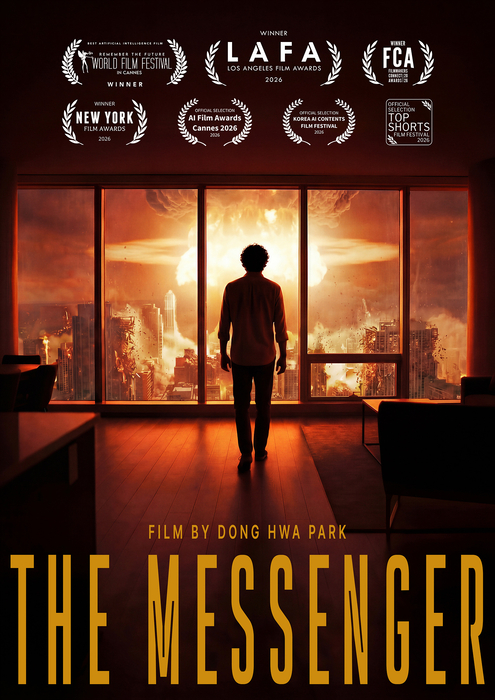
The boundaries between human imagination and algorithmic execution are dissolving, and the cinematic world is taking notice. In a landmark achievement for the burgeoning field of generative AI filmmaking, the sci-fi thriller short film The Messenger has secured five prestigious awards at international film festivals, signaling a paradigm shift in how stories are told and produced.
Directed by Donghwa Park, an AI Director at the creative agency HSAD, The Messenger is more than just a technical demonstration; it is a narrative triumph that leverages artificial intelligence to craft a compelling, high-stakes science fiction experience. The film’s recognition across multiple global platforms underscores a growing acceptance of AI-driven content within the traditional and experimental film communities.
As the industry grapples with the integration of generative tools, the success of Park’s work provides a tangible blueprint for how AI can be utilized not to replace the director, but to expand the very vocabulary of visual storytelling. For critics and enthusiasts alike, The Messenger represents a moment where the “uncanny valley” begins to give way to genuine cinematic immersion.
The Success of ‘The Messenger’: A New Standard for AI Narratives
The Messenger, a sci-fi thriller, has distinguished itself in a crowded landscape of short films by focusing on atmosphere, tension, and a cohesive visual language—elements that have historically been tough for purely AI-generated content to maintain. The film’s ability to win five awards at global film festivals highlights its ability to transcend the “tech demo” label that often plagues AI-assisted projects.
While the specific details of each festival win reflect the diverse appreciation for the film—ranging from technical innovation to narrative structure—the collective impact is clear: the global film circuit is beginning to formalize its relationship with AI-generated media. The film’s genre, science fiction, provides a particularly fertile ground for AI, allowing the director to manifest otherworldly environments and complex visual concepts that would traditionally require massive budgets and extensive CGI teams.
The accolades received by The Messenger serve as a testament to the meticulous direction required to guide generative models toward a unified aesthetic. Unlike early iterations of AI video, which often felt disjointed or surreal in a way that lacked intent, Park’s work demonstrates a controlled application of the technology to serve a specific, driving plot.
Behind the Lens: Donghwa Park and the Evolution of the AI Director
At the center of this technological milestone is Donghwa Park, an AI Director at HSAD. His role represents an emerging professional category that is rapidly redefining the creative hierarchy in advertising and filmmaking. As an AI Director, Park’s expertise lies at the intersection of traditional cinematic principles—composition, pacing, and character arc—and the technical mastery of generative AI workflows.
Working within HSAD, a major player in the creative and advertising landscape, Park is positioned at the forefront of how brands and agencies are beginning to view artificial intelligence. Rather than seeing AI as a tool for mere efficiency, his work suggests that AI is a medium for heightened creativity. The transition from a traditional director to an AI director involves a shift from managing physical sets and crews to managing “latent space”—the mathematical realm where AI models generate images and motion based on linguistic prompts and visual references.
This new role requires a unique skill set: the ability to “direct” a machine through iterative prompting, fine-tuning, and post-production integration. The success of The Messenger suggests that the most effective AI filmmakers will be those who possess a deep understanding of classical film language, using the machine to execute visions that were previously cost-prohibitive or technically impossible.
Redefining the Creative Workflow: From Prompt to Premiere
The production of The Messenger highlights a fundamental shift in the filmmaking pipeline. In traditional production, the journey from concept to screen involves pre-production, principal photography, and extensive post-production. In the workflow pioneered by directors like Park, these stages often overlap and become highly iterative.
- Conceptualization and Prompt Engineering: The process begins with a narrative framework that is translated into highly specific visual prompts. This stage requires a profound understanding of lighting, camera angles, and texture to guide the AI toward a consistent look.
- Generative Execution: Using advanced generative video and image models, the director generates the foundational visual assets. This is not a one-click process but a continuous cycle of generation and refinement.
- Visual Consistency and Cohesion: One of the greatest challenges in AI filmmaking is maintaining character and environmental consistency across different shots. Achieving this in The Messenger required advanced techniques to ensure the sci-fi world felt lived-in and stable.
- Hybrid Post-Production: The final film is often a hybrid, where AI-generated footage is integrated with traditional editing, sound design, and color grading to ensure the emotional beats of the thriller land with precision.
This workflow democratizes high-concept filmmaking. A modest team or even a single visionary can now produce visuals that rival the scale of major studio productions, potentially shifting the power balance from those with the largest budgets to those with the most innovative ideas.
The Industry Implications: Creativity in the Age of Algorithms
The rise of award-winning AI films like The Messenger brings the ongoing debate regarding AI in the creative industries into sharper focus. While the success of Donghwa Park is a celebration of innovation, it also prompts critical questions about the future of labor, copyright, and the definition of “authorship” in art.
The Creative Expansion Argument: Proponents argue that AI is a “force multiplier” for human creativity. By automating the most labor-intensive aspects of visual creation, filmmakers can spend more time on storytelling and conceptual development. In this view, AI is simply the next evolution in the history of film technology, following the transition from silent film to sound, and from practical effects to digital CGI.
The Labor and Authenticity Concern: Conversely, many in the traditional film community express concern over the displacement of human artists, including concept artists, set designers, and VFX technicians. There is also a persistent debate regarding the “soul” of the work—whether a film generated through algorithmic probability can ever truly capture the nuanced, lived experience of human emotion that defines great cinema.
As The Messenger moves through the global festival circuit, it will likely serve as a case study for these discussions. The industry must now navigate how to integrate these powerful tools while establishing ethical frameworks that protect human creators and ensure the integrity of the medium.
Key Takeaways: The Impact of AI on Cinema
- Narrative Viability: AI-generated films are moving beyond technical novelty to achieve genuine narrative and emotional resonance.
- New Professional Roles: The emergence of the “AI Director” signifies a shift in the skills required for modern visual storytelling.
- Democratization of Scale: High-concept sci-fi and fantasy can now be produced with significantly lower overhead, leveling the playing field for independent creators.
- Industry Integration: Major creative agencies like HSAD are already leading the way in institutionalizing AI production workflows.
Frequently Asked Questions
Is ‘The Messenger’ entirely made by AI?
While the visual assets are generated using AI technologies, the film is the result of human direction, narrative structuring, and intensive post-production editing by Donghwa Park.
What makes an ‘AI Director’ different from a traditional director?
An AI Director focuses on managing generative models and prompt-based workflows to create visuals, rather than managing physical actors, lighting rigs, and camera crews on a traditional set.
Will AI replace filmmakers?
Current trends suggest AI is acting as a sophisticated tool that augments the filmmaking process, though it is fundamentally changing the types of roles and skills required within the industry.
As the global film community continues to react to these technological leaps, further updates regarding the film’s distribution and upcoming festival appearances are expected. We will continue to monitor how the successes of pioneers like Donghwa Park shape the future of the silver screen.
What are your thoughts on the rise of AI in cinema? Is it a tool for liberation or a threat to tradition? Share your thoughts in the comments below and share this article with your fellow film enthusiasts.
Worth a look