
Manchester Code: The Self-Clocking Innovation That Transformed Digital Communication
In a modest laboratory at the University of Manchester during the late 1940s, a team of engineers confronted a problem that threatened to derail the entire field of digital computing: how to reliably transmit and read back binary data when the hardware itself couldn’t maintain consistent timing. Their solution, known as Manchester code, wasn’t just a clever workaround—it became one of the most influential encoding schemes in computer history, forming the backbone of modern networking, data storage and even consumer electronics.
The breakthrough was officially recognized on April 13, 2026, when the IEEE installed a Milestone plaque at the University of Manchester, honoring the invention that “made bits behave” by embedding timing information directly within the data stream. This self-clocking technique eliminated the need for separate synchronization signals, solving a fundamental challenge that had plagued early computer systems and enabling the reliable digital communication we take for granted today.
For technology journalist Linda Park, who holds an MSc in Computer Science from Stanford University, Manchester code represents more than just an engineering solution—it’s a testament to how early innovators worked within the limitations of their hardware rather than against them. “What makes this invention particularly remarkable is that it wasn’t just about fixing a specific problem,” Park notes. “It fundamentally changed how we think about data transmission by making the signal itself carry its own timing information.”
The Birth of a Digital Revolution
In the late 1940s, as computer engineers at Manchester University worked on the Manchester Mark I, one of the world’s first practical stored-program computers, they encountered a persistent issue: while the machine could generate bits, it couldn’t reliably read them back. The problem manifested as inconsistent computing results—not because of logical errors, but due to the physical behavior of the hardware itself.
Led by Frederic C. Williams, Tom Kilburn, and graduate student G. E. (Tommy) Thomas, the team traced the failures to timing inconsistencies in the magnetic drum memory system. Using oscilloscopes to probe the signals, they discovered that electrical pulses didn’t arrive with consistent timing. Memory signals blurred over time, making them harder to read, and long runs of identical bits created flat waveforms with no transitions—effectively causing the system to lose track of when to sample the signal.
The engineers first attempted to stabilize the hardware through circuit improvements and more consistent pulse generation, but these fixes proved fragile. The electronics of the day simply couldn’t maintain the required precision. This led to their pivotal insight: if the hardware couldn’t provide a dependable clock, the signal itself would have to carry one.
How Manchester Code Works
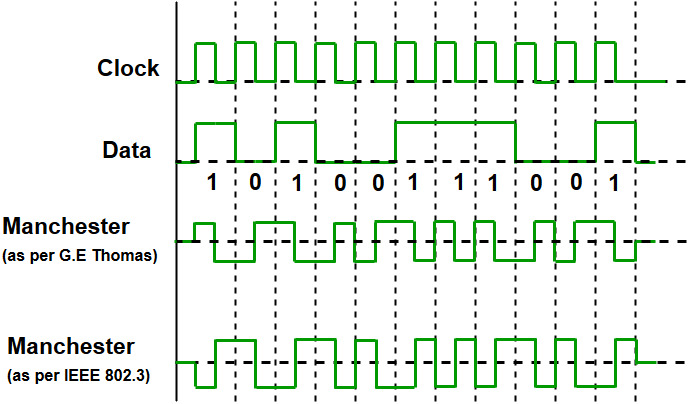
The solution was deceptively simple: instead of representing each bit as a static high or low signal, Manchester code encoded each bit with a transition in the middle of the bit period. This created a self-clocking signal where:
- Each bit contained its own timing information through guaranteed state changes
- Transitions occurred at regular intervals, allowing continuous timing recovery
- Long runs of identical bits no longer produced ambiguous flat waveforms
- The system could maintain synchronization even with signal degradation
This approach addressed multiple challenges at once. By embedding timing in the data itself, Manchester code eliminated the need for separate clock signals, reduced synchronization errors, and made data transfer more robust across cables and circuits. The innovation was particularly well-suited for the noisy transmission environments of early computing systems.
From Lab Curiosity to Global Standard
The immediate application of Manchester code was for the Manchester Mark I’s magnetic drum memory, but its benefits quickly became apparent for other digital communication systems. The self-clocking nature of the encoding made it particularly valuable for technologies requiring reliable timing and synchronization.
Key Applications of Manchester Code
Manchester code’s influence extended far beyond its original application:

- Early Ethernet Networks: When Robert Metcalfe and his team at Xerox PARC developed the first Ethernet system in 1973, they relied on Manchester code to solve fundamental timing problems. “Manchester code solved a fundamental problem for us: timing,” Metcalfe explained. “Each bit carried its own clock and removed the need for a global synchronized signal.”
- Data Storage: The encoding became a standard for computer magnetic tapes and floppy disks, ensuring reliable data storage and retrieval.
- Space Exploration: Manchester code is used aboard NASA’s Voyager 1 and 2 spacecraft, demonstrating its reliability in extreme environments during interstellar space travel.
- Consumer Electronics: Infrared remote controls for televisions and audio equipment commonly use Manchester code through protocols like Philips’ RC-5, developed in the early 1980s.
- RFID Systems: The encoding is widely used in radio frequency identification tags and various control network standards.
Technical Advantages
Beyond its self-clocking properties, Manchester code offered several technical advantages:
- Collision Detection: On shared coaxial cables like those used in early Ethernet, Manchester encoding allowed transceivers to detect when other stations were transmitting simultaneously. If a transceiver detected a signal when it expected the line to be undriven, it indicated a collision that could be handled appropriately.
- Efficient Signal Usage: Each transceiver drove the signal only about half the time during transmission, leaving the line undriven during the other half of each bit cycle. This allowed multiple devices to share the same communication medium without constant interference.
- Robustness: The regular transitions made signals easier to detect than static levels, particularly in noisy environments.
Recognition and Legacy
The enduring impact of Manchester code was formally recognized on April 13, 2026, when the IEEE installed a Milestone plaque at the University of Manchester. The ceremony, attended by dignitaries including Tom Coughlin (2024 IEEE President), Duncan Ivison (University of Manchester President and Vice-Chancellor), and Nagham Saeed (Chair of the IEEE U.K. And Ireland Section), highlighted the invention’s profound influence on digital communication.
The plaque reads:
“At this site in 1948–1949, Manchester code was invented for reliably encoding digital data stored on the Manchester Mark I computer’s magnetic drum. It became a standard for computer magnetic tapes and floppy disks and was used in digital communications, including the Voyager 1 and 2 spacecraft and early Ethernet networks. It found wide use in domestic remote controllers, radio frequency identification (RFID) tags, and many control network standards.”
During the ceremony, Kees Schouhamer Immink, the 2017 IEEE Medal of Honor laureate known for his work on compact discs and other high-density digital media, and Peter Green, Manchester’s Deputy Dean for the Engineering Faculty, discussed the code’s lasting impact on digital data storage and communications.
Why This Innovation Matters Today
Manchester code represents more than just a historical engineering achievement—it embodies a fundamental shift in how we approach digital communication. By embedding timing information within the data itself, the Manchester team:
- Eliminated the need for separate clock signals, simplifying hardware design
- Enabled reliable communication over noisy channels and long distances
- Created the foundation for modern networking protocols
- Made possible the development of shared-medium networks like Ethernet
- Enabled robust communication in extreme environments like space
Today, while more advanced encoding schemes have been developed, Manchester code remains in use in numerous applications due to its simplicity and reliability. Its principles continue to influence modern digital communication systems, serving as a reminder of how fundamental innovations can have far-reaching consequences across multiple technological domains.
Key Takeaways
- Fundamental Problem Solved: Manchester code addressed the critical issue of timing synchronization in early digital systems, which threatened the viability of practical computing.
- Self-Clocking Innovation: By embedding timing information within each bit, the encoding eliminated the need for separate clock signals.
- Broad Applications: From early Ethernet networks to spacecraft communications and consumer electronics, Manchester code’s influence spans multiple technological domains.
- Technical Advantages: The encoding scheme improved signal robustness, enabled collision detection, and allowed efficient use of shared communication media.
- Enduring Legacy: Recognized as an IEEE Milestone, Manchester code continues to be used in modern systems due to its reliability and simplicity.
Where to Learn More
For readers interested in exploring further:
- Manchester Code on Wikipedia – Comprehensive overview of the encoding scheme
- IEEE Milestones Program – Information about the recognition process for significant technical achievements
- University of Manchester Computer Science Department – Historical context and research materials
- Ethernet Alliance – Information about networking standards that utilize Manchester code
Looking Ahead
While Manchester code was developed over 70 years ago, its principles continue to influence modern digital communication systems. As we move toward even more complex networking environments and the Internet of Things, the lessons learned from this early innovation remain relevant. The next IEEE Milestone recognition for digital communication technologies is expected to be announced in late 2026, with nominations currently being reviewed by the IEEE History Center.
For technology enthusiasts and professionals, Manchester code serves as a reminder of how foundational innovations can shape entire industries. Whether you’re working with modern networking protocols, space communication systems, or consumer electronics, the principles established by the Manchester team continue to resonate in today’s digital world.
We’d love to hear your thoughts on this historical innovation. How has Manchester code influenced the technologies you use today? Share your experiences and insights in the comments below.
Worth a look
- iPhone 18 Pro Price Leak: Will Apple’s Next Flagship Be More Expensive?
- No Public Record of El Salvador President’s Alleged Facebook Claim
- Kreios Space to Demo Air-Breathing Electric Propulsion in Very Low Earth Orbit (time.news)
- Why Museums Still Ban Your Camera Flash, Even Though It's Harmless (daybreakwire.com)