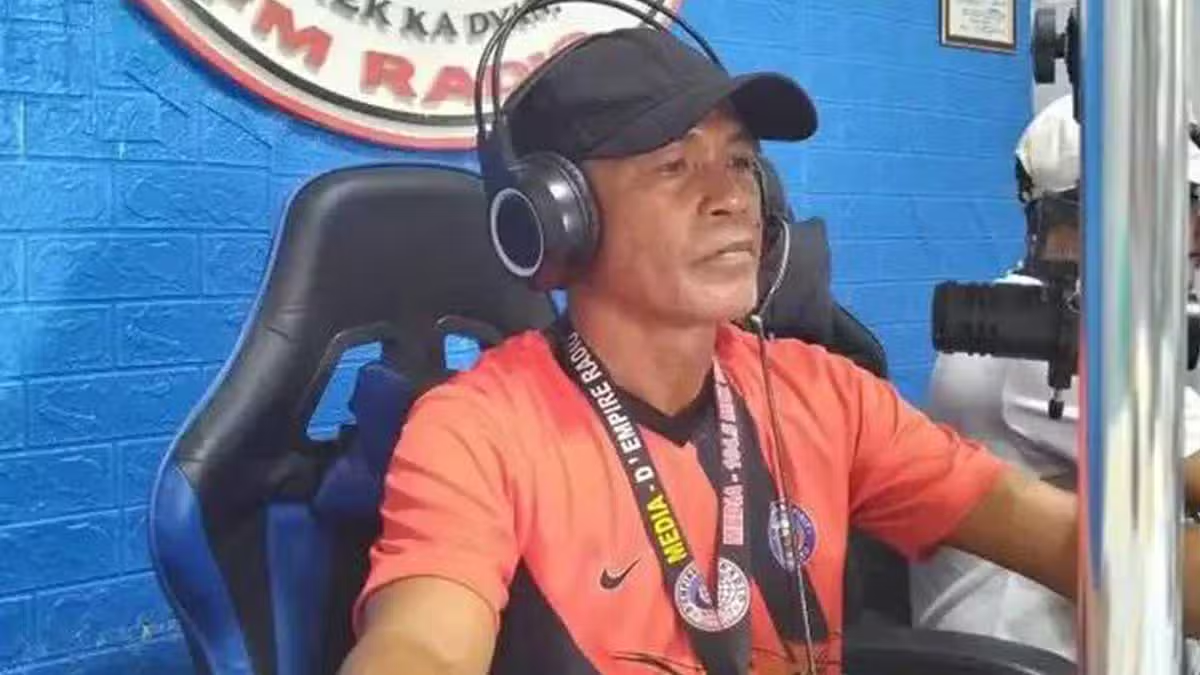
The killing of Filipino journalist Nestor Micator in Cotabato City has reignited global alarm over the Philippines’ persistent crisis of media violence and impunity, with press freedom advocates demanding urgent action from authorities. Shot dead in what local media describe as an apparent targeted attack, Micator’s murder underscores a troubling trend: the Philippines remains one of the world’s most dangerous countries for journalists, with at least 11 journalists killed since 2016—many linked to their reporting on conflict zones, corruption, or human rights abuses. The incident has prompted condemnation from international bodies, including the United Nations and the Committee to Protect Journalists (CPJ), which have repeatedly called on Manila to address systemic failures in investigations and prosecutions.
Micator, a veteran reporter based in Mindanao, was known for his coverage of local governance and security issues in the southern Philippines, a region frequently marred by clashes between government forces, insurgent groups, and armed factions. While no group has claimed responsibility for the attack, officials have not ruled out connections to Micator’s professional work. The killing follows a pattern of unsolved journalist murders in the Philippines, where fewer than 10% of cases result in convictions, according to CPJ’s Impunity Index. This statistic places the Philippines among the worst offenders globally for unresolved media-related killings.
In response to Micator’s death, the National Union of Journalists of the Philippines (NUJP) issued a statement demanding a thorough investigation and justice for the slain reporter. “This is not just another tragedy—it is a deliberate assault on press freedom,” said NUJP spokesperson Reynaldo Santos Jr., who emphasized the need for international pressure on the Philippine government. Meanwhile, the Philippine National Police (PNP) confirmed an ongoing probe but provided no further details, citing sensitivity around the case. The lack of transparency has fueled skepticism among journalists and rights groups, who argue that past investigations into media killings have been hindered by political interference and inadequate resources.
Why the Philippines’ Media Killing Crisis Persists
The Philippines’ struggle with journalist killings is deeply rooted in its complex security landscape. Mindanao, where Micator was based, has long been a flashpoint for armed conflict, including the decades-long insurgency by the Moro Islamic Liberation Front (MILF) and clashes with extremist groups like the Abu Sayyaf. While the Philippine government has made strides in peace negotiations—most notably the 2014 peace deal with the MILF—violence in the region persists, often spilling over into attacks on media workers documenting these conflicts.
Exacerbating the crisis is the Philippines’ weak legal framework for protecting journalists. Despite the passage of the Anti-Terrorism Act of 2020 and the Free Exercise of Press Freedom Act, critics argue that enforcement remains lax. The Philippine Center for Investigative Journalism (PCIJ) notes that many journalists operate without adequate security measures, particularly in high-risk areas. “The problem is not just the lack of laws, but the lack of political will to implement them,” said PCIJ Executive Director Charo Ison in a recent interview. “Journalists are often seen as obstacles rather than partners in holding power accountable.”
International pressure has mounted in recent years, with the United Nations Special Rapporteur on the Situation of Human Rights Defenders urging the Philippine government to adopt a national plan of action to end impunity. The European Union and the United States have also tied aid packages to improvements in press freedom. However, progress has been slow, with many cases of journalist killings remaining unsolved for years. Micator’s death, coming just months after the killing of Perla Santos, a radio reporter in Davao, has intensified calls for a more robust response.
Who Was Nestor Micator?
Nestor Micator, 48, was a seasoned journalist with over two decades of experience covering regional politics and security in Mindanao. He worked primarily for local outlets, including Mindanao Daily Monitor, where he focused on issues such as land disputes, military operations, and the impact of insurgency on civilian populations. Colleagues described him as a tenacious investigator who often put himself in harm’s way to report stories that others avoided.
Micator’s death has prompted tributes from media organizations worldwide. The International Federation of Journalists (IFJ) called his killing a “stark reminder of the dangers faced by journalists in conflict zones.” Locally, the Philippine Press Freedom Center has launched a campaign urging the government to establish a special prosecutor’s office dedicated to media-related crimes—a demand that has gained traction among civil society groups.
What Happens Next?
The Philippine government faces mounting scrutiny over its handling of Micator’s case. Key stakeholders, including:
- The Philippine National Police (PNP): Leading the investigation, with a deadline for filing charges expected within 30 days, though no timeline has been officially confirmed.
- The Department of Justice (DOJ): Under pressure to fast-track the case, particularly after the UN called for a “swift and impartial inquiry.”
- International bodies (UN, CPJ, IFJ): Monitoring the case and threatening sanctions or aid cuts if no progress is made.
- Civil society groups (NUJP, PCIJ, Free Press Coalition): Organizing protests and legal actions to push for accountability.
The next critical checkpoint is the PNP’s preliminary report, expected within the next two weeks. If the investigation identifies suspects, the DOJ will determine whether to file charges under anti-terrorism laws or other relevant statutes. Meanwhile, journalists in Mindanao are bracing for potential retaliation, with some reporting increased surveillance and harassment.
Global Context: A Crisis of Impunity
Micator’s killing is part of a broader global crisis affecting journalists, particularly in regions with weak rule of law. According to the Reporters Without Borders (RSF) Impunity Index, the Philippines ranks among the top five countries where journalists are killed with impunity. The trend is mirrored in other conflict zones, including Mexico, India, and Syria, where media workers are frequently targeted for their reporting.
What sets the Philippines apart is the intersection of organized crime, insurgency, and political corruption. Many journalist killings are linked to local elites, military factions, or criminal syndicates seeking to silence critical voices. The lack of a centralized database for media-related crimes further complicates efforts to track patterns and hold perpetrators accountable. “This is not just a law enforcement issue—it’s a governance failure,” said Maria Ressa, Nobel Peace Prize laureate and CEO of Rappler, in a statement condemning Micator’s death.
How You Can Help
For readers seeking to take action, several organizations are mobilizing:

- Committee to Protect Journalists (CPJ): Offers resources on press freedom advocacy and legal support for journalists.
- Reporters Without Borders (RSF): Provides tools for reporting on media killings and pressuring governments.
- International Federation of Journalists (IFJ): Coordinates global campaigns for justice in media-related crimes.
- National Union of Journalists of the Philippines (NUJP): Leading local efforts to demand accountability.
the public can support Micator’s family by donating to the NUJP Legal Aid Fund, which provides financial assistance to journalists and their families in distress. The fund’s contact information can be found on the NUJP website.
A Call for Justice
As the investigation into Nestor Micator’s killing unfolds, the world watches to see whether the Philippines will finally break the cycle of impunity that has claimed so many lives. For journalists in Mindanao and beyond, the stakes could not be higher. “Every unsolved murder sends a message: that violence will go unpunished, and that reporting the truth carries a price,” said Santos Jr. of the NUJP. “We cannot afford to let Nestor’s death be another statistic.”
The next steps will determine whether the Philippines takes meaningful action—or continues to fail its journalists. The international community, civil society, and the Philippine people must hold their leaders accountable. The time for words is over; the time for action is now.
Maria Petrova is an international journalist and editor based in Sofia, Bulgaria. She holds an MA in International Relations from Sofia University and has covered global press freedom issues for over a decade.
How do you think governments should address the crisis of media killings? Share your thoughts in the comments below.
Related reading