
The trajectory of Willian Pacho from the coastal town of Quinindé in Ecuador to the defensive heart of Paris Saint-Germain (PSG) is one of the most compelling narratives in modern football. As the 23-year-old prepares for high-stakes European competition, the global spotlight intensifies on his ability to anchor a backline that demands nothing less than perfection. Pacho, who officially joined the French giants in August 2024, has rapidly transitioned from a promising talent in the Bundesliga to a cornerstone of the Parisian squad, embodying the technical rigor and physical resilience required at the elite level of the UEFA Champions League.
For football observers, the rise of Willian Pacho at PSG represents more than just a transfer fee; it is a testament to the scouting networks that continue to unearth world-class talent in South America. As PSG navigates a season defined by intense pressure to maintain their continental dominance, Pacho’s role in neutralizing high-caliber attacking threats has become a focal point of tactical analysis. His performance against Premier League opposition, such as Arsenal, serves as a litmus test for his capacity to handle the unique intensity of English-style offensive transitions.
From Quinindé to the Parc des Princes
Born in the Esmeraldas province, Pacho’s early development was rooted in the youth systems of Independiente del Valle, a club renowned for its commitment to nurturing young Ecuadorian prospects. His professional ascent began in earnest before he moved to Europe, where he first gained international attention during his tenure at Royal Antwerp in Belgium. It was there that he secured a domestic league title, helping the club end a 66-year wait for the trophy, according to official UEFA reporting. Following his success in Belgium, he transitioned to Eintracht Frankfurt in the Bundesliga, where he demonstrated the tactical maturity that eventually caught the eye of PSG’s recruitment team.
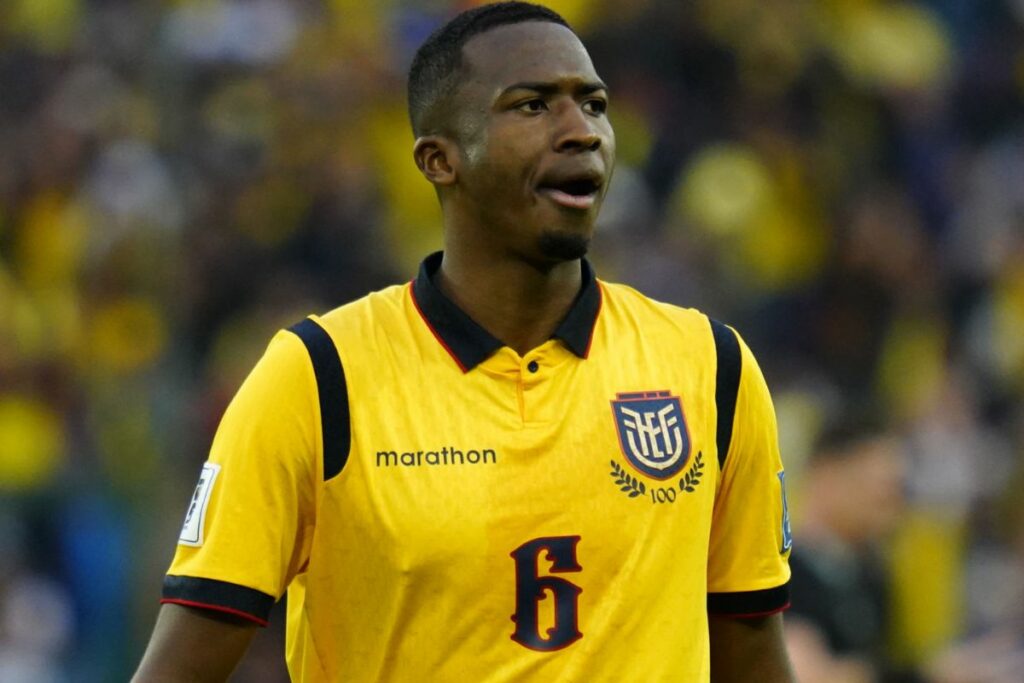
The move to Paris in the summer of 2024 marked a significant step in his career. According to the official club statement, Pacho signed a five-year contract, committing his future to the French capital until 2029. This stability has allowed him to integrate seamlessly into a squad undergoing a period of tactical transition. His arrival was not merely for squad depth; he was brought in to provide a specific profile: a left-footed central defender capable of distributing the ball under pressure while maintaining a high defensive line.
Tactical Integration and Defensive Responsibility
In the modern game, the role of a defender extends far beyond tackling. For a club like PSG, which often dominates possession, the ability to read the game and intercept counter-attacks is paramount. Pacho has integrated well into this system, often tasked with covering the space behind attacking fullbacks. His physical attributes—stature, speed, and composure—allow him to compete with the world’s most agile forwards.
When facing clubs like Arsenal, the tactical challenge is distinct. Mikel Arteta’s side is known for intricate build-up play and high-pressing intensity. For Pacho, this requires a high level of concentration. The defensive unit must remain compact to prevent the ball from being played through the central channels, a task that often falls to the central defenders to organize. As reported by Reuters, his transfer to PSG was valued at approximately €40 million, highlighting the significant investment the club has made in his defensive capabilities.
The Champions League Challenge
The UEFA Champions League remains the ultimate pursuit for many of Europe’s elite clubs. PSG, having invested heavily in a project centered on collective cohesion rather than individual superstars, views the tournament as the definitive measure of their progress. For Pacho, playing at this level is the culmination of years of professional development that began in the Ecuadorian youth leagues.
The question of whether Pacho can contain top-tier opposition is one that will be answered on the pitch throughout the tournament. His defensive statistics in domestic and continental play, tracked by platforms like WhoScored, indicate a high success rate in aerial duels and ground interceptions. These metrics, while useful, only capture a fraction of the defensive work performed in a 90-minute match, particularly the communication and positioning required to manage an entire defensive line.
Key Factors in Pacho’s Development
- Versatility: His experience in different European tactical systems (Belgium and Germany) has provided him with a broad understanding of defensive structures.
- Physicality: At 1.87 meters, he provides a significant aerial presence, which is essential for defending set-pieces against tall, physical strikers.
- Composure: His ability to play out from the back is a prerequisite for the possession-based football currently favored by PSG’s technical staff.
Looking Ahead: The Road to the Finals
As the season progresses, the focus for PSG remains on maintaining consistency across all competitions. For Willian Pacho, the immediate future involves navigating the rigorous demands of the Champions League group stages and the competitive landscape of Ligue 1. The pressure to deliver is constant, but his rapid adaptation suggests that he is well-equipped for the challenges of the highest level of European football.
The next major checkpoint for PSG will be their upcoming fixture in the UEFA Champions League, where the team will look to solidify their standing in the competition. Official updates regarding squad rotation and tactical preparations are typically released via the club’s communication channels 48 hours prior to kickoff. We will continue to monitor the performance of Pacho and the broader PSG squad as they push for silverware in this demanding campaign.
What are your thoughts on Willian Pacho’s impact on PSG’s defensive structure this season? Share your perspective in the comments below and join the conversation on the evolving landscape of European football.
Keep reading