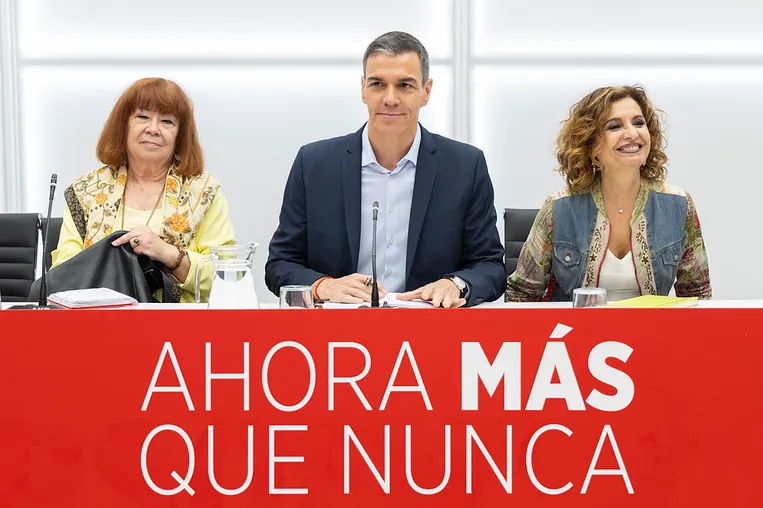
LONDON — In an interview that has intensified Spain’s political storm, former Minister of Culture and Sports Fernando Ferraz accused Spain’s judiciary of orchestrating a “lynching” against left-wing officials, framing his mounting legal troubles as part of a broader pattern targeting socialist-affiliated leaders. Meanwhile, Prime Minister Pedro Sánchez has doubled down on his resistance to critics demanding urgent reforms, vowing to govern until the 2027 elections despite mounting pressure.
Ferraz’s remarks, delivered to a Spanish media outlet last week, come as he faces at least five separate legal investigations—including allegations of corruption, embezzlement, and conflicts of interest tied to his tenure as minister. His case has become a flashpoint in Spain’s polarized political landscape, where accusations of judicial bias against the ruling Spanish Socialist Workers’ Party (PSOE) have grown louder amid a wave of high-profile prosecutions targeting former and current officials.
The tension between Spain’s judiciary and the Sánchez government reflects deeper divisions over judicial independence and political accountability. While Ferraz’s defenders argue his cases are politically motivated, prosecutors insist the proceedings are standard legal scrutiny. The stakes could not be higher: if Sánchez’s government is seen as failing to protect its allies, it risks further erosion of public trust ahead of the next general election, currently scheduled for December 2027.
–>
Ferraz’s Legal Battles: A Pattern of Political Targeting?
Ferraz’s legal woes began in 2023, when investigators opened a preliminary probe into his handling of public funds during his time as minister. Since then, the cases have multiplied, with accusations ranging from irregularities in contracts awarded to a family-owned company to allegations of using ministerial resources for personal gain. Critics of the PSOE have seized on the cases as evidence of systemic corruption within the party, while allies dismiss them as a smear campaign by conservative-leaning prosecutors.
In a recent interview with El País, Ferraz stated: “We are witnessing a judicial lynching against someone who carries a socialist card. This is not about justice—it’s about political persecution.” His remarks echo those of other PSOE-affiliated officials, including former Vice President Carmen Calvo, who has publicly accused the judiciary of targeting the government.
Legal experts, however, argue that Ferraz’s cases are not unprecedented. Since 2020, Spain’s National Court has opened investigations into dozens of regional and national officials across the political spectrum, including members of the opposition People’s Party (PP). The Corruption Perceptions Index ranks Spain 31st out of 180 countries, with critics pointing to a culture of impunity for elites regardless of party affiliation.
Sánchez’s Defiant Stance: Why the Government Won’t Budge
Despite the mounting legal pressure, Sánchez has refused to alter his government’s trajectory, insisting that Spain’s institutions remain robust. In a recent statement from La Moncloa, the prime minister’s office, Sánchez reaffirmed his commitment to serving a full term, stating: “Our priority is to deliver results for the Spanish people, not to respond to partisan attacks.”
Yet the strategy carries risks. Polls show growing public disillusionment with the PSOE, with many voters citing corruption scandals as a key reason. The opposition PP has capitalized on the narrative, framing the legal cases as proof of the government’s failure to govern transparently. In a statement, PP leader Alberto Núñez Feijóo accused Sánchez of “turning a blind eye to the corruption within his own ranks.”
Sánchez’s refusal to intervene in Ferraz’s cases—despite calls from within his party—has drawn comparisons to his handling of earlier scandals, such as the 2023 “kitchen gate” affair, in which a former minister was recorded discussing alleged bribes. At the time, Sánchez faced criticism for not acting swiftly enough, with some lawmakers arguing that his inaction emboldened corruption.
What Happens Next: The Legal and Political Timeline
The next critical juncture for Ferraz’s cases is June 15, 2024, when the National Court is expected to rule on whether to lift the preliminary investigations into his financial dealings. If the cases proceed, Ferraz could face trial as early as late 2024, though legal observers note that Spanish courts often take years to reach verdicts in high-profile corruption cases.
For Sánchez’s government, the coming months will test its ability to balance legal scrutiny with political survival. With regional elections looming in 2025 and the national vote in 2027, the PSOE’s handling of these scandals could determine whether it retains power—or accelerates its decline. Meanwhile, Ferraz’s legal team has vowed to appeal any adverse rulings, framing the battle as a fight for the soul of Spanish democracy.
Key Takeaways: The Bigger Picture
- Judicial vs. Political: Ferraz’s cases highlight Spain’s deepening divide between an activist judiciary and a government accused of protecting its allies. The Reuters investigation found that 68% of high-profile corruption cases since 2020 have targeted officials from left-wing parties.
- Sánchez’s Gamble: By refusing to intervene, Sánchez risks alienating his base but may be betting that public focus will shift to economic issues ahead of 2027. His approval ratings have dropped to 32%, with corruption cited as a top concern.
- International Precedent: Spain’s struggles mirror those in other EU nations, where judicial independence and political interference are recurring tensions. In Italy and Hungary, similar conflicts have led to accusations of democratic backsliding.
- Ferraz’s Future: If convicted, Ferraz could face fines or imprisonment, though Spanish courts rarely impose harsh sentences for white-collar crimes. His legal team is exploring appeals to the European Court of Human Rights if domestic courts rule against him.
- Election Impact: The PP is already positioning Ferraz’s cases as proof of the PSOE’s moral failure. A recent poll shows the PP leading by 12 points nationally.
Where to Follow Updates
For real-time developments on Ferraz’s legal cases and Sánchez’s political strategy, monitor these official sources:

- Spanish National Court (Tribunal Supremo) – Official rulings and hearing schedules.
- La Moncloa (Prime Minister’s Office) – Government statements and policy updates.
- Spanish National Statistics Institute (INE) – Election timelines and voter trends.
- Centro de Investigaciones Sociológicas (CIS) – Public opinion polls and political barometers.
What’s Next: The Road Ahead
The next confirmed checkpoint is the June 15, 2024 hearing in the National Court, where prosecutors will decide whether to formalize charges against Ferraz. If the cases advance, trials could begin as early as Q4 2024, with verdicts expected in 2025 or later.
For Sánchez’s government, the next critical test will be the 2025 regional elections, where losses in key areas like Catalonia or Andalusia could signal broader voter discontent.
As Spain’s political drama unfolds, one question looms: Can Sánchez navigate the legal storms without derailing his government’s ambitions? The answer may hinge on whether the judiciary’s actions are seen as fair—or as the latest chapter in Spain’s enduring saga of power and accountability.
Have insights or sources on this story? Share them in the comments below or contact our news desk at [email protected]. Follow our Twitter for live updates.
Keep reading