
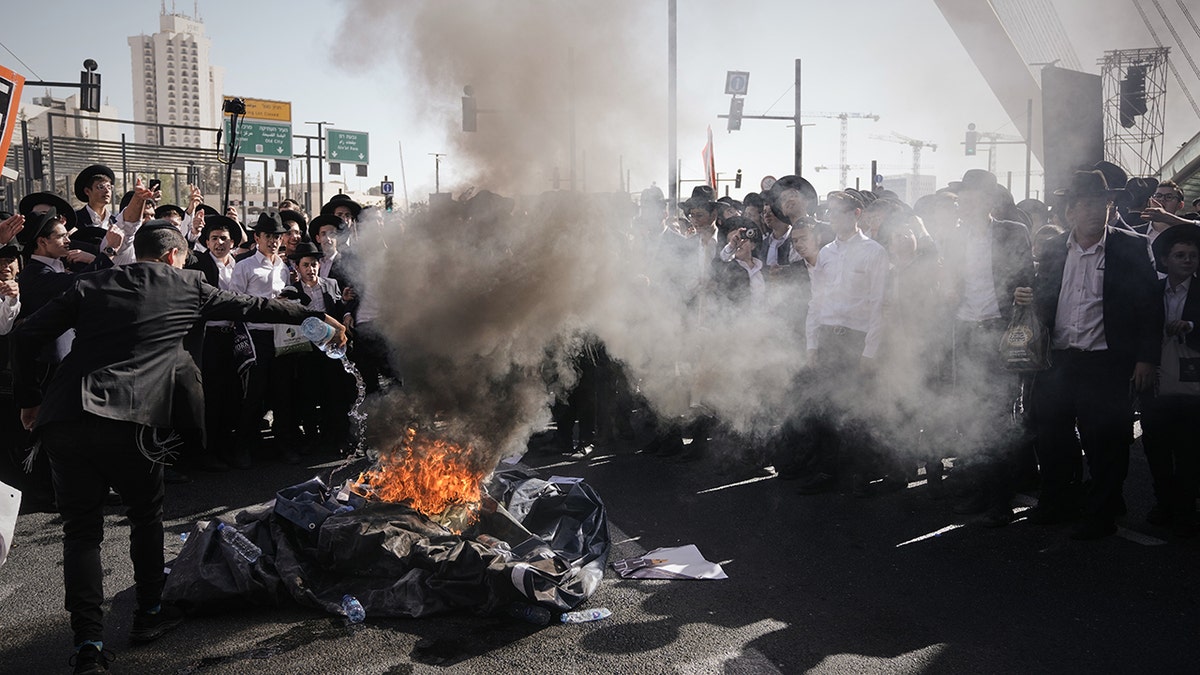
JERUSALEM — Israel’s ultra-Orthodox community has taken to the streets in a wave of protests that has paralyzed transportation networks and reignited a decades-old debate over military conscription. On Monday, demonstrations erupted across the country, with protesters blocking major roads and train lines in cities including Jerusalem, Bnei Brak and Beit Shemesh. While the exact scale of participation remains under official verification, eyewitness accounts and local media reports describe scenes of unprecedented civil disruption, raising urgent questions about the stability of Israel’s draft policy and the future of its military integration.
The protests follow a landmark Supreme Court ruling in June 2024 that overturned the long-standing exemption of ultra-Orthodox Jewish men from mandatory military service. The court’s decision, which required the government to begin drafting Haredi men aged 18 and above, has sparked fierce resistance from religious leaders and community members who argue that military service conflicts with their religious obligations to study Torah full-time. The latest demonstrations mark a dramatic escalation in what has become one of the most contentious social issues in Israel today.
What began as peaceful gatherings has in some cases turned confrontational, with reports of vehicles being set ablaze and clashes between protesters and security forces. While no official death toll has been confirmed, local authorities have reported injuries among both demonstrators and police. The situation has prompted urgent discussions within the Israeli government about potential compromises, including extended exemptions for yeshiva students or alternative national service requirements. However, with no clear resolution in sight, the protests show no signs of abating.
Why This Protest Matters: The Roots of Israel’s Draft Crisis
The current unrest stems from a fundamental tension between Israel’s national security needs and the religious exemptions granted to its ultra-Orthodox population. Since Israel’s founding in 1948, Haredi men have been exempt from mandatory military service under the assumption that their primary duty is to study religious texts. This exemption has been a cornerstone of Israel’s social contract, allowing the ultra-Orthodox community to grow while contributing to the economy through exemptions from income tax and other benefits.
However, the exemption has also created demographic imbalances. While ultra-Orthodox Jews make up approximately 12% of Israel’s population, they represent a disproportionately small share of Israel Defense Forces (IDF) recruits. The Supreme Court’s 2024 ruling sought to address this by mandating that yeshiva students be drafted unless they meet specific educational criteria. The decision was widely seen as a necessary step to ensure equitable burden-sharing across Israeli society.
Yet for many in the ultra-Orthodox community, the ruling represents an existential threat. Religious leaders have framed military service as a violation of their faith, with some rabbis issuing binding directives instructing young men to refuse conscription. The protests reflect not just opposition to the draft, but a broader resistance to what they perceive as government overreach into their religious autonomy.
The Economic and Social Stakes
The draft crisis also intersects with Israel’s economic and social fabric. The ultra-Orthodox community has long been a political force, with parties like Shas and United Torah Judaism holding significant influence in the Knesset. Their opposition to the draft has led to coalition negotiations and legislative battles, with some lawmakers proposing alternative solutions such as:
- Extended yeshiva studies with government funding
- Non-combat national service roles
- Gradual phase-ins of conscription over a decade
Economically, the ultra-Orthodox population has a lower workforce participation rate compared to the general population, partly due to the exemption from military service. Some analysts argue that integrating Haredi men into the workforce could boost Israel’s GDP, while others warn of potential social unrest if the transition is not managed carefully. The current protests risk exacerbating these tensions, particularly as the Israeli economy faces other challenges, including inflation and housing shortages.
What Happens Next: The Path Forward
As of Tuesday, June 2, 2026, the Israeli government remains locked in negotiations with ultra-Orthodox leaders to find a compromise. Prime Minister Benjamin Netanyahu’s office has indicated a willingness to explore legislative solutions, including a new law that would define the conditions under which yeshiva students could be exempted from military service. However, with protests continuing and no clear breakthrough in sight, the situation remains volatile.
Key developments to watch include:
- The Knesset’s scheduled vote on draft legislation, expected in the coming weeks
- Potential government concessions, such as expanded funding for yeshivas or alternative service programs
- The IDF’s preparedness for potential conscription waves, including logistics and training requirements
In the meantime, protesters are maintaining their roadblocks, and security forces have been deployed to manage the unrest. The Israeli Police have urged demonstrators to avoid violence, while also warning that enforcement actions will be taken if necessary. For now, the focus remains on de-escalation and dialogue.
Who Is Affected and Why It Matters Globally
The draft crisis is not just an internal Israeli issue—it has implications for global discussions about religious freedom, national service, and demographic integration. Countries with similar conscription policies, such as South Korea and Switzerland, have faced their own debates about religious exemptions and military participation. Israel’s struggle to balance these competing priorities offers a case study in how societies navigate the tension between collective security and individual religious rights.
For the ultra-Orthodox community, the protests are a matter of survival. Many young men fear that military service will disrupt their religious studies and family lives. For the Israeli government, the stakes are equally high: failing to integrate this growing demographic could weaken the IDF’s strength and cohesion. And for the broader public, the crisis raises questions about whether Israel’s social contract can adapt to changing demographics without fracturing along religious lines.
Key Takeaways
- The protests are the largest yet in response to Israel’s 2024 Supreme Court ruling on ultra-Orthodox conscription, with reports of roadblocks and clashes across multiple cities.
- Religious leaders are leading the resistance, with some rabbis issuing directives against military service, framing it as a violation of faith.
- Economic and social tensions are at play, as the ultra-Orthodox community represents a growing share of Israel’s population but a smaller share of its workforce and military.
- Government negotiations are ongoing, with potential legislative solutions including extended yeshiva studies or alternative national service.
- The global implications are significant, as Israel’s approach to conscription and religious exemptions could influence similar debates worldwide.
How to Follow the Story
For real-time updates and official statements, readers can monitor the following sources:
- Israeli Government Media Center – For official government responses and legislative updates.
- Israel Defense Forces (IDF) Website – For military-related announcements and conscription policies.
- Haaretz Israel News – For in-depth reporting on the protests and political developments.
- Times of Israel Live Blog – For breaking news and eyewitness accounts.
The next critical checkpoint will be the Knesset’s vote on draft legislation, expected in the coming weeks. Until then, the ultra-Orthodox community and the Israeli government remain locked in a high-stakes negotiation that could redefine the country’s social and military landscape.
What do you think about Israel’s approach to conscription and religious exemptions? Share your thoughts in the comments below or join the discussion on social media using #IsraelDraftCrisis. For more analysis on global military policies, subscribe to our Business & Policy newsletter.
Keep reading