
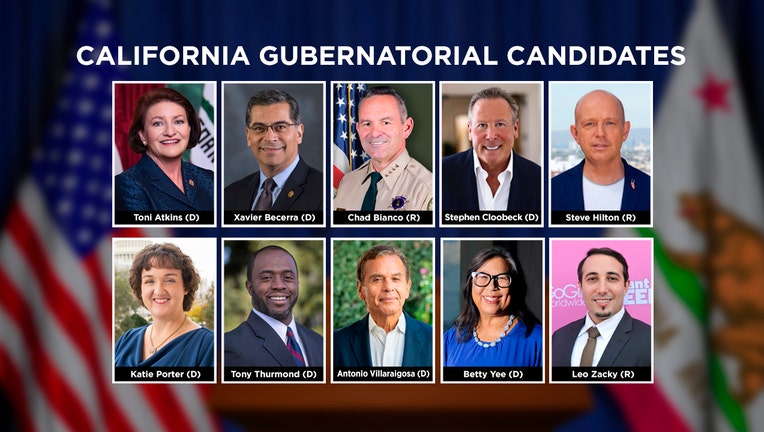
As California voters head to the polls this Tuesday, the state’s gubernatorial race—once considered a predictable contest—has transformed into one of the most volatile political battles in the nation. With Governor Gavin Newsom nearing his term-limit exit, the field has seen a dramatic shift in momentum. Among the most notable developments is the emergence of former U.S. Secretary of Health and Human Services Xavier Becerra as a frontrunner in the primary election.
The race, which features over 60 candidates, has been defined by significant upheaval. Earlier this year, Representative Eric Swalwell was widely viewed as the candidate to beat, but his campaign collapsed following allegations of sexual assault—which he has denied—leading to his resignation from Congress. In the wake of this vacuum, recent polling data suggests a surge for Becerra. According to an Emerson College poll released on May 30, 2026, Becerra holds 28% of the vote, moving ahead of billionaire philanthropist Tom Steyer at 22% and political commentator Steve Hilton at 21%. This represents a stark turnaround from earlier surveys, such as the Berkeley/IGS Poll taken two months prior, which placed Becerra at just 5%. Under California’s “jungle primary” system, the two candidates who secure the largest share of the vote will advance to the November general election, regardless of their party affiliation.
California Democratic gubernatorial candidate Xavier Becerra speaks to supporters at the Long Beach Arena in Long Beach, California on May 31, 2026. —Apu Gomes—Getty Images
A Path Through Public Service
Born in 1958 in Sacramento, California, Xavier Becerra’s personal history is often highlighted as a central element of his political identity. As the son of working-class Mexican immigrants, he became the first person in his family to earn a college degree. He pursued his education at Stanford University, where he obtained a Bachelor’s Degree in Economics, followed by a Juris Doctor from Stanford Law School.
Becerra’s entry into elected office began in 1990 with a successful run for the California State Assembly. Following a single term in the state legislature, he moved to the federal level in 1993, representing the Los Angeles area in the U.S. House of Representatives for 24 years. His transition to executive leadership occurred in 2017 when then-Governor Jerry Brown appointed him to succeed Kamala Harris as California Attorney General. During his tenure in the state’s top legal office, he gained national attention for his legal challenges against the first Trump Administration, filing 122 lawsuits focused on environmental protections, reproductive rights, and immigration policy. In 2021, he joined the Biden Administration to lead the Department of Health and Human Services (HHS).
Policy Priorities and Campaign Challenges
Throughout his career, Becerra has remained firmly aligned with the national Democratic platform, supporting measures such as stricter gun control and the protection of reproductive rights. However, his tenure as HHS Secretary brought significant scrutiny. Reports from outlets like Politico highlighted internal criticism from members of the Biden Administration regarding his effectiveness during the COVID-19 pandemic, a characterization Becerra has publicly refuted.
His record on immigration has also become a focal point of the current campaign. During his time at HHS, he faced criticism regarding the management of unaccompanied migrant children. The New York Times reported that as the volume of children arriving at the border increased, Becerra pushed staff to expedite their placement in shelters. Concerns were raised after it was discovered that HHS had failed to conduct follow-up calls for a significant portion of released children, some of whom were later found to have been injured or killed while working in dangerous labor conditions. Addressing these reports, Becerra stated during an interview that he could not be held responsible for the actions of employers after the children had left federal custody, noting, “What employers did after they [the children] left our jurisdiction, where the exploitation may have occurred, was not on my watch.”
The Governor’s Office: Economic and Social Proposals
As he seeks to transition from federal service to the California Governor’s mansion, Becerra has centered his platform on affordability and housing. On the social media platform X, he pledged to freeze utility and home insurance rates to provide immediate relief to residents, though he faces the reality that such rate changes are subject to the regulatory authority of the California Department of Insurance. He has proposed an expansion of the state’s down payment assistance program, which currently offers up to $150,000 for first-generation home buyers, though specific implementation details remain to be fully articulated.
On the issue of homelessness, Becerra has characterized the crisis as a consequence of systemic failures in housing supply and government accountability. In discussions with CalMatters, he set an ambitious goal to double the housing production seen under the Newsom administration, targeting the construction of 1.5 to 2 million new homes during his first term. He has also taken a firm stance on the necessity of intervention, suggesting that unhoused individuals should not be permitted to remain on the streets if alternative resources are available, though he has stopped short of advocating for criminal penalties for those who refuse assistance.
Regarding healthcare, Becerra has promised to use his executive authority to ensure “coverage continuity” for Californians affected by potential federal rollbacks to Medi-Cal, the state’s Medicaid program. A study by the California Healthcare Foundation noted that federal Medicaid cuts could impact up to 3.4 million residents. He intends to expand the CalRx program, an initiative aimed at lowering drug costs through state-managed production or pharmaceutical negotiations.
As the primary election concludes this week, the focus shifts to whether Becerra can maintain his momentum against his remaining challengers. The outcome of Tuesday’s vote will determine the final two candidates moving toward the November general election. Voters are encouraged to check their local county election office websites for the latest vote counts and official results as they are certified.
Keep reading