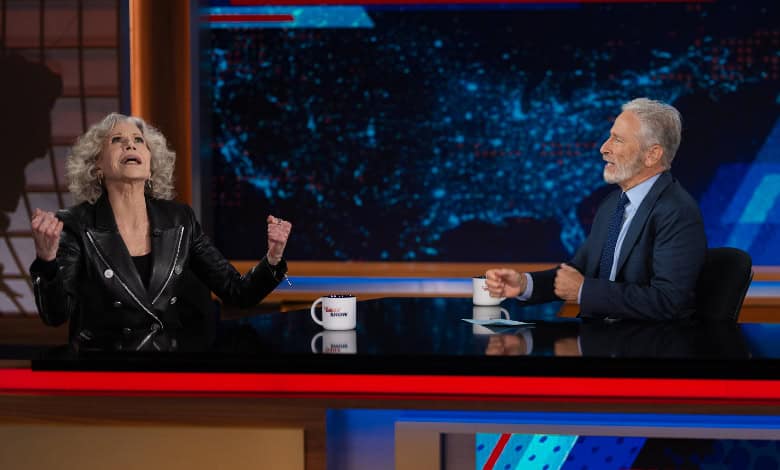
Actor and activist Jane Fonda has revived the Committee for the First Amendment, a historical advocacy group, to focus on contemporary debates surrounding free speech in the United States. During a guest appearance on The Daily Show on Monday, Fonda discussed the initiative alongside host Jon Stewart, framing the effort as a response to what she described as mounting threats against artistic and political expression. The organization, which traces its origins to the 1940s, plans to host a benefit concert on June 14 featuring performers including Bette Midler, Rufus Wainwright, Julia Roberts, and Patti Smith.
Fonda’s return to political activism via the Committee for the First Amendment marks a shift from her recent public focus on climate change advocacy, which included her multi-year Fire Drill Fridays campaign. While Fonda characterized the current climate for free expression as increasingly precarious, the initiative has drawn scrutiny regarding its scope and the political alignment of its participants. Critics point to a perceived inconsistency in the advocacy for free speech, noting that some high-profile figures associated with the movement have not historically addressed censorship concerns involving conservative viewpoints or actions taken by various political leaders.
The Committee for the First Amendment Relaunch
The Committee for the First Amendment was originally established in 1947 by Hollywood figures, including Humphrey Bogart and Lauren Bacall, to oppose the House Un-American Activities Committee’s investigations into the film industry. By reviving the name, Fonda seeks to apply the group’s historical mission to modern challenges, which she claims are currently impacting the entertainment industry and broader public discourse. According to the organization’s stated goals, the group aims to protect the rights of artists and citizens to express dissenting opinions without fear of retaliation.
The upcoming concert on June 14 serves as both a public outreach event and a fundraiser for the organization’s activities. The participation of prominent actors and musicians suggests a significant mobilization of cultural figures. However, the initiative has faced questions from media observers, such as the Media Research Center, regarding the criteria used to determine which free speech threats warrant public intervention. Critics argue that the current focus on the Committee for the First Amendment appears selectively applied, potentially ignoring instances where free speech was curtailed under Democratic administrations or by major technology platforms.
Late-night TV is cratering.
On @WilkowMajority, @DavidBozell breaks down how Stephen Colbert’s show is reportedly losing $40M/year because the “Manhattanite elitist crowd” only cares about pushing a negative narrative.
Paramount can’t sustain this business model. pic.twitter.com/RbuTr4ehWS
— Media Research Center (@theMRC) June 8, 2026
Shifting Landscapes in Late-Night Media
The discourse surrounding free speech in entertainment is unfolding against a backdrop of financial instability in the late-night television sector. Reports suggest that programs like The Late Show with Stephen Colbert have faced significant economic pressure, with some industry analysts citing an annual loss of approximately $40 million. While some advocates have framed the cancellation or restructuring of such programs as a threat to political satire, others, including the Media Research Center, attribute these losses to a disconnect between the content produced and broader audience preferences.
During the Daily Show segment, Fonda asserted that comedians are currently the primary targets of an encroaching “tyranny.” She did not provide specific evidence for this claim during the interview. The assertion that comedians are the first to suffer under authoritarianism is a common historical trope, yet it remains a point of contention among free speech advocates who argue that censorship efforts have historically spanned the political spectrum. The lack of discussion regarding past incidents—such as the 2013 controversy involving a performer who faced career repercussions for a sketch mocking President Barack Obama—has led some critics to label the current movement as partisan rather than principled.
Scrutinizing the Scope of Advocacy
A central criticism of Fonda’s initiative is the perceived inconsistency in identifying what constitutes a “threat” to the First Amendment. Observers have noted that many of the prominent figures supporting the new committee remained silent during instances of deplatforming by major social media companies, such as the actions taken by Twitter under its previous leadership, or during controversies involving university speech codes. This silence is cited by critics as evidence that the current advocacy is driven more by political opposition to specific figures, such as President Donald Trump, than by a comprehensive defense of speech rights.

The intersection of celebrity activism and political policy often results in public debate over the legitimacy of the platforms used. By engaging with The Daily Show—a program known for its liberal-leaning editorial stance—Fonda has solidified the perception that this iteration of the Committee for the First Amendment is aligned with a specific ideological agenda. Whether the group will expand its advocacy to include cases that do not align with its founders’ political views remains to be seen. For now, the focus remains on the June 14 concert and the broader effort to frame the current political environment as a defining moment for American civil liberties.
The next major milestone for the group is the scheduled June 14 concert, which is expected to provide further insight into the organization’s long-term strategy and the specific policy goals it intends to pursue. As the event approaches, public interest in the intersection of celebrity influence and political discourse is likely to persist. Readers are encouraged to share their perspectives on the role of advocacy groups in shaping national conversations on constitutional rights.
Related reading