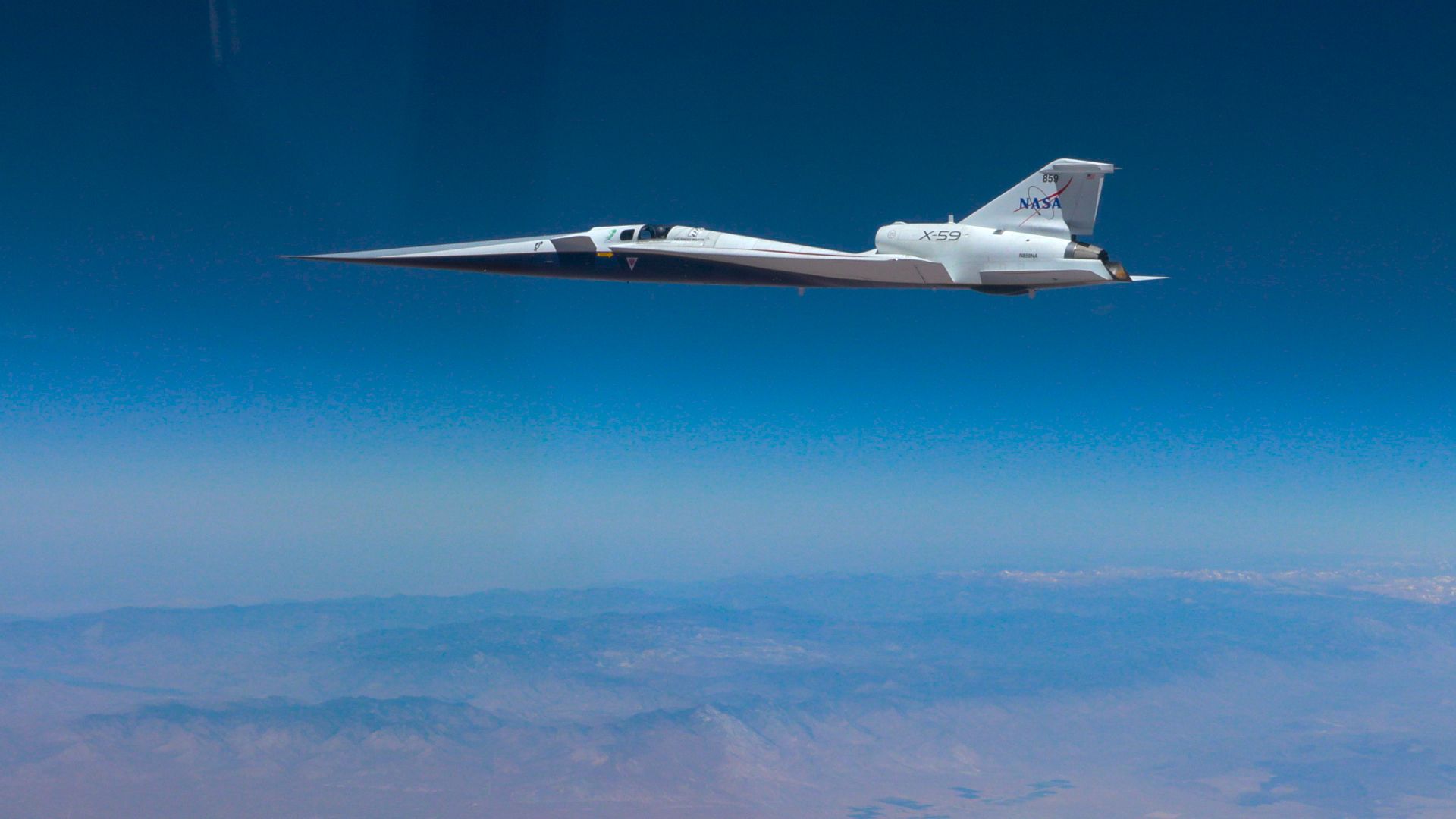
NASA’s experimental X-59 aircraft has successfully reached a speed of Mach 1.1, marking a significant milestone in the agency’s ongoing effort to demonstrate quiet supersonic flight. The flight, conducted at the Armstrong Flight Research Center in California, confirms that the aircraft’s specialized airframe design can withstand the structural demands of transonic speeds, bringing the project one step closer to potentially overturning long-standing regulations against supersonic travel over land.
The X-59, developed in partnership with Lockheed Martin, is designed to minimize the traditional “sonic boom” that occurs when an aircraft exceeds the speed of sound. Instead of a loud, disruptive shockwave, engineers intend for the jet to produce a much quieter “thump,” a sound comparable to a distant car door closing. According to NASA’s official project documentation, the data gathered during this flight test will be used to validate aerodynamic models that are essential for the next phase of the Quesst mission.
The Physics of Quiet Supersonic Technology
The primary challenge in supersonic aviation has historically been the atmospheric pressure waves generated by aircraft moving faster than the speed of sound. When an object travels at or above Mach 1, it forces air molecules to compress, creating a shockwave that propagates toward the ground as a sonic boom. This noise pollution led the Federal Aviation Administration (FAA) to ban civil supersonic flights over land in 1973, a regulation that remains in effect today.
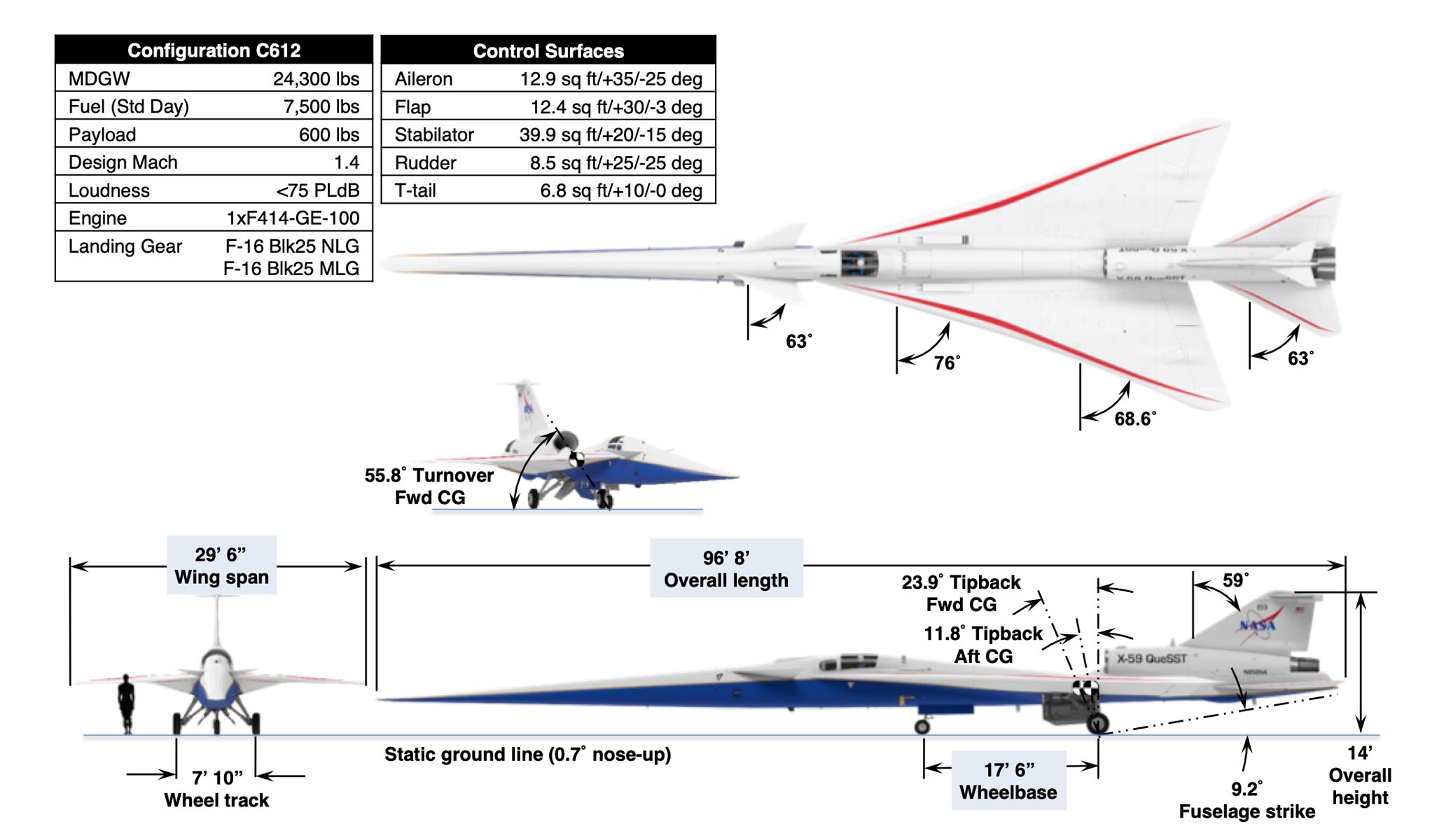
The X-59 addresses this through its unique, elongated airframe, which measures approximately 100 feet in length but only 30 feet in wingspan. This design is intended to prevent the shockwaves from merging into a single, high-intensity boom. By separating the pressure waves, the aircraft disperses the energy of the boom, which NASA researchers hope will allow for the future normalization of supersonic travel over populated areas. The recent Mach 1.1 flight provided the first real-world validation of these structural theories in a flight environment, as reported by NASA’s mission updates.
Data Collection and Regulatory Implications
Achieving supersonic speeds is only the initial step for the Quesst mission. Following these performance tests, NASA plans to conduct a series of community overflight tests. During these missions, the X-59 will fly over selected residential areas to collect human response data. This feedback is critical, as the agency intends to present its findings to international and domestic aviation regulators, including the FAA and the International Civil Aviation Organization (ICAO).

The goal is to provide a sound basis for changing the current “speed-based” regulations to “noise-based” standards. If the X-59 can consistently prove that its signature remains below established decibel thresholds, it could pave the way for a new generation of commercial supersonic transport. According to official agency FAQs, the success of these trials depends on the ability to replicate the “quiet” phenomenon across varying atmospheric conditions and altitudes.
Comparing X-59 to Historical Supersonic Precedents
The X-59 represents a departure from the design philosophy of previous supersonic aircraft like the Concorde. While the Concorde was built for speed and efficiency, it was notoriously loud, which restricted its flight paths and ultimately contributed to its limited commercial viability. The following comparison highlights the shift in engineering priorities:
- Concorde (1976–2003): Optimized for high-speed, long-distance travel; generated massive sonic booms that prohibited land-based supersonic flight.
- X-59 (Experimental): Optimized for acoustic signature reduction; designed specifically to demonstrate that supersonic flight can be quiet enough to be socially acceptable over land.
Unlike the Concorde, which prioritized passenger capacity and raw velocity, the X-59 is a single-seat research platform. It is not intended to carry passengers but rather to serve as a flying laboratory. Every flight, including the recent Mach 1.1 milestone, is tracked through rigorous telemetry to ensure that the aircraft’s performance matches the highly complex computational fluid dynamics (CFD) models created by Lockheed Martin engineers, as noted in Lockheed Martin’s project overview.
What Happens Next in the Flight Test Program
NASA has not yet released the specific dates for the upcoming community response trials. The current phase of the program remains focused on “envelope expansion,” where the aircraft is gradually pushed to higher speeds and varying altitudes to ensure total airframe stability. As the test program progresses, the agency will continue to provide updates through its official Quesst mission portal.
For aviation enthusiasts and industry stakeholders, the next major checkpoint will involve the public release of the initial acoustic data gathered during these supersonic passes. These datasets will be essential for validating the “quiet” claim to independent researchers and regulatory bodies. As the project continues to evolve, the global aviation community will be watching to see if the X-59 can successfully redefine the boundaries of modern flight.
Do you have thoughts on the future of supersonic travel or questions about the technology behind the X-59? We invite our readers to share their perspectives in the comments section below.
Related reading