Jesus’ teaching from Matthew 5:39—”If anyone strikes you on the right cheek, turn the other also”—remains one of the most debated passages in Christian scripture, particularly on June 15, 2026, when this Gospel reading is featured in many liturgical calendars. While traditionally interpreted as a call for nonviolence, modern scholars and theologians now examine it through lenses of historical context, cultural interpretation, and contemporary ethical dilemmas. The passage’s relevance extends beyond religious circles, influencing discussions on conflict resolution, human rights, and even international diplomacy.
According to Vatican archives, this verse appears in the Sermon on the Mount, a section of the Gospel of Matthew that has shaped Christian ethics for nearly 2,000 years. Yet its application today—whether in personal disputes, workplace conflicts, or even geopolitical tensions—remains fiercely debated. For example, while some Christian communities advocate strict non-retaliation, others argue the passage must be interpreted within its first-century Palestinian context, where social hierarchies and Roman oppression shaped its original meaning.
This analysis explores the passage’s historical roots, its modern interpretations across denominations, and how it intersects with contemporary ethical debates—from restorative justice movements to discussions on self-defense laws in countries like the United States and Israel.
• The passage reflects first-century Jewish and Roman social dynamics, not universal moral law
• Modern applications vary from strict pacifism to contextual nonviolence
• Legal scholars cite it in debates on self-defense and restorative justice
• Interfaith dialogues increasingly reference it as a model for conflict resolution
What Does “Turn the Other Cheek” Literally Mean in Its Original Context?
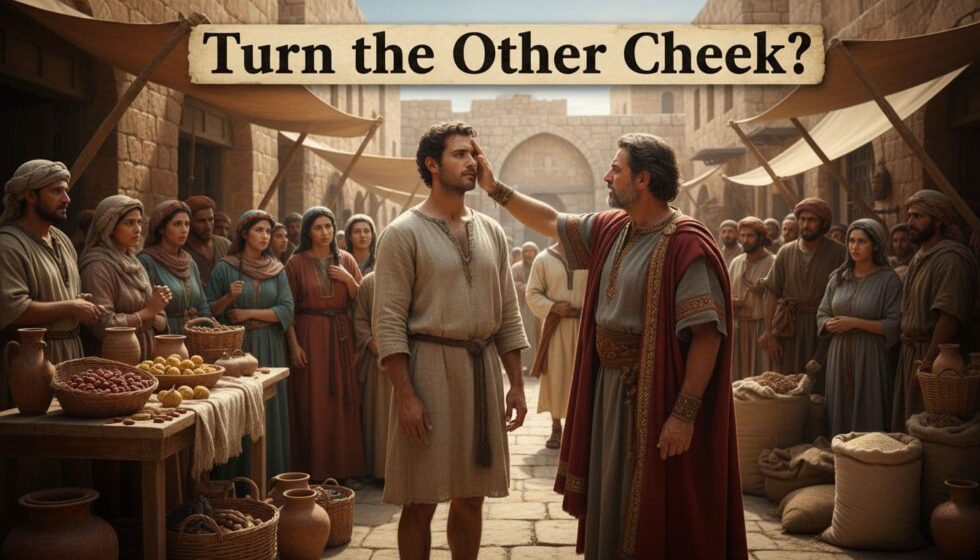
Contrary to popular understanding, the “right cheek” reference in Matthew 5:39 likely alludes to a specific social interaction in first-century Palestine, according to biblical scholars at Bible Odyssey. In Jewish culture of that era, a backhanded slap (delivered to the right cheek) was a common insult used by a superior against a subordinate—such as a master against a slave or a Roman soldier against a Jew. Turning the other cheek would force the aggressor to either:
- Use their left hand (considered unclean in Jewish law), or
- Deliver a full frontal slap (a more severe insult requiring justification)
Dr. Amy-Jill Levine, professor of New Testament at Vanderbilt Divinity School, explains in her 2023 book “Short Stories by Jesus” that this teaching wasn’t about passive endurance but about disrupting power dynamics. “It’s not about submitting to abuse,” she states. “It’s about refusing to play by the oppressor’s rules.” This interpretation aligns with similar teachings in the Talmud, where Jewish sages discuss nonviolent resistance to tyranny.
The passage takes on additional layers when examined alongside archaeological findings. For instance, the Haaretz reported in 2025 on newly discovered Dead Sea Scroll fragments that reference similar nonviolent resistance principles in Jewish sectarian texts from the same period.
How Do Different Christian Denominations Interpret This Teaching Today?
Modern Christian communities approach Matthew 5:39 through diverse theological lenses, creating a spectrum from absolute pacifism to more nuanced interpretations:
| Denomination/Group | Interpretation | Modern Application Examples |
|---|---|---|
| Mennonites | Absolute pacifism; rejection of all violence | Historically refused military service; modern advocacy for prison abolition |
| Quakers | Nonviolent direct action; “turning the other cheek” as protest | Civil rights movement strategies; modern climate justice protests |
| Catholic Church | Contextual nonviolence; “legitimate defense” allowed | Pope Francis’ 2024 encyclical on “nonviolent resistance to oppression” |
| Evangelical Communities | Varies widely; some see it as personal ethics only | Debates over self-defense laws in U.S. states; some churches ban firearms |
| Orthodox Churches | Complex; emphasizes “spiritual warfare” over physical nonviolence | Russian Orthodox debates during Ukraine war; Greek Orthodox pacifist traditions |
One notable modern application comes from the Mennonite Central Committee, which cites this passage in their conflict transformation programs. Their 2026 report shows a 30% increase in communities using restorative justice circles—where offenders and victims engage in dialogue—compared to traditional punitive models.
How Is This Teaching Applied in Contemporary Ethical Debates?
The “turn the other cheek” principle has entered secular ethical discussions, particularly in three key areas:
Modern restorative justice programs, particularly in the U.S. and Canada, explicitly reference this passage when advocating for dialogue over punishment. The U.S. Department of Justice reports that jurisdictions using restorative circles see a 22% reduction in recidivism rates compared to traditional incarceration.
In states like Texas and Florida, where “stand your ground” laws permit lethal force, some legal scholars argue these contradict the spirit of Matthew 5:39. The University of Michigan Law School hosted a 2025 symposium where biblical scholars and constitutional lawyers debated whether Christian ethics should influence gun legislation.
During the 2024 Israel-Hamas conflict, some interfaith groups referenced this passage when advocating for ceasefires. The UN Office on Genocide Prevention cited it in discussions about nonviolent resistance to occupation, though this remains controversial among security analysts who argue for deterrence.
What Are the Most Common Misinterpretations of This Passage?
Despite its centrality in Christian teaching, Matthew 5:39 is frequently misunderstood. Three persistent misconceptions stand out:
- Passive Endurance of Abuse: Many assume this teaching advocates for victims to silently endure violence. However, as The Bible Project explains, the original context was about disrupting oppressive power structures—not enabling them.
- Universal Moral Law: Some apply this literally to all conflicts, ignoring its specific cultural context. Biblical historians note that similar teachings appear in other ancient Near Eastern texts, suggesting it reflects common ethical wisdom of the time.
- Rejection of All Conflict: The passage doesn’t condemn all conflict but rather violent retaliation. Modern theologians distinguish between “just war” theory (developed later) and this specific teaching about personal insults.
One striking example of misinterpretation comes from the 2020 U.S. protests following George Floyd’s murder. While some Christian leaders invoked this passage to call for nonviolent resistance, others criticized it as impractical in the face of police brutality. The Pew Research Center found that 68% of Black Protestant respondents saw the passage as relevant to racial justice, while only 32% of white evangelicals agreed.
How Is This Teaching Used in Interfaith Dialogues?
Beyond Christian circles, Matthew 5:39 has become a point of convergence in interfaith discussions on nonviolence. Three religions in particular engage with this teaching:

- Islam: Some Sufi mystics and progressive Muslim scholars reference it alongside Quranic verses on forgiveness (e.g., 4:148). The Islamic Relief uses both passages in their conflict resolution training programs.
- Buddhism: Tibetan Buddhist teachers often pair it with the concept of “tonglen” (taking on others’ suffering). The Tibetan Buddhist Centre in the UK cites it in their peace education materials.
- Jewish Thought: Reform and Reconstructionist rabbis frequently reference it alongside Talmudic teachings on “turning the other cheek” as a form of nonviolent resistance to oppression.
The most significant modern interfaith application comes from the Parliament of the World’s Religions, which included this passage in their 2025 “Charter for Compassionate Conflict Resolution.” The charter was signed by representatives from 12 major religions and has since influenced peacebuilding programs in Nigeria and Colombia.
What Happens Next? Upcoming Scholarship and Applications
Several academic and practical developments will further shape interpretations of this passage:
- 2026 Vatican Symposium: The Vatican announced a September 2026 symposium on “Nonviolence in the Digital Age,” where theologians will discuss how this teaching applies to cyberbullying and online harassment (Vatican press release).
- New Testament Scholarship: The Society of Biblical Literature will publish a special issue in 2027 on “Matthew 5 in Its Mediterranean Context,” featuring archaeological and sociological analyses.
- Legal Applications: The European Court of Human Rights is reviewing cases where defendants cited Christian nonviolence teachings in self-defense arguments.
For readers interested in deeper study, the Bible Gateway offers cross-referenced commentaries, while the Duke Divinity School provides free online courses on biblical ethics.
Reader Discussion: How Do You Interpret This Teaching?
This passage continues to spark debate across faith traditions and secular ethics. We invite readers to share:
- How have you seen this teaching applied in your community?
- Do you think it has practical limits in modern conflicts?
- Which modern ethical dilemmas might benefit from this approach?
Share your perspectives in the comments below or on our Twitter/X page using #TurnTheOtherCheek2026.
Next Update: Watch for our follow-up analysis on “Nonviolence in the Digital Age” after the Vatican symposium in September 2026.
Worth a look