
Canada accepts over 400,000 permanent residents annually through programs like Express Entry, which require applicants to meet specific age, education, and work experience criteria to qualify for immigration. As of 2024, the average age of successful Express Entry candidates falls between 25 and 35, with a minimum of a high school diploma or equivalent, though professional qualifications often demand bachelor’s degrees or higher. Work experience must align with the National Occupational Classification (NOC) system, with skilled trades and healthcare roles frequently prioritized.
For temporary workers, the Temporary Foreign Worker Program (TFWP) and International Experience Canada (IEC) offer alternative pathways, though they also enforce age limits (18–35 for IEC) and job-specific qualifications. The Canadian government’s emphasis on economic immigration—accounting for 60% of all permanent residency approvals in 2023—means understanding these requirements is critical for prospective immigrants.
This guide breaks down the verified criteria for Canada’s most common immigration routes, including Express Entry, Provincial Nominee Programs (PNPs), and family sponsorship, with direct links to official application forms and eligibility tools.
What Are Canada’s Age Requirements for Immigration?
Canada does not set a strict upper age limit for immigration, but age significantly impacts eligibility under points-based systems like Express Entry. The Comprehensive Ranking System (CRS) awards points based on age, with applicants aged 18–35 receiving the highest scores. For example:

- 18–24 years: 110 CRS points
- 25–30 years: 100 CRS points
- 31–35 years: 90 CRS points
- 36–45 years: 0 CRS points (no penalty, but no bonus)
Applicants over 45 can still qualify through family sponsorship or Provincial Nominee Programs (PNPs), which often have more flexible age criteria. The Express Entry CRS calculator confirms these age-based point allocations.
How Does Education Factor Into Canada’s Immigration System?
Education is a cornerstone of Canada’s immigration criteria, with the Educational Credential Assessment (ECA) required for most economic-class applicants. A high school diploma is the minimum for many programs, but skilled occupations (NOC TEER 0, 1, 2, or 3) typically demand:
- Bachelor’s degree or equivalent for professional roles (e.g., engineers, healthcare workers)
- College diplomas or apprenticeships for skilled trades (e.g., electricians, welders)
- Master’s or PhD degrees for research-focused positions (e.g., scientists, professors)
For Express Entry, a bachelor’s degree can award up to 150 CRS points, while a master’s or PhD adds 160–175 points. The World Education Services (WES) is a designated ECA provider, verifying foreign credentials against Canadian standards.
What Work Experience Is Needed for Canadian Immigration?
Work experience must be:
- Skilled, paid, and legal: Unpaid work (e.g., internships) or self-employment without proof of income does not qualify.
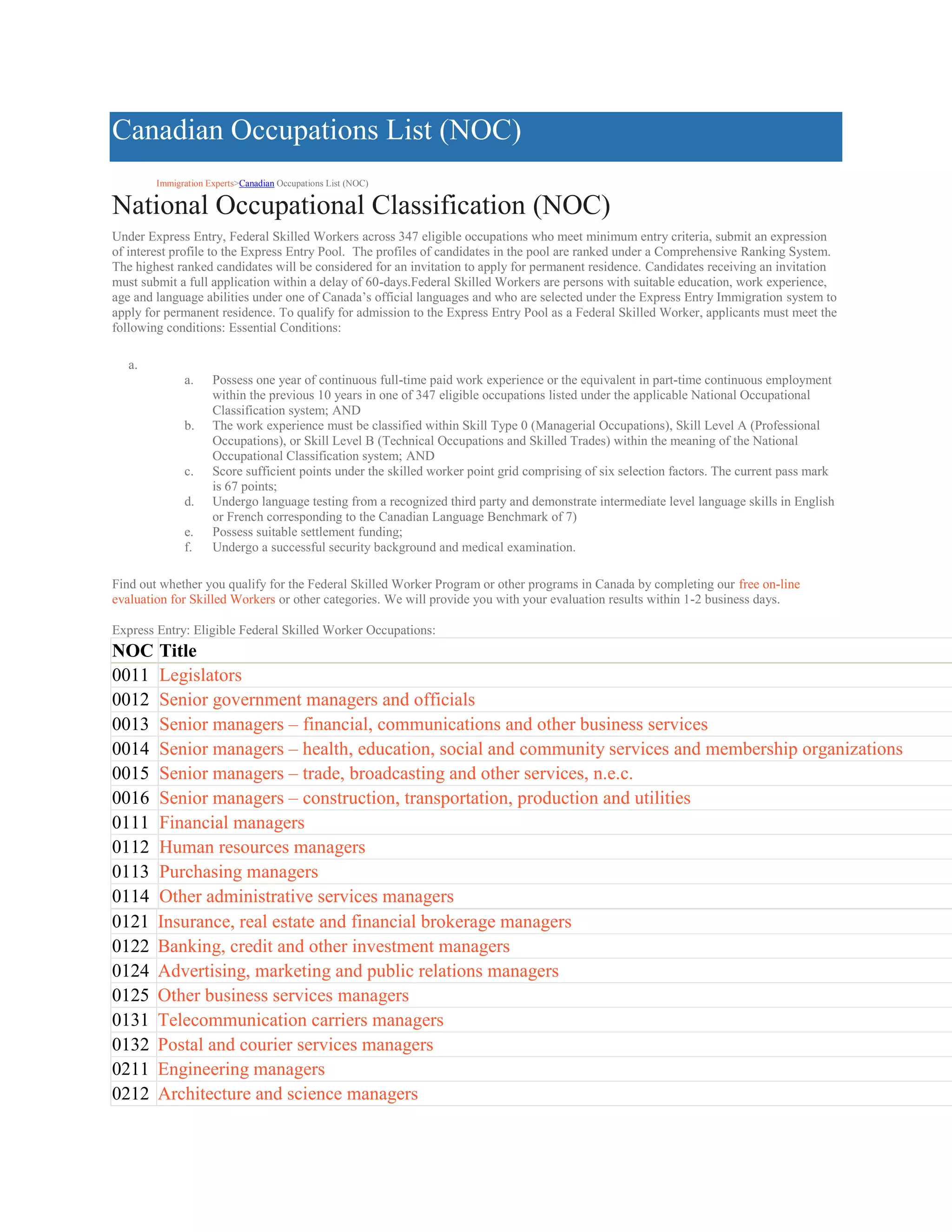
- NOC-aligned: Jobs must match the National Occupational Classification (NOC) system, with TEER 0 (management), 1 (professional), 2 (technical), or 3 (skilled trades) roles eligible for Express Entry.
- Full-time or equivalent: Part-time work can be counted if it totals 1,560 hours (30 hours/week for 1 year).
For example, a software developer (NOC 21231) with 3 years of experience in coding and system design would qualify, while a retail associate (NOC 65200) would not. The Express Entry work experience guidelines specify that only Canadian or foreign work legally obtained counts.
Which Immigration Programs Have the Most Flexible Requirements?
While Express Entry is the most competitive, other programs offer alternatives:
- Provincial Nominee Programs (PNPs): Provinces like Ontario and British Columbia set their own criteria, often prioritizing in-demand skills over age. For example, Ontario’s Human Capital Priorities Stream requires a minimum CRS score of 400 (lower than Express Entry’s 470+ threshold).
- Family Sponsorship: Spouses, common-law partners, and dependent children can be sponsored with no age or work experience requirements, though financial support obligations apply.
- Start-Up Visa Program: Entrepreneurs with support from a designated organization can qualify with less work experience if their business proposal is innovative.
In 2023, PNPs accounted for 10% of all permanent residency approvals, making them a viable option for those who don’t meet Express Entry’s strict criteria.
How Do Temporary Work Visas Compare to Permanent Residency Pathways?
For those unable to meet permanent residency requirements immediately, temporary work visas offer a bridge:

- Temporary Foreign Worker Program (TFWP): Requires a valid job offer from a Canadian employer with a Labor Market Impact Assessment (LMIA). No age limit, but work must be full-time and align with NOC TEER 0–3.
- International Experience Canada (IEC): Open to citizens of 36 countries (including Germany, France, and Australia) aged 18–35. Allows work for up to 2 years without an LMIA, with 10,000 spots allocated annually.
- Study Permits: International students can work part-time (20 hours/week) during studies and full-time during breaks. Graduates with a Canadian degree can apply for the Post-Graduation Work Permit (PGWP), which can lead to permanent residency.
According to 2023 IRCC data, 600,000 temporary work permits were issued, with 40% of holders transitioning to permanent residency within 5 years.
What Are the Next Steps After Meeting the Criteria?
Once eligibility is confirmed, applicants must:
- Create an Express Entry profile (if applying through this route) and submit to the pool. Invitations to apply (ITAs) are issued based on CRS scores.
- Gather documents: Passport, language test results (IELTS/CELPIP for English, TEF/TCF for French), ECA, police certificates, and proof of funds (CAD 13,495 for a single applicant in 2024).
- Submit the application within 60 days of receiving an ITA. Processing times vary by program (e.g., 6 months for Express Entry, 18 months for PNPs).
- Attend medical exams and biometrics as required by IRCC.
The next Express Entry draw is scheduled for June 5, 2024, with a minimum CRS score of 500 expected. Applicants can check their eligibility using the Come to Canada tool.
For those unsure about their eligibility, the IRCC’s online assessment provides a personalized report. The next major policy update is expected in November 2024, when IRCC will announce new immigration levels for 2025.
Have questions about your specific situation? Share your details in the comments below, and our team of immigration experts will review your case. For official updates, follow IRCC’s news section.
Related reading