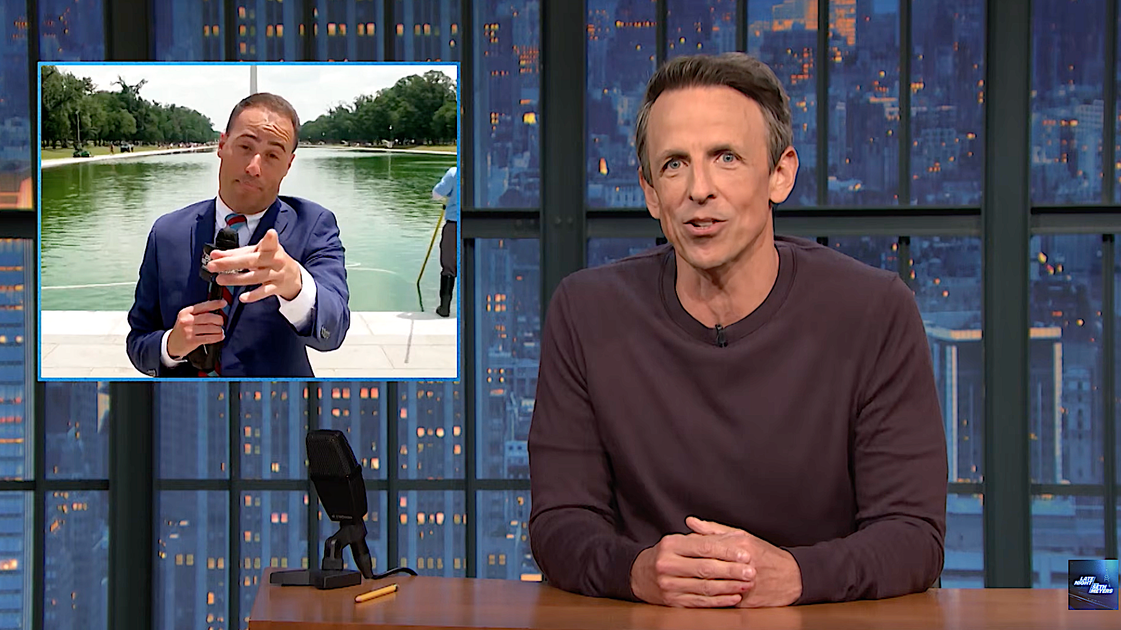
Late-night host Seth Meyers recently criticized a segment aired on Fox News regarding the color of a reflecting pool, using his platform on Late Night with Seth Meyers to highlight what he characterized as a departure from objective reality. The segment in question featured a discussion about a body of water that appeared green on screen, leading to a comedic analysis of how media outlets frame visual evidence for their audiences.
The incident gained traction after the program featured a clip of a reflecting pool that was visibly green, yet the accompanying commentary reportedly suggested a different interpretation of the scene. Meyers, who has spent over a decade analyzing political media and cultural discourse, utilized his “A Closer Look” segment to dissect the discrepancy between the visual evidence and the verbal narrative provided by the network’s hosts.
According to the official transcripts from NBC, Meyers focused on the absurdity of denying observable facts, noting that the pool’s color was an objective, verifiable detail. This critique fits into a broader pattern of late-night hosts using satire to address how cable news networks manage information and public perception in a polarized media environment.
The Context of Media Fact-Checking
The segment serves as a case study in how visual media can be interpreted through different lenses. When a news organization presents an image—such as a green reflecting pool—and provides a narrative that contradicts the visual data, it creates a friction that observers often identify as “gaslighting.” In his critique, Meyers argued that the attempt to steer public opinion against what the viewer can plainly see is a hallmark of modern partisan broadcasting.
Research into media literacy, such as studies conducted by the Pew Research Center, suggests that audiences are increasingly aware of these editorial choices. The divide between how different outlets report on identical events often hinges on the selection of “frames,” a concept in journalism where the context provided for a fact is as important as the fact itself. For viewers, this highlights the necessity of cross-referencing visual media with primary sources or neutral reporting to determine the accuracy of a broadcast.
How Late-Night Comedy Shapes Political Discourse
Seth Meyers has carved out a niche in late-night television by combining traditional comedy with deep-dive investigative reporting. Since his tenure began at Late Night in 2014, his “A Closer Look” segments have become a staple for viewers looking to synthesize complex political events through a critical, albeit humorous, lens. By isolating specific clips from cable news, Meyers provides a curated view of what he considers to be journalistic malpractice.

This approach has been credited with influencing how younger demographics engage with news. By breaking down the rhetorical strategies used by cable pundits, Meyers helps viewers identify fallacies in real-time. Whether it is a discussion about a green pool or a more significant legislative debate, the goal remains the same: to strip away the editorial layer and reveal the underlying event. The Hollywood Reporter has noted that this style of “news-comedy” has become an essential pillar of the modern entertainment landscape, bridging the gap between celebrity culture and civic engagement.
The Role of Visual Evidence in News
The debate over the green reflecting pool brings up fundamental questions about the role of visual evidence in journalism. In an era where digital manipulation is a constant concern, the authenticity of what appears on screen is paramount. When a network chooses to ignore or reframe a blatant visual reality, it risks eroding the trust of its audience. This is not the first time a network has faced criticism for such choices; however, the speed at which social media platforms can debunk these claims has changed the stakes.

According to the Society of Professional Journalists Code of Ethics, truth and accuracy are the primary obligations of any news organization. While satire programs like Late Night are not bound by the same journalistic standards as news divisions, they often function as a necessary check on the industry. By highlighting these moments of absurdity, Meyers and his peers ensure that network narratives are held accountable to the standard of observable reality.
As of this writing, there have been no official responses from the network involved regarding the specific segment. The next scheduled airings of Late Night with Seth Meyers will continue to follow the standard production schedule on NBC. Readers interested in the intersection of media criticism and entertainment are encouraged to share their thoughts on how visual narratives influence their own perception of current events.