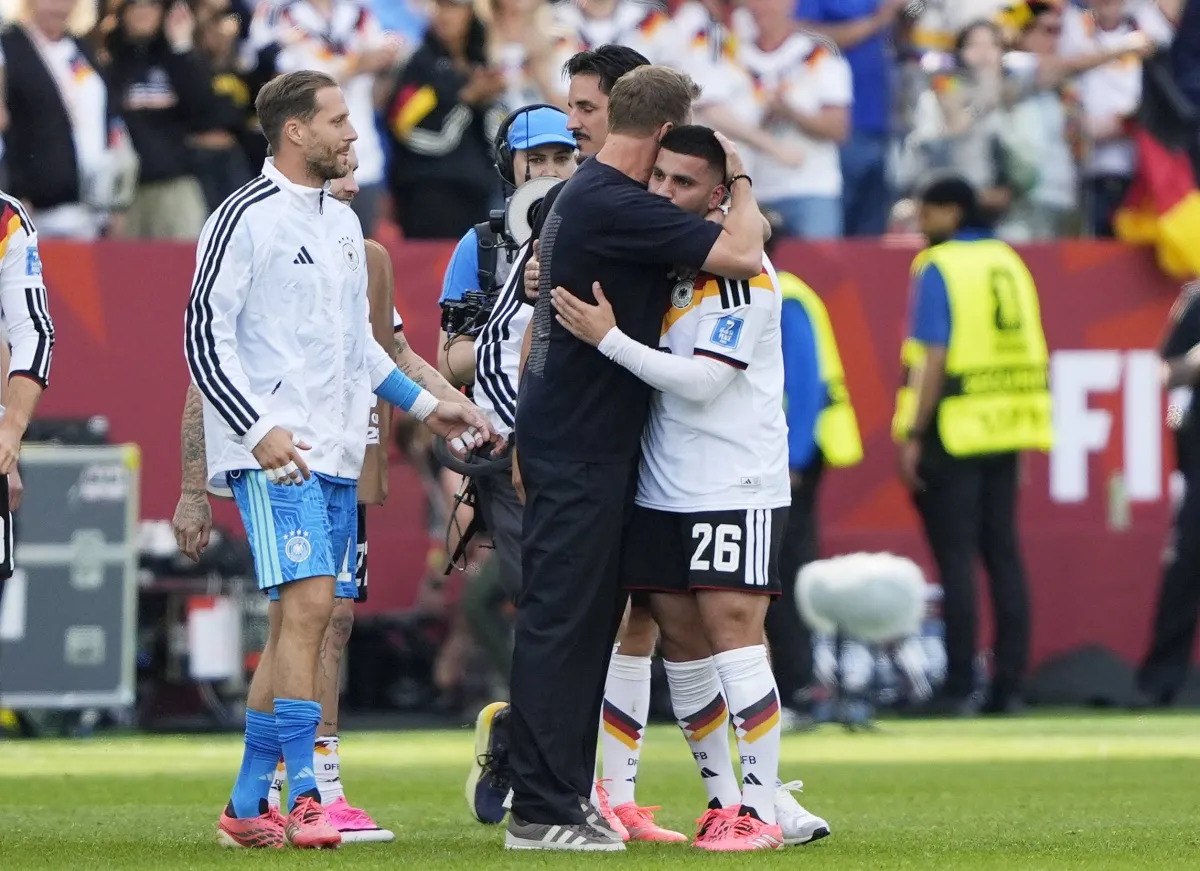
Germany national team manager Julian Nagelsmann is increasingly positioning Deniz Undav as a central figure in his attacking rotation following the striker’s consistent goal-scoring form in domestic and international contexts. The decision marks a tactical shift for the Mannschaft as Nagelsmann seeks to balance traditional target-man play with the high-mobility requirements of modern international football.
Undav, who has seen a significant rise in profile through his performances in the Bundesliga, is being considered for more frequent starting roles. This development comes as Nagelsmann attempts to solidify a frontline that has undergone multiple iterations during the current international cycle. While the German coaching staff has not released a definitive starting lineup for all upcoming fixtures, recent tactical patterns suggest Undav’s versatility is becoming a primary asset for the squad.
The integration of Undav represents a broader trend in Nagelsmann’s coaching philosophy, which prioritizes players capable of operating across multiple attacking positions. Unlike traditional center-forwards who remain static in the penalty area, Undav’s ability to drop into deeper pockets of space allows Germany to maintain better structural cohesion during transition phases.
The Tactical Evolution Under Julian Nagelsmann
The selection of Deniz Undav signals a departure from the more rigid attacking structures previously employed by the German national team. Under Nagelsmann, the tactical emphasis has shifted toward fluidity, requiring strikers to act as both finishers and facilitators. According to recent tactical analyses of the German setup, Undav’s profile fits this requirement more closely than several of his contemporaries.
Nagelsmann’s system often relies on “interchanging” roles between the striker and the attacking midfielders. While players like Jamal Musiala operate in the half-spaces, the central striker must provide the gravity necessary to pull defenders out of position. Undav’s tendency to drift wide or drop into the midfield facilitates this movement, creating lanes for late-running midfielders to exploit.
This tactical flexibility is a response to the increasing speed of international defensive blocks. By utilizing a striker who does not occupy a single fixed point, Nagelsmann aims to disrupt the defensive organization of opponents who rely on zonal marking. The coaching staff appears to be testing how Undav’s movement affects the spacing between the opposition’s defensive and midfield lines.
Analyzing Undav’s Scoring Trajectory and Form
Undav’s rise within the national team hierarchy is underpinned by his statistical output in the Bundesliga. His ability to convert high-value chances has made him a difficult player for Nagelsmann to overlook. During recent competitive stretches, Undav has demonstrated a high level of efficiency, particularly in high-pressure matches where clinical finishing is required to break deadlocks.
The striker’s effectiveness is not limited to pure goalscoring; his contribution to the buildup play has also seen an uptick. Data from recent domestic campaigns indicates that Undav’s involvement in successful attacking sequences—measured by progressive carries and passes into the box—has placed him among the top tier of Bundesliga forwards. This holistic contribution is what distinguishes him from pure “poachers” in the eyes of the German technical staff.
For the German national team, this form provides a much-needed sense of reliability. The Mannschaft has struggled in recent years with a lack of a consistent “number nine” who can guarantee goals while participating in the team’s collective pressing scheme. Undav’s current trajectory suggests he may fill this void, providing a bridge between the midfield’s creativity and the final clinical touch.
The Competition for the Starting Striker Role
Despite Undav’s increasing prominence, the competition for a starting spot in the German attacking unit remains intense. Nagelsmann faces a selection dilemma involving several distinct profiles of players, each offering different tactical advantages.
The primary competition for Undav includes:
- Niclas Füllkrug: A traditional target man whose aerial strength and physical presence offer a different dimension, particularly when Germany needs to play more direct football or hold up play under pressure.
- Kai Havertz: While often deployed in a more advanced midfield or “second striker” role, Havertz’s ability to operate centrally makes him a direct competitor for the spaces Undav occupies.
- Emerging Talents: The depth of the German talent pool means that players from various Bundesliga clubs are constantly vying for attention through high-scoring domestic seasons.
The choice between these players often dictates the entire tactical shape of the German team. A lineup featuring Füllkrug tends to be more direct and physically imposing, whereas a lineup built around Undav or Havertz allows for a more possession-oriented, technical approach. Nagelsmann’s recent experiments suggest he is moving toward a hybrid model that attempts to incorporate elements of both styles.
Comparison of Striker Profiles in the German Squad
| Player Profile | Primary Strength | Tactical Role | Movement Style |
|---|---|---|---|
| Deniz Undav | Versatility & Finishing | Fluid Forward | High mobility, drops deep |
| Niclas Füllkrug | Physicality & Aerial Ability | Traditional Target Man | Static, occupies center-backs |
| Kai Havertz | Creativity & Space Finding | Shadow Striker | Roaming, operates in pockets |
Impact on Germany’s International Outlook
The decision to integrate Undav into the starting XI has significant implications for Germany’s standing in upcoming international competitions. As the team prepares for major tournament cycles, the stability of the attacking unit is a critical factor in their success probability.
If Undav can cement his position, it allows Nagelsmann to build a more predictable attacking structure. A settled striker-midfielder relationship is essential for the high-tempo, possession-based football that Germany aims to implement. Furthermore, Undav’s ability to play alongside multiple types of attacking midfielders provides Nagelsmann with the tactical “tools” to adapt to different opponents mid-match.
However, the pressure on Undav to maintain his scoring rate at the international level is substantial. The jump from domestic club football to the rigors of international competition often exposes players to more sophisticated defensive structures. The coaching staff will be monitoring how Undav handles the increased physical and mental demands of representing the Mannschaft in high-stakes qualifying and tournament scenarios.
The long-term goal for the German football federation (DFB) is to establish a settled attacking core that can compete with the world’s elite. Whether Undav becomes a permanent fixture or remains a high-impact rotational player, his presence has undeniably shifted the tactical conversation within the German camp.
The German national team is expected to provide further updates on squad selection and tactical directions ahead of their next scheduled international window. Observers will be looking for whether Undav features in the starting lineup for upcoming competitive fixtures.
What are your thoughts on Nagelsmann’s tactical shift? Do you prefer a traditional target man or a more fluid striker like Undav? Let us know in the comments below and share this article with your fellow football fans.
Related reading