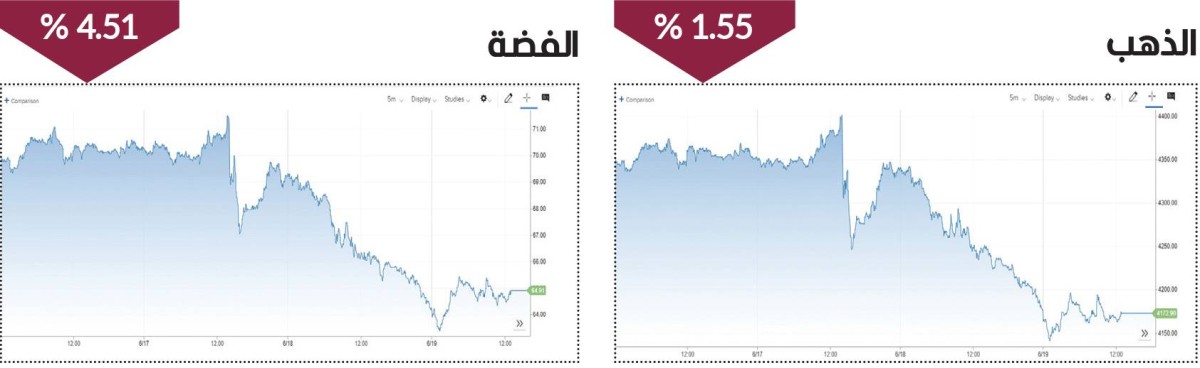
Gold prices have recorded a third consecutive weekly loss, pressured by a strengthening U.S. dollar and hawkish signals from the Federal Reserve regarding future interest rate adjustments. As of the close of trading on Friday, the precious metal saw a cumulative decline of approximately 1.4% for the week, pushing it to its lowest levels in seven days as investors recalibrate their expectations for monetary policy, according to market data reported by Reuters.
The recent downturn in bullion reflects a broader shift in global market sentiment as persistent inflation data and resilient economic indicators prompt the Federal Reserve to adopt a more cautious stance on cutting interest rates. When central banks maintain higher rates for longer, the opportunity cost of holding non-yielding assets like gold increases, leading investors to favor higher-yielding instruments such as U.S. Treasury bonds.
Impact of Federal Reserve Policy on Gold Valuations
The primary driver behind the current downward pressure on gold is the Federal Reserve’s evolving monetary policy outlook. Recent public comments from Federal Reserve Chair Jerome Powell have emphasized that the central bank is in no rush to lower borrowing costs, noting that the economy’s strength allows for a measured approach to policy easing, as detailed in the official transcript of his recent remarks. This hawkish rhetoric has bolstered the U.S. Dollar Index (DXY), which tracks the greenback against a basket of six major currencies. Because gold is priced in dollars, a stronger currency makes the metal more expensive for holders of foreign denominations, effectively dampening demand.
Market analysts observe that the transition from aggressive rate-cut expectations to a “higher-for-longer” narrative has forced a technical sell-off in gold futures. While gold traditionally serves as a hedge against inflation and geopolitical instability, these defensive characteristics are currently being outweighed by the direct impact of rising real yields, which serve as a primary headwind for the commodity.
Market Dynamics and Investor Sentiment
Beyond the influence of U.S. monetary policy, investors are closely monitoring the interplay between physical demand and speculative trading. Historically, gold acts as a safe-haven asset, yet the current environment of relative stability in major equity markets has reduced the urgency for portfolio diversification into precious metals. According to data tracked by Bloomberg, institutional outflows from gold-backed exchange-traded funds (ETFs) have accelerated throughout the week as traders rebalance portfolios to account for higher Treasury yields.
The following table summarizes the key factors currently influencing the price of gold:
| Factor | Directional Impact | Reasoning |
|---|---|---|
| U.S. Dollar Strength | Negative | Increases the cost of gold for non-dollar investors. |
| Federal Reserve Policy | Negative | Higher interest rates increase the opportunity cost of gold. |
| Treasury Yields | Negative | Investors favor interest-bearing assets over bullion. |
What Happens Next: Key Economic Indicators
Market participants are now turning their attention to the upcoming release of key economic data, including the Consumer Price Index (CPI) and Producer Price Index (PPI) reports, which will provide further clarity on the trajectory of inflation. These metrics are critical for the Federal Reserve’s decision-making process at its next meeting. Any sign that inflation is cooling faster than anticipated could lead to a reversal in interest rate expectations, potentially providing a floor for gold prices.
The next major checkpoint for the market will be the Federal Open Market Committee (FOMC) meeting minutes, which are scheduled for release later this month. These documents will offer a deeper look into the internal deliberations of committee members regarding the pace of future policy shifts. Until then, gold is expected to remain sensitive to fluctuations in the U.S. dollar and bond market volatility.
Investors are advised to monitor official updates from the Federal Reserve website for the most accurate information regarding policy changes. We welcome your perspective on the current gold market; feel free to share your analysis or questions in the comments section below.
Worth a look