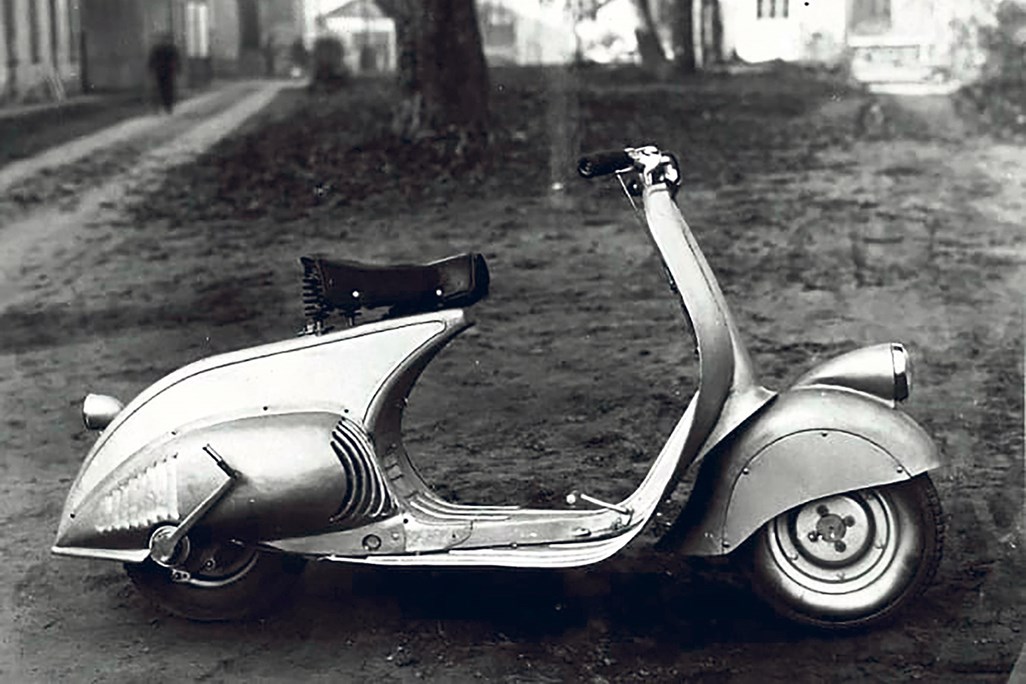
The motorized scooter’s origins trace back to the United States in the early 20th century, predating the mid-century Italian Vespa. While the Vespa became the global icon of the category, historical records show that motorized platforms, such as the Autoped, were in use in America as early as 1915.
For decades, popular culture has attributed the invention of the modern scooter to the Italian manufacturer Piaggio and its iconic Vespa model. However, motorcycle historians, including Vittorio Tessera, suggest that the concept of a small, motorized two-wheeled vehicle originated in the United States. This distinction separates the invention of the motorized platform from the later refinement of the step-through design that defined the post-war European era.
The shift in understanding historical timelines highlights a distinction between the “scooter” as a primitive motorized device and the “scooter” as a sophisticated consumer product. While the Vespa revolutionized urban mobility in the 1940s, the technical lineage of the motorized two-wheeler includes American developments from the early 1900s.
The American Roots: The Autoped and the 1915 Era
The claim that the scooter was born in America is supported by the existence of the Autoped, a motorized vehicle produced by the Autoped Company of America. Developed in the early 20th century, the Autoped functioned as a motorized platform that allowed riders to stand while traveling, a design closely related to the modern kick scooter concept.
Historical records indicate that by 1915, these motorized devices were already being utilized for practical purposes. Most notably, the United States Post Office experimented with these small motorized vehicles to assist mail carriers in navigating urban environments. These early machines lacked the enclosed bodywork and seated comfort of later models, but they established the core utility of the scooter: compact, motorized, and easy to maneuver in crowded spaces.
Unlike the later Italian designs, the American precursors were often viewed as industrial or utilitarian tools rather than lifestyle accessories. The Autoped’s design focused on short-distance transport, providing a motorized solution for workers who required mobility without the bulk of a standard motorcycle.
Challenging the Vespa Legacy
The Vespa, launched by Piaggio in 1946, is frequently cited as the inventor of the scooter. This misconception stems from the fact that the Vespa was the first vehicle to successfully market the “scooter lifestyle” to a mass global audience. Designed by aeronautical engineer Corradino D’Ascanio, the Vespa was intended to solve the specific mobility needs of post-war Italy.
D’Ascanio’s design was a departure from traditional motorcycles of the era. He sought to eliminate the need for riders to climb over a high fuel tank or deal with grease and heavy machinery. By implementing a step-through frame, a front shield to protect the rider, and an enclosed engine, he created a vehicle that was accessible to a much broader demographic, including women and commuters.
While the Vespa did not invent the motorized two-wheeler, it did invent the modern “scooter” archetype. Historians like Vittorio Tessera note that the distinction lies in the transition from the utilitarian American motorized platforms to the highly engineered, aesthetically driven Italian design. The Vespa’s success was not in being the first, but in being the first to perfect the ergonomics and social appeal of the category.
Evolution of the Scooter Silhouette: Platform vs. Step-Through
Understanding the history of the scooter requires comparing the two distinct evolutionary paths: the American motorized platform and the Italian step-through design. These two lineages represent different approaches to urban mobility.
The American model, exemplified by the 1915-era devices, focused on a standing position. These vehicles were essentially motorized “monopattini” (kick scooters), designed for stability and simplicity. They were built for utility, often used in commercial or governmental capacities to move goods or personnel through tight city streets.
In contrast, the Italian design philosophy prioritized rider comfort and protection. The introduction of the seated position and the enclosed chassis allowed for longer commutes and protection from the elements. This shift moved the scooter from a niche tool for postal workers to a primary mode of personal transportation for the middle class.
This evolution can be summarized by the following technical distinctions:
- Riding Position: American precursors primarily utilized a standing posture, whereas the Vespa popularized the seated, upright position.
- Protection: Early American models offered minimal protection from debris or weather; Italian designs introduced integrated leg shields and enclosed engines.
- Target Demographic: The American models were largely utilitarian and commercial; the Italian models were designed for mass-market personal consumer use.
Frequently Asked Questions
Did Italy invent the scooter?
No. While Italy, specifically through Piaggio, perfected and popularized the modern scooter design in the post-war era, the concept of motorized two-wheeled platforms originated in the United States in the early 20th century.

What was the first motorized scooter?
While there is no single undisputed “first,” the Autoped, produced in the United States around 1915, is one of the earliest documented motorized platforms used for urban transport and postal services.
Why is the Vespa so famous if it wasn’t the first?
The Vespa became famous because its design—created by Corradino D’Ascanio—was revolutionary for its comfort, ease of use, and style. It transformed the scooter from a utility tool into a global cultural icon.
How did the Autoped differ from a Vespa?
The Autoped was primarily a standing platform used for utility, whereas the Vespa was a seated, step-through vehicle designed for consumer comfort and style.
The historical debate regarding the origins of the scooter highlights how technological evolution often moves from utilitarian necessity to consumer-driven design. As urban mobility continues to evolve with electric micro-mobility, the legacy of both the American platform and the Italian step-through continues to influence modern transport.
For more updates on the history of transport and motorcycling, follow our sports and lifestyle sections. We welcome your thoughts on the evolution of motorcycling—share your comments and stories below.
Related reading