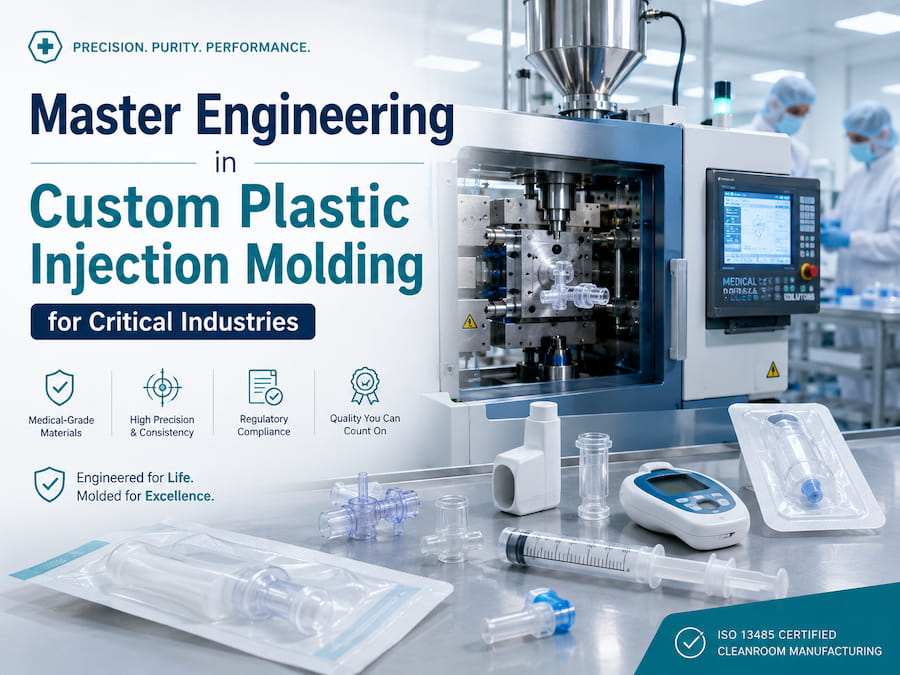
In high-stakes manufacturing, custom plastic injection molding serves as the critical infrastructure for the medical, aerospace, and electronics industries, where component failure is not an option. As global regulatory standards tighten, Original Equipment Manufacturers (OEMs) increasingly shift toward specialized engineering partners to manage the complexities of material science, mold design, and rigorous quality validation. According to industry data, the transition from standard vendor relationships to end-to-end engineering partnerships is now a primary strategy for ensuring structural integrity in high-performance devices.
The regulatory environment for these components underwent a significant shift with the implementation of the U.S. Food and Drug Administration’s (FDA) Quality Management System Regulation (QMSR). Effective February 2, 2026, the FDA amended current good manufacturing practice (CGMP) requirements to align with the international ISO 13485 standard for medical device quality management systems, as detailed in the Federal Register (Volume 89, Issue 20). This harmonization mandates that manufacturers of finished devices and their accessories maintain strictly documented, traceable, and repeatable production processes to meet global safety expectations.
Advanced Molding Techniques for Hybrid Components
Modern device requirements often exceed the capabilities of single-material manufacturing, necessitating advanced processes like insert molding and overmolding. Insert molding involves placing a pre-formed component—such as a steel surgical blade or a brass fastener—directly into the mold cavity before injecting the molten polymer. This creates a reinforced, singular part that eliminates the need for secondary assembly, which can be a point of mechanical weakness. In the medical and electronics sectors, this technique is essential for ensuring that connectors and instruments maintain stability under extreme mechanical stress.

Overmolding, by contrast, applies a second layer of material—typically a thermoplastic elastomer (TPE)—over a rigid substrate. This process is frequently used to provide ergonomic, soft-touch grips for surgical tools or to create water-resistant, shock-absorbing bumpers for sensitive electronic hardware. Beyond improving tactile usability, overmolded seals are vital in clinical settings, as they prevent the ingress of sterilization chemicals and biological contaminants, thereby extending the operational lifespan of the device.
The Engineering Phase: Scientific Material Selection and Validation
The success of a production run is largely determined before the first cycle of an injection press. Engineers must conduct a scientific analysis of material properties to ensure compatibility with the end-use environment. For instance, a polymer that remains stable in a consumer electronics housing may fail catastrophically when exposed to the high-pressure steam of a hospital autoclave. Experts evaluate resins based on specific requirements such as biocompatibility, flame retardancy, UV resistance, and structural stiffness.
To mitigate financial risk and design flaws, elite manufacturers prioritize prototype development and computational flow analysis. By using rapid prototyping methods like 3D printing or aluminum tooling, engineers can test the physical integrity and ergonomic feel of a component. Simultaneously, flow analysis software allows the team to simulate the behavior of molten plastic within the mold, optimizing gate placement and cooling channels. This pre-production validation is critical for avoiding the high costs associated with modifying hardened steel molds after production has begun.
Forensic Analysis and Post-Production Integrity
When components fail in the field, forensic failure analysis is required to identify the root cause of the defect. Seasoned engineering partners conduct detailed post-mortem investigations to distinguish between various manufacturing anomalies. Common issues identified during these investigations include:
- Weld Lines: These occur when two separate flows of cooling plastic fail to bond at the molecular level, creating a structural weak point.
- Thermal Degradation: This happens when resin is overheated in the barrel, causing the polymer chains to break and resulting in a brittle part.
- Environmental Stress Cracking: This is identified when chemical exposure in the user’s environment slowly dissolves the polymer matrix, leading to hairline fractures.
By pinpointing these issues, manufacturers can adjust processing parameters or switch to more resilient materials, preventing future failures. Many high-value production cycles also include secondary operations, such as ultrasonic welding or precision laser engraving, which are performed under the same quality-controlled roof to ensure that traceability is maintained from the raw pellet to the final packaged device.
Future Regulatory and Supply Chain Outlook
As the industry moves toward 2027, the focus remains on maintaining compliance with the harmonized ISO 13485 standards. OEMs are advised to review their supply chain partnerships to ensure that all vendors—particularly those involved in molding and sub-assembly—are fully capable of providing the documentation required for global audits. The integration of quality systems and engineering expertise is expected to remain a prerequisite for businesses looking to accelerate time-to-market for medical and aerospace innovations.

Industry leaders and quality managers are encouraged to consult the latest guidance from the FDA’s Quality Management System Regulation page to ensure their manufacturing partners remain in alignment with current requirements. For those navigating specific supply chain disruptions or engineering challenges, further technical updates and industry reports are available through professional engineering associations. Readers are invited to comment or share this article with colleagues in the manufacturing and medical technology sectors.