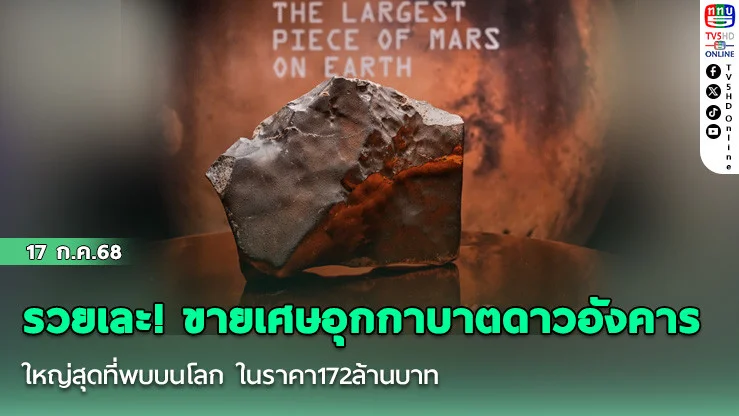
Reports from Thai media outlets indicate a Martian meteorite has sold for 172 million baht (approximately $4.8 million), a figure that would represent one of the most expensive sales of a single Martian specimen. While this specific transaction has not been confirmed by international auction houses such as Christie’s or Sotheby’s, the reported price underscores the extreme rarity and high market demand for materials originating from Mars.
Martian meteorites are rare fragments of the Red Planet that reach Earth after massive asteroid impacts eject them from the Martian crust. These specimens provide the only physical samples of Mars available for study on Earth, making them highly prized by both scientific institutions and private collectors. According to the Meteoritical Society, the global body that classifies meteorites, Martian samples are identified through specific chemical signatures and oxygen isotope ratios that distinguish them from lunar or asteroidal rocks.
The valuation of these objects typically depends on the specimen’s mass, its classification, and whether the fall was witnessed. While the 172 million baht figure is significantly higher than most recorded public sales for single fragments, high-grade Martian meteorites can command prices in the thousands of dollars per gram in the private market. The scarcity of “witnessed falls”—meteorites seen hitting the ground—further drives prices, as these pieces are less likely to be contaminated by Earth’s environment.
How Martian Meteorites Are Identified and Verified
A rock cannot be classified as Martian based on visual appearance alone. Scientists use a rigorous process of chemical analysis to confirm a specimen’s origin. The primary method involves measuring the isotopic composition of oxygen and the concentration of noble gases trapped within the rock’s glass inclusions.
According to NASA, these trapped gases match the Martian atmosphere as measured by the Viking landers in the 1970s. This “atmospheric fingerprint” provides definitive proof that the rock originated on Mars. If a specimen lacks this specific gas signature or the correct isotopic ratio, it is generally classified as a common achondrite or a lunar meteorite.
The verification process typically follows these steps:
- Petrographic Analysis: Examining the mineral structure under a microscope to identify Martian-specific minerals.
- Isotopic Testing: Using mass spectrometry to analyze oxygen isotopes.
- Gas Analysis: Extracting gases from shock-melted glass to compare them with the Martian atmosphere.
- Official Registration: Submitting the data to the Meteoritical Society for formal naming and classification.
The SNC Classification: Understanding Martian Rock Types
Almost all Martian meteorites fall into the “SNC” group, an acronym representing the three main types of Martian igneous rocks: Shergottites, Nakhlites, and Chassignites.
Shergottites are the most common type of Martian meteorite. They are volcanic rocks, similar to basalts found on Earth, and often contain crystals of pyroxene and plagioclase. Many Shergottites are “shocked,” meaning they show evidence of the violent impact that blasted them off the Martian surface.
Nakhlites are primarily composed of augite and plagioclase. These rocks are significant because they often show evidence of alteration by liquid water, suggesting that the area of Mars where they formed once had aqueous activity.
Chassignites are the rarest of the three. They are dunites, consisting almost entirely of olivine. Because of their rarity, Chassignites are often the most sought-after specimens for collectors and researchers.
The Journey from Mars to Earth
The process of a Martian rock reaching Earth is a multi-million-year journey. It begins with a “spallation event,” where a large asteroid or comet strikes the Martian surface with enough force to launch debris into space at speeds exceeding Mars’ escape velocity (approximately 5.03 km/s).

Once in space, the fragment orbits the sun as a small asteroid for thousands or even millions of years. If the fragment’s orbit eventually intersects with Earth’s orbit, it is captured by Earth’s gravity and enters the atmosphere as a meteor. The intense heat of atmospheric entry melts the outer layer of the rock, creating a dark, glassy “fusion crust” that protects the interior.
Most Martian meteorites are found in Antarctica or the Sahara Desert. These environments are ideal for recovery because the dark rocks contrast sharply with the light-colored ice or sand, and the arid conditions help preserve the specimens from weathering.
Market Value vs. Scientific Value
There is often a disconnect between the market price of a meteorite and its scientific utility. While a collector may pay millions for a large, aesthetically pleasing specimen, scientists prioritize “fresh” samples with minimal terrestrial contamination.
The reported 172 million baht sale reflects the “trophy asset” nature of rare space rocks. For high-net-worth individuals, a piece of another planet is a unique status symbol. However, for the scientific community, the most valuable samples are those that contain organic compounds or evidence of ancient microbial life.
The market for these items is largely unregulated, leading to significant price volatility. Legitimate sales usually involve a “Certificate of Authenticity” from a recognized laboratory or a listing in the Meteoritical Society’s database. Without such documentation, the value of a claimed Martian meteorite is negligible.
Comparing Martian Meteorites to Other Space Rocks
Martian meteorites are generally more valuable than lunar meteorites or common chondrites (stony meteorites from asteroids). This is due to the extreme difficulty of ejecting material from a planet with a significant gravitational pull compared to the Moon or a small asteroid.
| Meteorite Type | Origin | Rarity | Primary Value Driver |
|---|---|---|---|
| Common Chondrite | Asteroid Belt | Low | Mass/Size |
| Lunar Meteorite | The Moon | Medium | Provenance/Origin |
| Martian (SNC) | Mars | High | Isotopic Verification |
| Iron Meteorite | Planetary Cores | Medium | Aesthetics/Density |
Identifying Meteorite Scams
Because of the high prices associated with Martian fragments, the market is rife with counterfeits. Many “Mars rocks” sold online are actually “slag”—industrial waste from smelting—or terrestrial volcanic rocks like basalt.

Experts warn buyers to be skeptical of any seller who cannot provide a verified chemical analysis from an independent laboratory. Common red flags include prices that seem too low for the claimed rarity and the absence of a fusion crust on a specimen that is not a slice (slab).
To verify a potential purchase, collectors are encouraged to use the Meteorite Guide or consult with academic departments specializing in planetary geology. A legitimate Martian meteorite will always have a specific classification (e.g., NWA 7034) that can be traced back to a recognized find or fall.
The next major milestone in the study of Martian materials will be the official return of samples collected by the Perseverance rover. NASA’s Mars Sample Return (MSR) mission aims to bring these pristine, strategically selected samples back to Earth, which will likely provide more scientific data than all existing Martian meteorites combined.
Do you think the value of space materials will increase as private space travel becomes more common? Share your thoughts in the comments below.