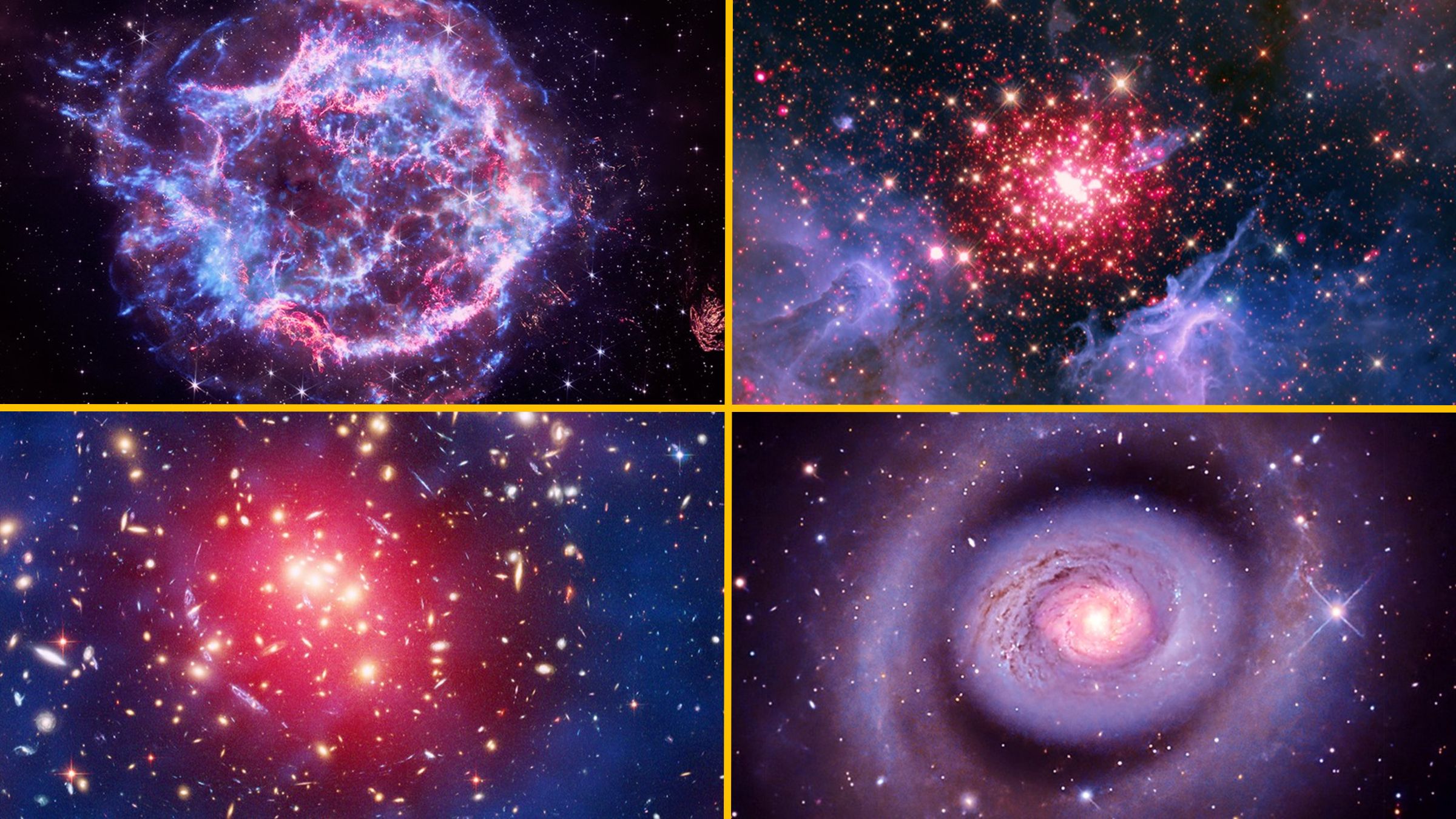
In celebration of the United States’ 250th anniversary, NASA has released a curated collection of cosmic imagery from the Chandra X-ray Observatory, featuring four deep-space objects rendered in a patriotic red, white, and blue color palette. The images, which were shared on June 30, 2026, synthesize data from NASA’s observatories to showcase some of the most dramatic structures in the universe, ranging from supernova remnants to massive galaxy clusters. According to the Chandra X-ray Observatory, this project integrates multi-wavelength data to provide a unique perspective on high-energy phenomena.
The collection serves as a technical demonstration of how modern astronomy maps invisible energy across the electromagnetic spectrum. By combining X-ray data from Chandra—which has been in operation since 1999—with infrared and optical observations from the Hubble and James Webb Space Telescopes (JWST), as well as ground-based instruments, astronomers have created composite views that highlight specific physical elements and cosmic structures. This initiative also incorporates sonification, a process that converts astronomical data into audible sound, allowing for a multisensory engagement with the deep-space objects.
Supernova Remnants and Stellar Nurseries
The image most reminiscent of Fourth of July fireworks is that of Cassiopeia A, a supernova remnant located approximately 11,000 light-years away. NASA reports that the object resulted from a massive star explosion that occurred roughly 340 years ago. In this composite image, Chandra’s X-ray data, represented in blue and purple, tracks the blast wave and identifies elements such as iron, calcium, and oxygen. Infrared data from the James Webb Space Telescope is overlaid in red and white to map the distribution of debris and cosmic dust.

Another highlight is NGC 3603, a giant nebula situated 20,000 light-years away in the Carina spiral arm of the Milky Way. It is the largest nebula seen in visible light in our galaxy. The image combines X-ray observations from Chandra with optical, infrared and ultraviolet data from the Hubble Space Telescope. This layering reveals a glittering array of stars, as well as dust and gas.
Galaxy Clusters and Dark Matter
Beyond our local neighborhood, the collection features NGC 4736, also known as M94, a spiral galaxy located 19 million light-years from Earth in the constellation Canes Venatici. This galaxy is noted for its “starburst ring,” an outer region where new stars are forming. The provided image layers Chandra’s X-ray data over visible-light imagery captured by ground-based astrophotographers.
The final entry in the set is the distant galaxy cluster ZwCl 0024+1652, located approximately 5 billion light-years away in the constellation Pisces. Hubble data has helped astronomers infer the presence of dark matter. Chandra’s X-ray data, shown in red, reveals a vast reservoir of superheated gas within the cluster. According to NASA, this gas contains more mass than the cluster’s galaxies combined.
The Science of Space Sonification
To increase accessibility, the project includes novel sonifications for three of the four objects: NGC 3603, NGC 4736, and ZwCl 0024+1652. Sonification transforms astronomical data into sound. The project allows audiences to experience space through both sight and hearing.

These sonifications are part of a broader effort to bridge the gap between complex astrophysical data and public interest. By translating the data from the Chandra X-ray Observatory into audio, the agency aims to demonstrate that space exploration is a multidisciplinary field that relies on both visual and analytical interpretation.
For those interested in viewing the full-resolution images or listening to the sonified data, official updates are regularly posted through the NASA Chandra mission portal. Readers are encouraged to share their thoughts on the intersection of science and public celebration in the comments section below.