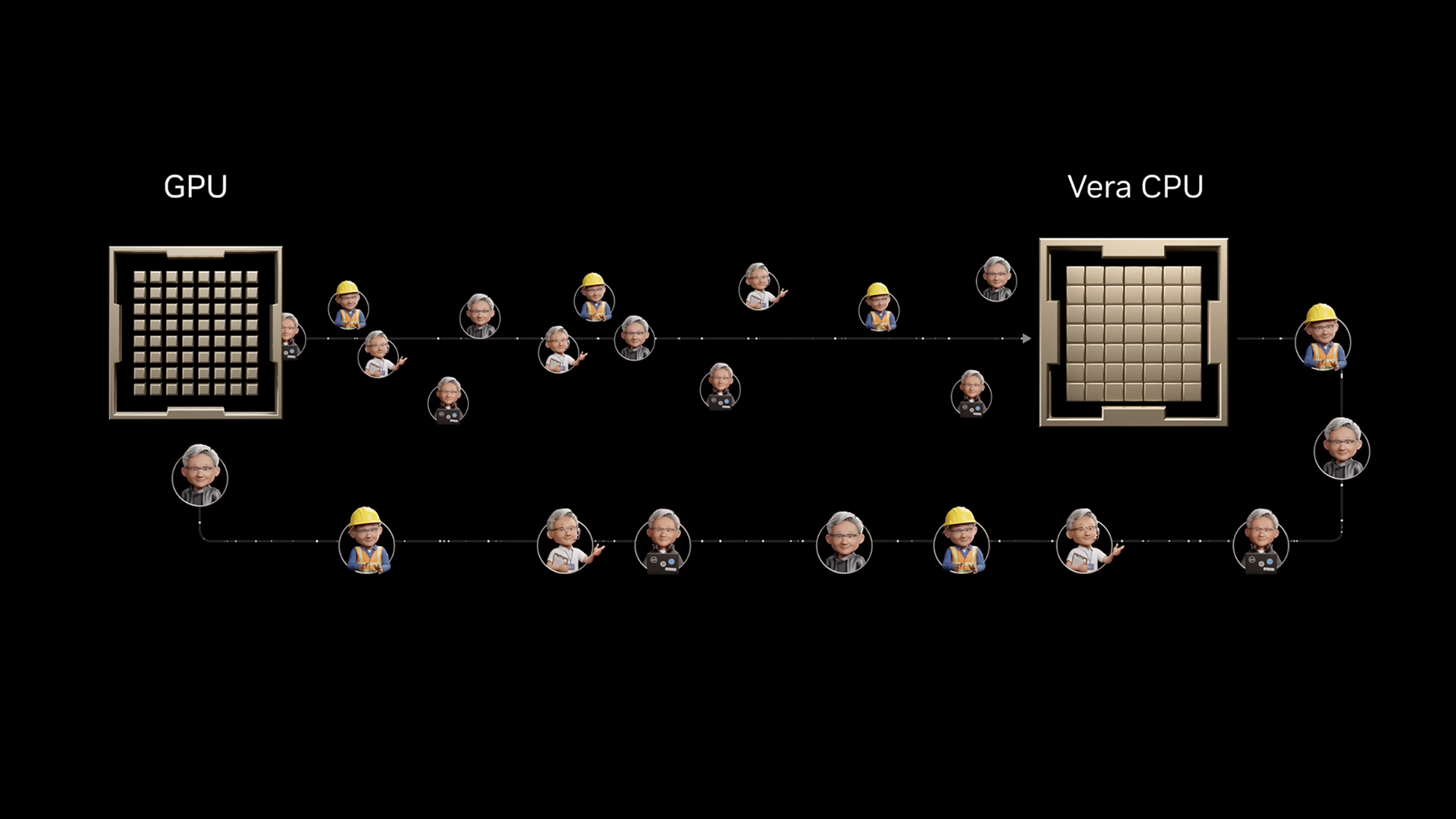
NVIDIA has introduced the Vera CPU, a new class of processor designed to maximize single-threaded performance at scale to accelerate “agentic” AI loops. Unlike traditional data center CPUs that prioritize high core counts for cloud throughput, Vera focuses on per-core speed to reduce the time AI agents spend executing tool calls, processing data, and running code between model inferences.
The architecture addresses a critical bottleneck in AI factories: GPU underutilization. Because AI agents operate in sequential loops—where a model reasons, the CPU executes a task, and the result informs the next reasoning step—slow CPU performance can leave expensive GPUs idling. NVIDIA Vera aims to eliminate this lag by providing high instructions per cycle and massive memory bandwidth to ensure every core runs at full speed even under heavy system loads.
According to NVIDIA, the Vera CPU features the custom Olympus core, which delivers 50% higher instructions per cycle than the previous NVIDIA Grace architecture. This performance boost is paired with a monolithic compute die and up to 1.2TB/s of LPDDR5X memory bandwidth, operating at less than 40 watts of memory power. These specifications allow the chip’s 88 cores to access full memory performance without the “chiplet tax” or bottlenecks common in current x86 data center designs.
Why Single-Threaded Performance Defines Agentic AI Speed
AI agents differ from standard LLM requests because they do not stop after one response. They function in a persistent loop: the model reasons about a step, the CPU executes the associated work (such as a Python script or a database query), and the result is fed back into the model. Because each step depends on the completion of the previous one, adding more cores cannot make a single agent loop run faster; only increasing the speed of the individual thread can shorten the cycle.
Traditional data center CPUs have evolved to optimize cost per rentable core, often increasing core counts while reducing the silicon area dedicated to high-performance memory fabrics and fast instruction processing. This shift has created a gap where data center CPUs lack the single-threaded “burst” speed found in consumer PCs and workstations. NVIDIA Vera is designed to bring that high-performance single-threaded capability to the data center scale, ensuring predictable latency and strong per-core performance even when the system is fully loaded.
In workloads simulating agentic execution, NVIDIA reports that Vera delivers 1.8x the sustained per-core performance of competing x86 architectures. This gain compounds across every tool call and verification pass, directly increasing the revenue potential of AI factories by maximizing the time GPUs spend generating work rather than waiting for the CPU to finish a task.
Real-World Benchmarks: Perplexity, Starburst, and Redpanda
Early testing by AI company Perplexity indicates a significant performance jump in coding workflows. When cloning a repository and running test suites in sandboxes, Perplexity found that Vera completed the job approximately 1.5x faster than x86 processors and initiated concurrent sandboxes up to 1.9x faster. Perplexity has stated it is now looking to deploy Vera in its upcoming production systems.

The performance gains extend to data-heavy agent tasks. Partners using the chip have measured 3x faster large-scale SQL analytics through Starburst and up to 6x lower latency on real-time streaming via Redpanda when compared to leading x86 server CPUs. These results suggest that Vera’s monolithic design and 3.4TB/s core-to-core bandwidth—which NVIDIA claims is 3x greater than any other data center CPU—effectively prevent the data starvation that typically slows down complex agentic workflows.
Integration Across the AI Factory Ecosystem
NVIDIA has positioned Vera as a universal processor for the AI factory. Rather than requiring different CPUs for different tasks, a single Vera chip can handle tool execution, data processing, request serving, and reinforcement learning. This architectural consistency extends to the broader hardware stack: Vera is the same CPU that hosts GPUs in the NVIDIA Vera Rubin system and powers the NVIDIA BlueField-4 STX storage processor.
By using a single architecture and toolchain, operators can reduce the complexity of their software stack and improve the efficiency of data movement between storage, the CPU, and the GPU. This integration is designed to support the projected scale of billions of autonomous agents, where the primary product is the volume of completed agent work.
The Roadmap: Moving from Olympus to Rigel
NVIDIA has already outlined the next step in its CPU evolution with the upcoming Rosa CPU. This next-generation processor will feature the Rigel core, an Arm v9.2 design intended to surpass the Olympus core’s per-core performance while maintaining the same silicon footprint. According to NVIDIA, the Rigel core will introduce improvements in instruction delivery, a larger L2 cache, and more efficient memory handling to further accelerate the agentic loop.
The transition from Grace to Vera and eventually to Rosa represents a strategic pivot toward “speed at scale.” While the industry has spent the last decade chasing core density, the agentic era shifts the priority back to the raw speed of the individual execution thread.
Further technical specifications and deployment timelines for the Rosa CPU and Rigel cores are expected to be released as NVIDIA continues its hardware roadmap for the agentic AI era. Readers can monitor official NVIDIA developer updates for the first production availability of these systems.
Do you think the shift toward single-threaded performance will force x86 manufacturers to redesign their data center roadmaps? Share your thoughts in the comments below.