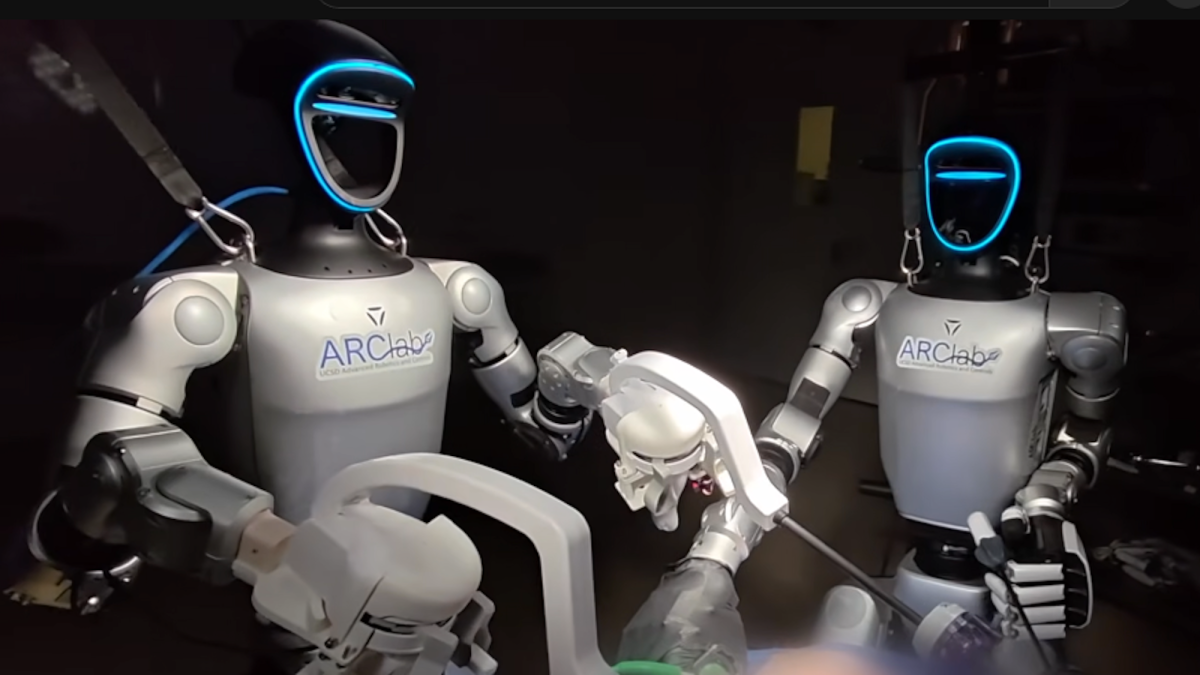
In a milestone for medical robotics, researchers at the University of California San Diego (UC San Diego) have successfully performed the first gallbladder removal surgeries using remotely operated humanoid robots. The preclinical trial, detailed in a study published in the journal Nature, involved two separate procedures on large, non-primate mammals: one conducted by a single humanoid robot working alongside a human attendant, and a second performed by a pair of cooperating robots.
This development represents a significant shift from the current standard of robotically assisted surgery. While systems like the da Vinci Surgical System have long been fixtures in operating rooms, they are typically massive, multi-armed devices that can weigh upwards of 1,800 pounds. These existing systems often require specialized, retrofitted operating rooms and are designed for specific, narrow procedures. In contrast, the UC San Diego team utilized humanoid robots—nicknamed “Surgie”—which stand approximately five feet tall and weigh roughly 60 pounds, offering a much more compact and potentially versatile alternative.
Addressing the Global Healthcare Access Gap
The primary motivation behind the development of the Surgie platform is to expand access to high-quality surgical care. By creating a system that is both affordable and portable, researchers aim to deploy these robots to environments where traditional surgical infrastructure is unavailable, such as rural clinics, military field hospitals, or even space-based missions. According to Michael Yip, an engineer at UC San Diego, the technology is designed to address healthcare disparities by providing critical interventions that patients might otherwise be unable to receive.
“Remotely operated and autonomous humanoid robots have real potential for amplifying access to critical surgeries to which patients would otherwise not have access,” Yip stated. “This can help address the healthcare crisis not only in the United States, but also worldwide.”
The researchers emphasize that the humanoid form factor allows the robots to integrate more naturally into existing human-centric workspaces. UC San Diego surgeon Nikita Thareja noted that the team was surprised by how effectively the robots adapted to the clinical environment. “We were surprised at how well Surgie meshed with our workspace and workflow,” Thareja said.
Overcoming Technical Challenges
Transitioning humanoid robotics into the operating room is not without significant engineering hurdles. During the initial trials, the research team encountered latency issues between the remote controllers and the robots, as well as the need for frequent recalibration. These technical bottlenecks resulted in longer procedure times compared to established robotic systems, which have been refined over decades to perform laparoscopic surgeries in as little as 30 minutes.
To bridge this gap, the team had to engineer custom adapters that allowed the humanoid robots to manipulate standard surgical instruments with precision. While the current trial serves as a proof-of-concept, the researchers are optimistic that improvements in latency and software will mirror the rapid evolution seen in previous generations of robotic surgery technology. The first machine-assisted laparoscopic procedures took approximately six hours to complete, a duration that has been reduced by more than 90% in modern practice.
The Future of the Integrated Operating Theater
Looking ahead, the UC San Diego team envisions a future where humanoid robots act as force multipliers for surgical teams rather than just isolated tools. By automating routine tasks such as tool management or post-surgical cleanup, these robots could alleviate the burden on human staff, who are often in short supply in under-resourced medical facilities.
“One of our goals is to develop an autonomous surgical assistant,” Yip explained. “Many communities struggle with adequate staffing on the surgical team, which means patients are not being treated. Our goal is an operating theater of the future, where humanoid robots and humans work side by side as an integrated team.”
The researchers continue to refine the Surgie platform, focusing on enhancing the autonomy of the robots to further streamline surgical workflows. As the technology matures, the team plans to conduct further studies to assess the long-term viability and safety of humanoid-assisted interventions in more complex clinical scenarios. Further updates regarding the progress of these robotic trials will be released through official university communications and subsequent peer-reviewed publications.
Have questions about the future of robotics in medicine or thoughts on how this tech might change patient care? Share your perspective in the comments below.