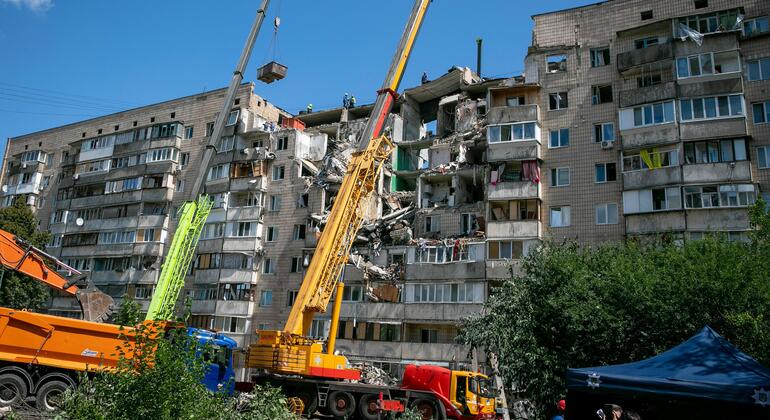
The United Nations Security Council held an emergency session on Thursday to address a sharp increase in civilian casualties resulting from intensified Russian drone and missile strikes across Ukraine. Rosemary DiCarlo, the UN Under-Secretary-General for Political and Peacebuilding Affairs, issued a formal appeal to the council, stating that there is an immediate requirement for all parties to utilize every available diplomatic channel to facilitate an urgent de-escalation of hostilities.
The meeting, convened as international concern mounts over the targeting of civilian infrastructure, focused on the human toll of the ongoing conflict. According to the Office of the UN High Commissioner for Human Rights (OHCHR), the conflict has resulted in tens of thousands of civilian casualties since February 2022, with recent months marked by a consistent pattern of aerial bombardment affecting residential areas and energy facilities. DiCarlo emphasized that the current trajectory of the war poses a severe threat to regional stability and urged council members to prioritize the protection of non-combatants in accordance with international humanitarian law.
Diplomatic Pressure and Security Council Dynamics
The UN Security Council remains deeply divided regarding the situation in Ukraine, reflecting the broader geopolitical tensions between permanent members. While Western nations and their allies have consistently called for the cessation of attacks on civilian centers, the Russian Federation maintains that its military operations are directed solely at legitimate military targets and energy infrastructure that supports the Ukrainian defense effort. These conflicting narratives have frequently resulted in gridlock within the council, limiting the body’s ability to pass binding resolutions aimed at ending the violence.
During the session, representatives from various member states reiterated their positions. The United States and its allies highlighted the documented impact of long-range strikes on Ukrainian urban centers, while Russian officials argued that Western military support for Kyiv is the primary driver of the escalation. Despite these persistent disagreements, the UN leadership continues to use the council as a platform to maintain pressure on both sides to adhere to the fundamental principles of the UN Charter.
The Humanitarian Impact on Ukrainian Civilians
The humanitarian situation in Ukraine continues to deteriorate as winter approaches, a season that historically places additional strain on energy infrastructure. DiCarlo noted that the repeated targeting of power grids has left millions of Ukrainians with limited access to heat, electricity, and clean water. The World Health Organization (WHO) has tracked over 1,800 attacks on healthcare facilities since the start of the full-scale invasion, further complicating the ability of local authorities to provide emergency care to those wounded in strikes.
The economic and social impact is profound. Displacement remains a critical issue, with millions of Ukrainians living as internally displaced persons (IDPs) or refugees in neighboring countries. The UN High Commissioner for Refugees (UNHCR) reports that while some citizens have returned to areas of relative calm, the unpredictability of long-range missile attacks prevents any significant stabilization of civilian life in the eastern and southern regions of the country.
The Path Forward for Peace Efforts
While the prospects for a comprehensive ceasefire remain distant, the UN continues to facilitate back-channel negotiations on specific humanitarian issues, such as prisoner exchanges and the safety of nuclear facilities. The International Atomic Energy Agency (IAEA) remains actively involved in monitoring the Zaporizhzhia Nuclear Power Plant, which has faced repeated power outages due to nearby shelling. These specialized efforts are viewed by diplomats as essential confidence-building measures that could, in theory, lead to broader political discussions.
The international community is also preparing for upcoming multilateral summits, where Ukraine’s security guarantees and the reconstruction of its economy will likely feature as primary agenda items. However, for the immediate future, the focus of the Security Council remains on the prevention of further civilian loss and the enforcement of international norms. The council is expected to reconvene for further briefings on the conflict as new developments emerge from the front lines.
Readers interested in the latest official briefings from the United Nations can monitor the UN Press Office for updates on upcoming Security Council meetings and transcripts of member statements. We invite you to share your perspectives on these developments in the comments section below.