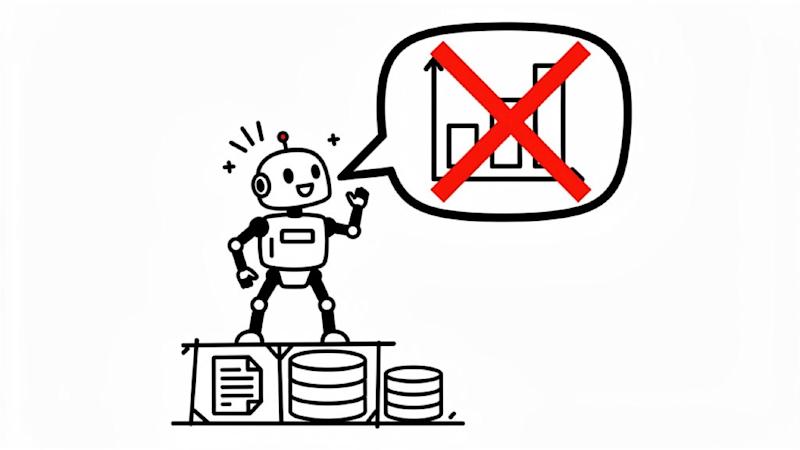
Enterprises are increasingly finding that their AI agents—while capable of generating sophisticated responses—often provide answers that are confidently incorrect due to flawed or inconsistent underlying business data. According to a June 2026 survey of 101 qualified enterprises with more than 100 employees, 57% of organizations traced such errors back to missing or inconsistent business context, with 31% reporting that they have encountered this issue on multiple occasions. The root cause frequently lies in the reliance on document-based retrieval systems, which fail when the context provided to the model is stale or lacks structural integrity.
The reliance on retrieval systems for business context is widespread, with 38% of surveyed enterprises identifying document-based retrieval as their primary method for grounding AI agents. However, these systems are often chosen for their ease of ingestion and operational simplicity, with accuracy frequently taking a secondary priority. This misalignment between selection criteria and performance requirements often remains hidden until the AI systems are deployed in production, at which point the discrepancy between the agent’s certainty and the factual accuracy of its output becomes a significant operational risk.
The Role of a Governed Context Layer
Industry consensus is shifting toward the implementation of a governed context layer, a centralized model of business definitions that agents can reference consistently rather than deriving context from raw, disconnected data. Currently, 75% of enterprises do not yet have such a layer in place. Research indicates that the adoption of this architecture is split, with 25% of respondents running a context layer in production, 34% actively building one, and 41% having yet to initiate development.

The urgency to adopt this solution is largely driven by experience with failure. Among companies that have already implemented or are building a governed context layer, 78% report having experienced a confident-wrong failure. In contrast, only 20% of companies without plans to build a layer report similar issues. This suggests that organizations that have been impacted by AI errors are significantly more likely to recognize the necessity of a structured, governed approach to data context.
Divergent Architectures Across Platforms
Major data and AI platform vendors are currently developing distinct versions of the context layer, though there is no consensus on a single architectural standard. Each vendor is approaching the problem through the lens of their existing infrastructure:

- DataHub: Utilizes catalog metadata and historical query behavior as a living knowledge source.
- Microsoft Fabric IQ: Focuses on a business ontology queryable by agents via the Model Context Protocol (MCP).
- Couchbase: Prioritizes agent memory and context retrieval at the edge, integrating these functions directly into the operational database.
- Pinecone Nexus: Compiles structural logic into the metadata layer prior to runtime, emphasizing pre-built structure over search speed.
- Snowflake: Operates a two-layer system, combining Horizon Context for customer-managed definitions with Cortex Sense for platform-inferred context.
- Oracle Unified Memory Core: Integrates vector, graph, and relational data into a single transactional engine to eliminate synchronization delays.
- Google Knowledge Catalog: Automates the curation of semantic context by mining query logs and usage patterns.
- AWS Context Service: Employs a knowledge graph that evolves based on how agents interact with it.
Analysts note that this market fragmentation presents challenges for practitioners who must manage multiple, often incompatible tools. As noted by Steven Dickens, CEO and principal analyst at HyperFRAME Research, data teams are facing “fragmentation fatigue” as they attempt to reconcile separate vector, graph, and relational stores to support agentic workflows. Similarly, Constellation Research VP and principal analyst Michael Ni has emphasized that “whoever controls runtime context controls the AI decision layer for enterprise data,” while cautioning that vector memory is not a substitute for business meaning or governance.
Strategic Shifts in Enterprise Budgeting
Despite the lack of a standardized market winner, the transition toward governed context layers is a priority for the coming year. According to the research, 57% of enterprises intend to switch or add a retrieval or context platform within the next 12 months. This intent is heavily skewed toward organizations that have already experienced repeat failures; 81% of such enterprises plan to upgrade their tooling, compared to 32% of those that have not encountered these issues.

For enterprises, the path forward involves integrating diverse systems rather than relying on a single vendor solution, at least for the near term. The focus is shifting away from simple retrieval-augmented generation (RAG) toward architectures that emphasize governed, low-latency, and current context. As noted by Stephanie Walter, practice leader for AI Stack at HyperFRAME Research, the market is converging on the understanding that agents require more than just increased token capacity or better models; they require the structural integrity provided by governed data.
These findings and the future of agentic AI will be a central topic of discussion at VB Transform 2026, scheduled for July 14 and 15, 2026, in Menlo Park. The event will address the ongoing race to close the enterprise context gap and evaluate which of the emerging architectures—including governed semantic layers and provider-native bundles—can reliably sustain production-grade AI agents.