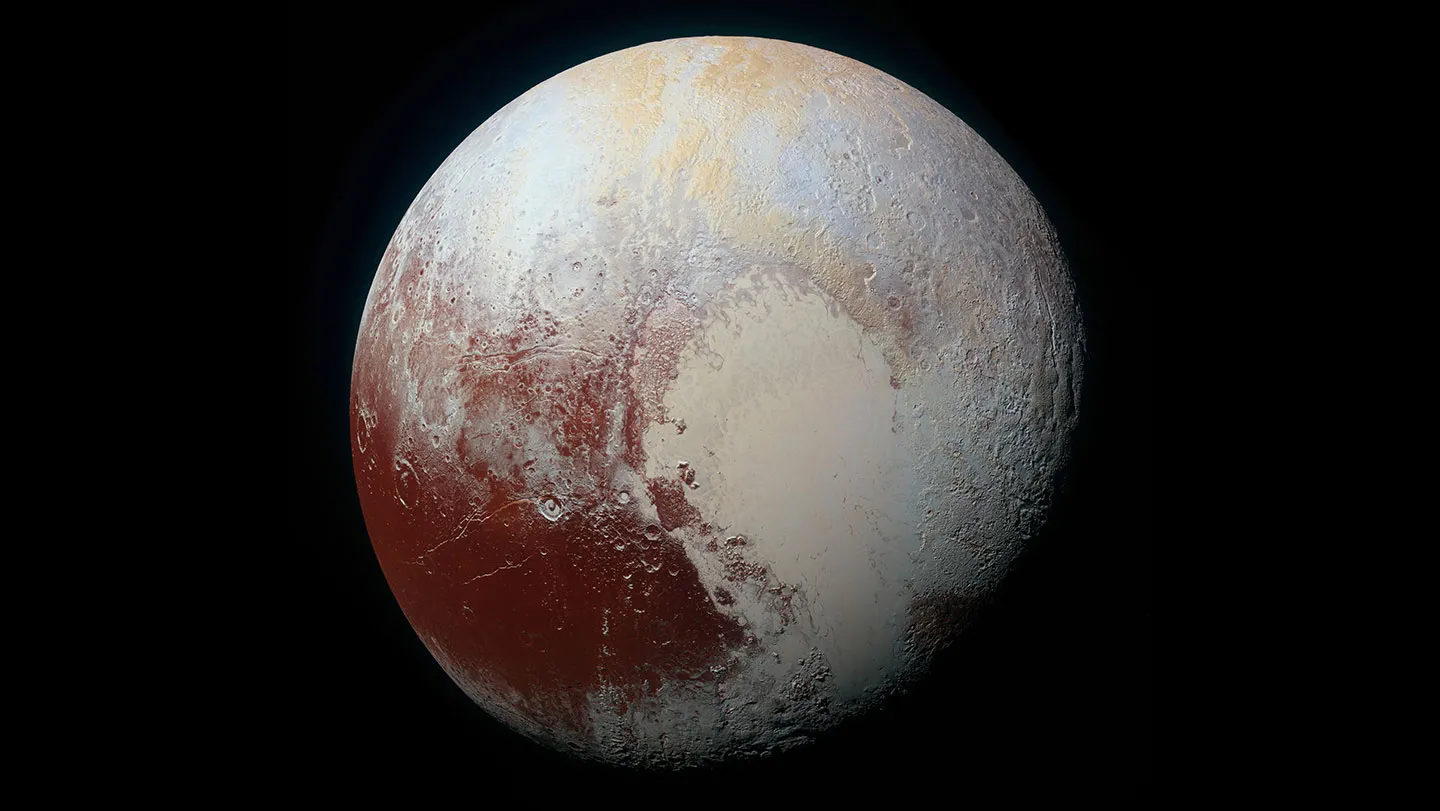
Data transmitted by NASA’s New Horizons spacecraft has confirmed the presence of six distinct landslides on Pluto, marking the first time such geological activity has been identified on the dwarf planet. Observations of the terrain along the rims of large craters indicate that material has collapsed and moved downslope, a discovery that challenges previous assumptions about the surface stability of this distant Kuiper Belt object. According to the National Aeronautics and Space Administration (NASA), these features demonstrate that Pluto’s surface is geologically complex and potentially more active than once theorized.
Geological Evidence of Surface Instability
The landslides were identified through high-resolution imagery captured during the New Horizons flyby in July 2015. Scientists analyzed the images to track the movement of debris along steep crater walls, observing features that bear a striking resemblance to mass-wasting events found on Earth and Mars. As reported by the Lunar and Planetary Institute, these landslides occur primarily along the rims of craters, where steep slopes provide the necessary gradient for loose material to slide toward the basin floors.
The mechanism behind these movements appears to be related to the unique composition of Pluto’s surface. Unlike the rocky crusts of inner planets, Pluto’s topography is dominated by nitrogen, methane, and carbon monoxide ices. Researchers suggest that sublimation—the process where ice turns directly into gas—may be weakening the structural integrity of these crater walls over time. When the material becomes unstable, gravity triggers the collapse, resulting in the observed debris piles at the base of the rims.
Comparing Pluto to Terrestrial and Martian Landforms
The identification of these landslides provides a new point of comparison for planetary geologists. While landslides are a common feature of terrestrial landscapes, often triggered by seismic activity or heavy rainfall, the conditions on Pluto are fundamentally different. The gravity on Pluto is roughly 6% of that on Earth, which requires a specific set of environmental triggers to initiate a slide. According to research published in Science, the presence of these landslides suggests that Pluto’s surface materials are subject to significant mechanical failure, likely driven by the extreme cold and the volatile nature of the surface ices.
This discovery adds to a growing body of evidence indicating that Pluto is not a frozen, static world. Earlier data from the New Horizons mission revealed vast, smooth plains of nitrogen ice that appear to be geologically young, suggesting ongoing resurfacing processes. The landslides represent a secondary, yet vital, indicator of the dynamic forces still at work on the surface of the dwarf planet, even billions of miles from the Sun.
What the Discovery Means for Kuiper Belt Research
The confirmation of these six landslides offers researchers a window into the evolution of small bodies in the outer solar system. By studying the size, distribution, and volume of the debris, scientists can better understand the internal processes of Pluto and other similar objects in the Kuiper Belt. This information is critical for future missions aiming to understand how volatile ices behave in low-gravity, low-temperature environments.

The New Horizons mission, which concluded its primary data transmission phase in 2016, continues to yield insights as researchers refine their models of Pluto’s surface. The NASA New Horizons project remains an ongoing endeavor for planetary scientists who are still cataloging the thousands of images and spectral data points collected during the encounter. As analysis continues, the geological history of Pluto becomes clearer, moving away from the perception of a dead world toward a model of a complex, evolving body.
Looking Toward Future Exploration
While no current mission is scheduled to return to Pluto, the data already gathered provides a baseline for future outer solar system exploration. The next steps for the scientific community involve integrating these landslide observations into broader climate and geological models of the dwarf planet. These models are expected to be refined as researchers compare Pluto’s surface features with data from other icy moons and dwarf planets in the outer solar system.
Readers interested in the latest findings from the New Horizons mission can track updates through the official NASA mission portal, which archives ongoing research and peer-reviewed studies related to the flyby. We invite you to share your thoughts on the geological evolution of our solar system in the comments section below.
Keep reading