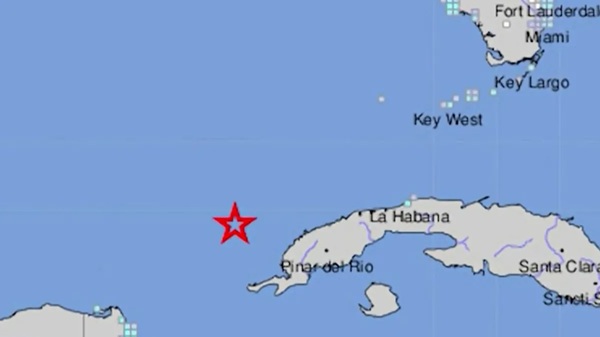
A magnitude 6.8 earthquake struck off the southern coast of Cuba on Sunday, November 10, 2024, prompting tremors that were felt across parts of the island and reaching as far as Florida. According to the United States Geological Survey (USGS), the quake occurred at approximately 11:49 a.m. local time, centered about 25 miles (40 kilometers) south of Bartolomé Masó in the Granma province.
While reports initially circulated regarding a 6.1 magnitude event, the USGS confirmed the final magnitude at 6.8, recording the depth at 14 kilometers. The seismic activity triggered reports of shaking in parts of Florida, particularly in high-rise buildings in the Miami area, though the National Weather Service in Miami confirmed via social media that there was no tsunami threat to the Florida coast following the event.
Seismic Activity and Regional Impact
The earthquake occurred in a region known for complex tectonic interactions near the Oriente Fault zone, which runs along the southern coast of Cuba. Residents in major cities, including Santiago de Cuba and Bayamo, reported significant shaking, with some individuals describing falling objects and structural vibrations. The Reuters news agency reported that the tremor was felt across much of eastern Cuba, an area already struggling with power grid instability and the aftermath of previous weather-related damage.

In the United States, the National Weather Service (NWS) Miami office addressed inquiries from residents who felt the ground move. In a post on X (formerly Twitter), the agency stated that they had received reports of shaking from various locations in South Florida but clarified that no tsunami warnings were issued for the U.S. coastline. The distance between the epicenter and the Florida peninsula—roughly 300 to 400 miles—meant that the energy felt in the U.S. was significantly dissipated, primarily affecting occupants of taller structures.
Infrastructure and Emergency Response
The earthquake struck during a period of heightened vulnerability for Cuba’s infrastructure. The country has been navigating chronic energy shortages and recent recovery efforts following Hurricane Rafael, which made landfall just days prior. Cuban authorities, including the Civil Defense, began assessing damage in the hours following the event. According to reports from the Associated Press, officials in Granma and Santiago de Cuba were tasked with checking residential buildings and critical infrastructure for cracks or structural failures.
There were no immediate reports of mass casualties or catastrophic building collapses, though the assessment of rural areas remained ongoing. The combination of the earthquake with existing power outages complicated communication efforts in the immediate aftermath, as local grids were already operating under severe strain. The Cuban government typically utilizes its Civil Defense network to coordinate disaster response, focusing on the safety of residents in older masonry buildings which are often the most susceptible to seismic damage.
Understanding the Tectonic Context
The Caribbean Plate’s boundary with the North American Plate is characterized by a series of fault systems that frequently produce seismic activity. The Oriente Fault is a major transform boundary that has historically been the source of significant earthquakes in the Caribbean region. Seismologists note that while Cuba is prone to tremors, a magnitude 6.8 event is considered a substantial seismic occurrence for the island.
For residents in affected areas, emergency management agencies often recommend that individuals stay clear of damaged structures and remain alert for aftershocks, which are common following an earthquake of this intensity. Updates from international monitoring agencies, such as the USGS, continue to provide real-time data on aftershock sequences. The next official updates regarding structural damage and recovery efforts will likely be issued by Cuban provincial authorities as inspections of school buildings, hospitals, and residential complexes continue through the week.
Readers are encouraged to monitor official announcements from the USGS Earthquake Hazards Program for the most accurate, up-to-date seismic data. We welcome your observations and reports from the affected regions in the comments section below.
Related reading