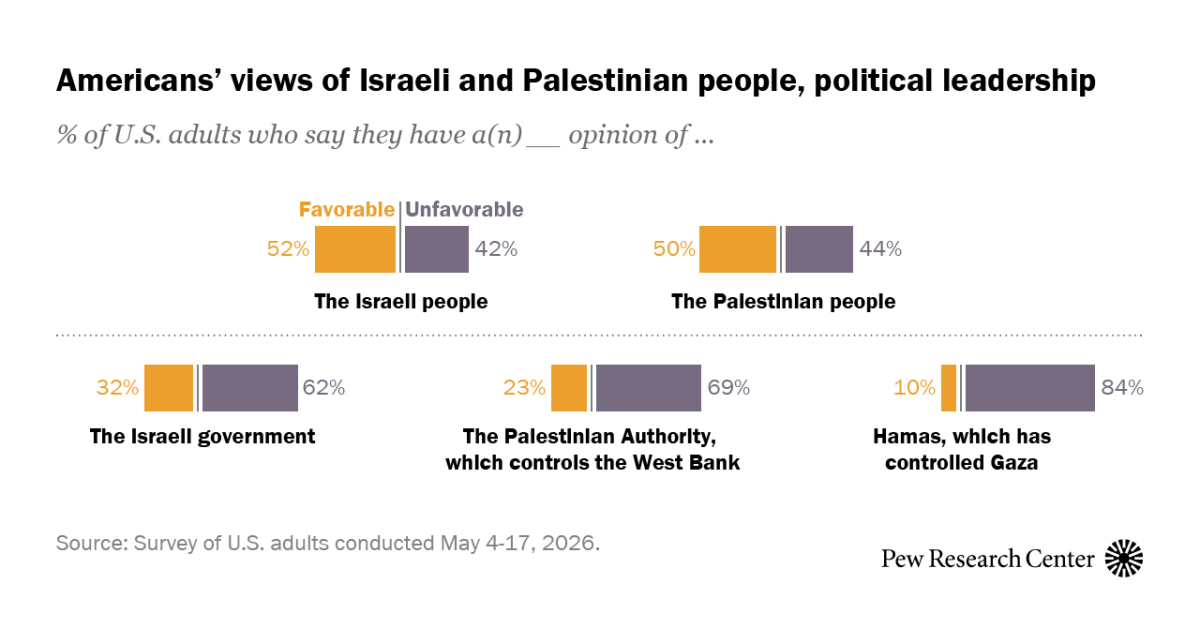
Public opinion in the United States regarding the Israeli government and its people has shifted toward a more negative trajectory across diverse demographic groups and political affiliations. Recent data indicates that while sentiment toward Israel has experienced a measurable decline, perceptions of the Palestinian people have remained largely stable, reflecting a complex and evolving landscape of American foreign policy sentiment.
This shift in public perception comes as the geopolitical situation in the Middle East remains a focal point of international concern. According to findings from the Pew Research Center, the decline in favorable views of Israel is not confined to a single segment of the population but appears to be a broader trend observed across age groups and political parties. This data provides a snapshot of how the American public is processing ongoing regional instability and the resulting humanitarian and political discourse.
Shifting Sentiment Toward Israel Across Political Lines
The decline in favorability toward Israel is particularly notable for its reach across the American political spectrum. Historically, support for Israel has been a hallmark of bipartisan agreement in Washington, yet recent polling suggests a divergence in how voters perceive the nation and its governing body. As reported by Gallup, a majority of Americans now express disapproval of the military actions taken in Gaza, a sentiment that has significantly influenced general favorability ratings.
This trend is not monolithic. While support remains stronger among certain older demographics and conservative-leaning voters, the intensity of that support has softened. Conversely, younger Americans and those who identify as liberal have shown a more pronounced shift toward negative views. The Pew Research Center highlighted that this partisan gap is widening, with younger generations increasingly critical of Israeli policies, creating a generational divide that policymakers are finding harder to ignore.
Stability in Views Toward Palestinians
In contrast to the volatility seen in opinions regarding Israel, sentiment toward the Palestinian people has shown a remarkable degree of consistency. While views on the Israeli government have fluctuated in response to specific military campaigns and diplomatic developments, the broader perception of the Palestinian populace has not undergone a similar shift in the same period.

Analysts suggest that this stability may stem from a distinction in the minds of many Americans between the actions of governing bodies and the humanitarian plight of civilians. According to reports from the Brookings Institution, while political discourse often focuses on state-level actors, public sentiment toward the Palestinian people is frequently framed through the lens of humanitarian concerns rather than political affiliation. This separation allows for a nuanced view where individuals may express criticism of various political actors while maintaining a steady level of sympathy or neutrality toward the civilian population.
Drivers of Public Opinion and Future Implications
The divergence in how Americans view these two groups is inextricably linked to the intensity of the media coverage surrounding the conflict. The Pew Research Center notes that the visibility of the humanitarian crisis in Gaza has played a significant role in shaping domestic opinion. As images and reports from the region reach American audiences, the public’s assessment of international allies and regional stakeholders is constantly recalibrated.

For policymakers, these shifts pose a challenge. The traditional consensus that has guided decades of U.S. foreign policy in the Middle East is facing pressure from a public that is increasingly divided. The Council on Foreign Relations has observed that as these domestic views harden, the ability for U.S. leadership to maintain a unified stance on regional aid and diplomatic engagement becomes more complex. The disconnect between official government policy and shifting voter sentiment remains a critical area of study for political scientists and international relations experts alike.
The next major checkpoint for assessing these trends will likely follow the release of updated longitudinal surveys from major polling organizations, which are expected to provide further data on whether these shifts in opinion are becoming entrenched or if they remain responsive to short-term events. We encourage our readers to share their thoughts and perspectives on these developments in the comments section below, as we continue to track how global events shape domestic discourse.