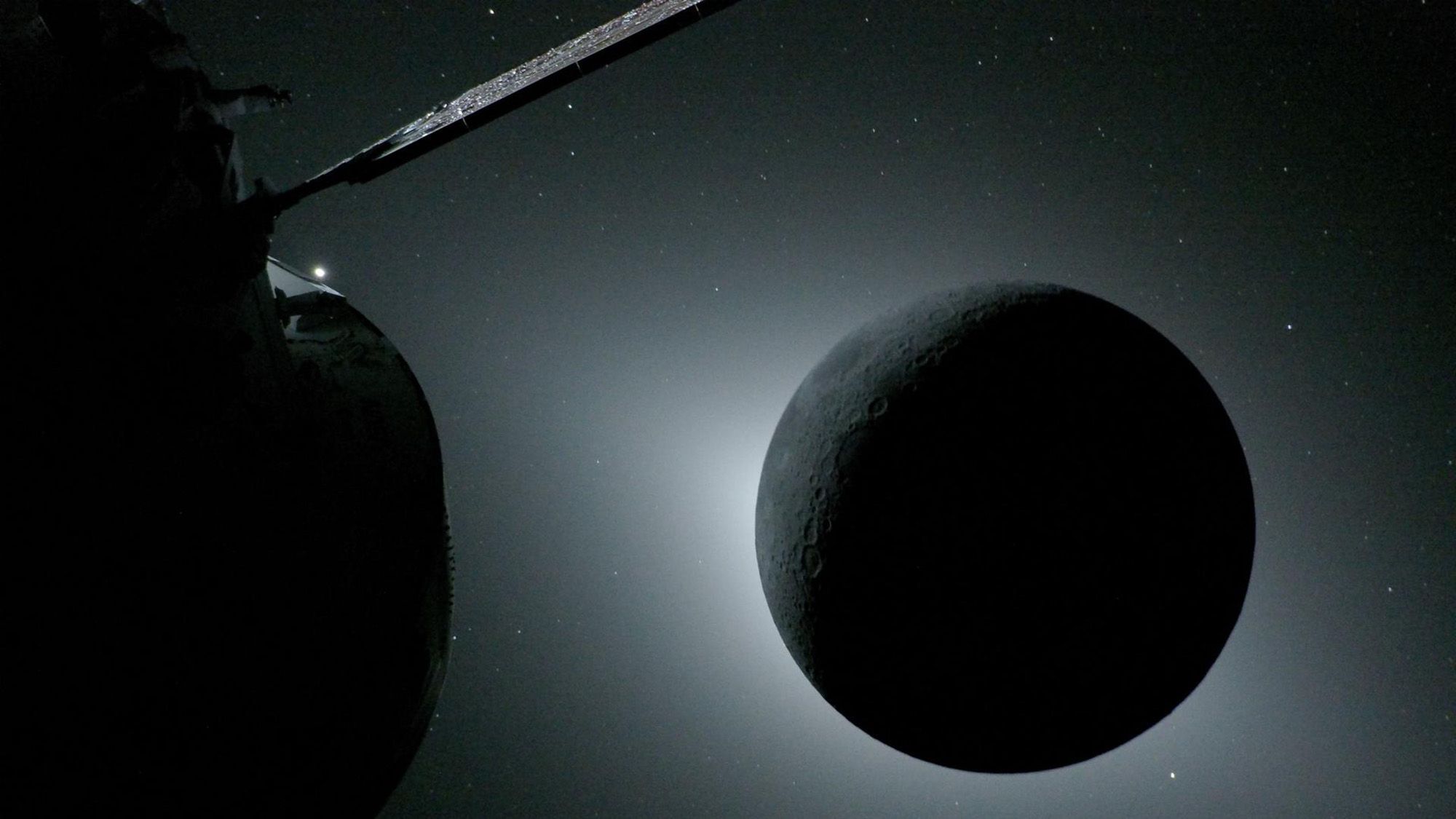
During the Artemis II mission, NASA’s lead integrated communications officer (INCO), Chris White, oversaw the complex task of capturing lunar imagery from 250,000 miles away. As the Orion spacecraft performed its lunar flyby, White and his team at NASA’s Mission Control Center in Houston managed nearly 300 camera commands, ultimately securing high-resolution photos of the moon and a total solar eclipse that have since been viewed by millions.
The mission, which marked a significant step in NASA’s return to crewed lunar exploration, required unprecedented coordination between flight control teams. White, who previously managed camera systems for the International Space Station (ISS), served as the primary contact for Orion’s communication and imaging systems. His role involved not only handling radio and audio systems but also coordinating the spacecraft’s orientation to ensure the cameras were positioned correctly for critical shots.
The Lunar Flyby Experience
For the flight control team in Houston, the lunar flyby was a period of intense focus and logistical precision. According to White, the team had spent over a year choreographing the camera movements. Because the spacecraft’s trajectory meant it would pass behind the moon—resulting in a 40-minute loss of signal (LOS)—the team had to rely on a pre-scripted, time-tagged sequence of commands. These commands were uploaded to the Orion spacecraft to trigger camera operations automatically during the period when Earth-based controllers could not intervene.

White described the visual experience of watching the moon approach through the telemetry and camera feeds as surreal. “The moon looked wrong,” White stated, noting that the perspective from the spacecraft allowed for views of the moon’s far side that are impossible to capture from Earth. The change in angle and the way the moon’s surface texture appeared under different lighting conditions challenged the team’s visual expectations, making the approach a unique experience for those monitoring the mission from the ground.
Managing the Loss of Signal
The 40-minute window of silence during the lunar flyby represented one of the most stressful periods for the INCO team. As the moon blocked all signals between the Orion spacecraft and Earth, White and his colleagues had to wait for the vehicle to emerge on the other side. During this time, White paced the halls of the Mission Control Center, waiting for the first signs of telemetry data to confirm the spacecraft’s status.
“It was all nerves,” White said, describing the atmosphere in the control room. The team’s primary concern was ensuring that all configurations had been set correctly before the signal loss and that the spacecraft would resume communications upon reemergence. The tension only broke once stable video was received and voice contact was re-established with the crew, approximately three to four minutes after the spacecraft moved past the moon’s horizon.
Capturing the Eclipse
Among the most significant results of the imaging plan was the capture of a total solar eclipse from the perspective of the Orion spacecraft. Because the sun was positioned behind the moon, the cameras were able to capture the moon in the foreground with the sun’s light bleeding out from behind it. White, who reviewed the images the day after they were transmitted via laser to Earth, described his reaction to seeing the eclipse photo as overwhelming.
“I opened a photo — the eclipse photo — and I couldn’t breathe,” White said. “I was like, ‘There’s no way that this turned out this well on the first try.'” The image, which features the moon, the sun, and the visible glow of the spacecraft, also captured distant planets and stars, providing a view that standard Earth-based photography cannot replicate due to the brightness of the spacecraft itself.

A Collaborative Effort
White emphasized that the success of the mission’s photography was not the result of a single person or team. Achieving the required shots involved deep integration across various NASA disciplines. The INCO team worked closely with power systems engineers to swing solar arrays into specific positions and coordinated with the guidance, navigation, and control (GNC) team to rotate the entire spacecraft to optimize camera angles.

This level of choreography was distinct from the operations performed on the International Space Station, where the vehicle’s orientation is often more static. The imagery team also played a crucial role in managing exposure settings, which White noted was particularly challenging given the bandwidth limitations of transmitting data from such a great distance. Adjusting these settings allowed the team to reveal subtle color variations on the lunar surface, moving beyond the monochromatic gray often associated with the moon.
As NASA prepares for future missions in the Artemis program, White confirmed his intention to remain part of the INCO team for Artemis III. While he will not serve as the lead for that mission, he remains committed to contributing to the flight control effort and hopes to continue capturing significant imagery from deep space. The mission stands as a milestone in human spaceflight, having sent the crew further from Earth than any previous mission, fundamentally altering the flight control team’s and the public’s perspective of lunar exploration.
We invite readers to share their thoughts on the significance of these lunar images in the comments below.