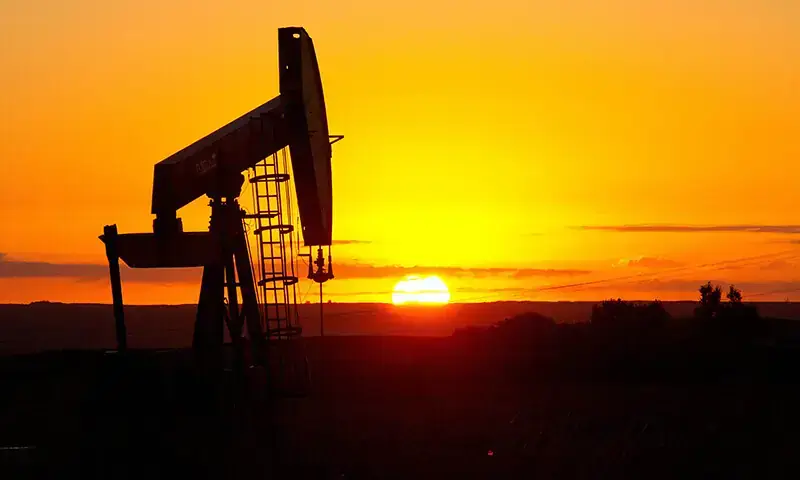
Global oil prices rose by more than three per cent on Monday following renewed military strikes between the United States and Iran, heightening market fears over the security of energy shipments through the Strait of Hormuz. Brent crude futures climbed $2.47, or 3.25pc, to reach $78.48, while US West Texas Intermediate (WTI) crude increased by $2.35, or 3.29pc, to $73.76 per barrel, according to market data recorded at 4:45pm PKT.
The Strait of Hormuz remains a critical chokepoint for the global economy, as approximately 20pc of the world’s oil and liquefied natural gas (LNG) transited the passage prior to the outbreak of conflict at the end of February. Heightened security risks have led to an immediate impact on maritime logistics, with ship-tracking data from Kpler indicating that vessel traffic through the strait fell to a five-week low on Sunday, with only six vessels completing the transit.
Market Volatility and Shipping Concerns
The surge in oil prices reflects a growing “risk premium” as shipping operators reassess the safety of regional waters. Analysts at ANZ noted that shipping companies are adopting a more cautious approach, which has resulted in a measurable slowdown in inbound movements toward the Gulf. Giovanni Staunovo, an analyst at UBS, stated that the market focus will remain on the volume of inbound tankers, warning that a sustained decrease in traffic could directly impact production levels and further support upward price pressure.

This volatility comes amid a backdrop of ongoing geopolitical friction. Tensions escalated over the weekend as Tehran targeted US facilities across the Gulf on Sunday, with Iran’s Revolutionary Guards claiming responsibility for strikes on US military bases in Kuwait and Bahrain. While US President Donald Trump stated on Sunday that the Strait of Hormuz remains open to commercial traffic, these assurances contrast with earlier declarations from Iranian officials, who claimed to have closed the route following an incident involving a vessel that allegedly traveled on an unapproved path.
The Status of US-Iranian Agreements
The recent military activity has cast doubt on the durability of an interim agreement signed last month between the United States and Iran. That pact was intended to facilitate the reopening of the strait and establish a path toward ending the conflict following an additional 60 days of negotiations. Although the agreement had initially provided a boost to global energy supplies—with the International Energy Agency (IEA) reporting a 4.1 million barrel per day (bpd) increase in June—the market remains constrained. According to the IEA’s Friday report, global supply levels are still 9.4m bpd below pre-war levels.

The economic impact of these disruptions is also being felt in regional pricing strategies. On Monday, the Abu Dhabi National Oil Company (Adnoc) announced that its official selling price for benchmark Murban crude for August would be set at $80.01 per barrel, a significant decrease from the $101.48 per barrel recorded the previous month.
Long-Term Infrastructure and Regional Supply
To mitigate the strategic risks posed by the Strait of Hormuz, industry analysts are looking toward the expansion of regional pipeline capacity. Goldman Sachs has projected that such infrastructure projects could shield more than 60pc of pre-war Gulf oil exports from future disruptions by the end of 2028. The bank’s base-case forecast anticipates that pipeline capacity bypassing the strait will increase by 3.8m bpd by the end of 2027, with a cumulative rise of 7.3m bpd by the end of 2028, bringing the total effective bypass capacity to more than 14m bpd.

Meanwhile, the broader energy market continues to contend with supply chain complexities. While Iranian oil supplies held at sea have risen following the interim peace deal, actual sales have remained sluggish. Independent refiners in China, a major buyer, have increasingly turned toward cheaper crude imports from Iraq, the United Arab Emirates, and Qatar. Outside the Gulf, energy infrastructure remains a target; Ukraine’s Security Service reported that it struck an oil depot in Russia’s Stavropol region and three storage tanks at an oil-loading site in the port of Kavkaz in the Krasnodar region overnight.
Market participants are now awaiting further updates regarding the 60-day negotiation window established by the recent US-Iranian agreement. As the situation remains fluid, observers are monitoring official announcements for signs of de-escalation or further maritime restrictions. We invite readers to share their analysis of these market shifts in the comments section below.
Worth a look
- Super-Rich Bid for T. Rex ‘Gus’ as Science is Sidelined
- Hiring Motivated Team Players for Austrian Startup (C2 German & English)
- Oil Prices Surge as US Strikes Iranian Targets and Blockades Hormuz Strait (archyworldys.com)
- Why Gas Prices Can Differ by $1 Between Stations a Block Apart (daybreakwire.com)