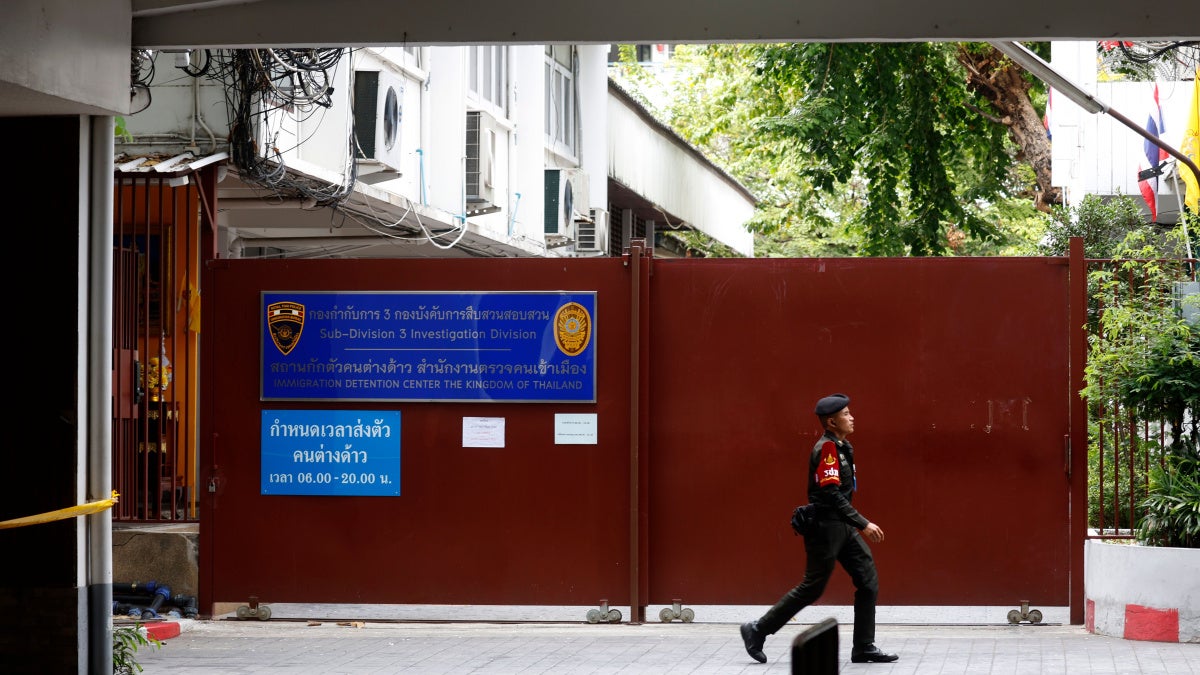
The Thai government is facing urgent calls to halt the potential deportation of at least four Chinese dissidents currently held at the Suan Phlu Immigration Detention Center in Bangkok. International observers and human rights advocates warn that returning these individuals to China would violate the principle of non-refoulement, which prohibits sending people to countries where they face a credible risk of persecution, torture, or other severe human rights abuses.
The situation has intensified as Prime Minister Anutin Charnvirakul prepares for a diplomatic visit to China, scheduled for July 16 to 20, 2026. According to Human Rights Watch, Thailand is a party to the UN Convention Against Torture, which explicitly forbids the transfer of individuals to countries where they are at risk of state-sponsored ill-treatment.
The immigration detention center at the Immigration Bureau in Bangkok, Thailand, February 27, 2025.
© 2025 Narong Sangnak/EPA-EFE/Shutterstock
Status of Detained Individuals
Among those currently detained are individuals who have been recognized as refugees by the United Nations High Commissioner for Refugees (UNHCR). The list of those at risk includes:
- Bai Zhaodong: A former investigative journalist for the Chinese outlet Caixin, known for reporting on rural corruption and the societal impacts of government poverty alleviation programs.
- Tan Yixiang: A Catholic activist who has vocalized support for Tibetan and Uyghur rights. He was initially arrested in 2022, briefly released on bail in 2023, and rearrested in February 2024.
- Zhang Xinyan: A practitioner of Falun Gong who fled China in 2014. She was arrested by Thai police in May 2026 for alleged visa violations. Reports indicate that Thai authorities prevented her from boarding a flight to Canada for resettlement on July 8.
- Zhou Junyi: A member of the China Democracy Party who has lived in Thailand since 2015. He was arrested in June 2025 following his participation in a memorial event for the 1989 Tiananmen Square Massacre.
While Thailand is not a signatory to the 1951 Refugee Convention, the country is bound by the customary international law principle of non-refoulement. Furthermore, this prohibition is explicitly integrated into the 2023 Act on Prevention and Suppression of Torture and Enforced Disappearances, which serves as a domestic legal framework to protect individuals from being returned to environments where they face life-threatening danger.
History of Forcible Returns
The current detention of these four individuals follows a pattern of Thai government actions regarding Chinese nationals. In February 2025, Thai authorities transferred 40 Uyghur men to Chinese custody. This incident echoed a larger case in July 2015, when more than 100 Uyghur men were forcibly returned to China.
Historical data shows that such returns often result in imprisonment or worse. In 2015, activists Dong Guangping and Jiang Yefei were returned to China despite having been recognized as refugees with pending resettlement plans for Canada. Both were subsequently imprisoned on charges of “inciting subversion” and “illegally crossing national borders.” Dong later managed to escape China again in 2026, eventually reaching Canada after a journey by boat to South Korea.
Conversely, some activists have successfully avoided deportation through international advocacy. In 2020, human rights activist Jian Xing was granted passage to New Zealand after being detained in Bangkok for overstaying his visa.
International Oversight and Legal Obligations
Thailand’s human rights record is set to undergo a Universal Periodic Review by the UN Human Rights Council this November. As a current member of the council, Thailand is under increased scrutiny regarding its commitment to protecting vulnerable populations. During its previous review, the Thai government pledged to implement legal measures to safeguard refugees and asylum seekers, a promise that advocates now argue is being undermined by the current detention center policies.
The lack of a formal national refugee law in Thailand leaves many asylum seekers in a precarious legal position, often relying on temporary visas that, once expired, lead to detention. As the July 16 diplomatic visit approaches, the international community remains focused on whether Thai authorities will uphold their stated commitments to human rights or proceed with the deportation of these dissidents.
Related reading