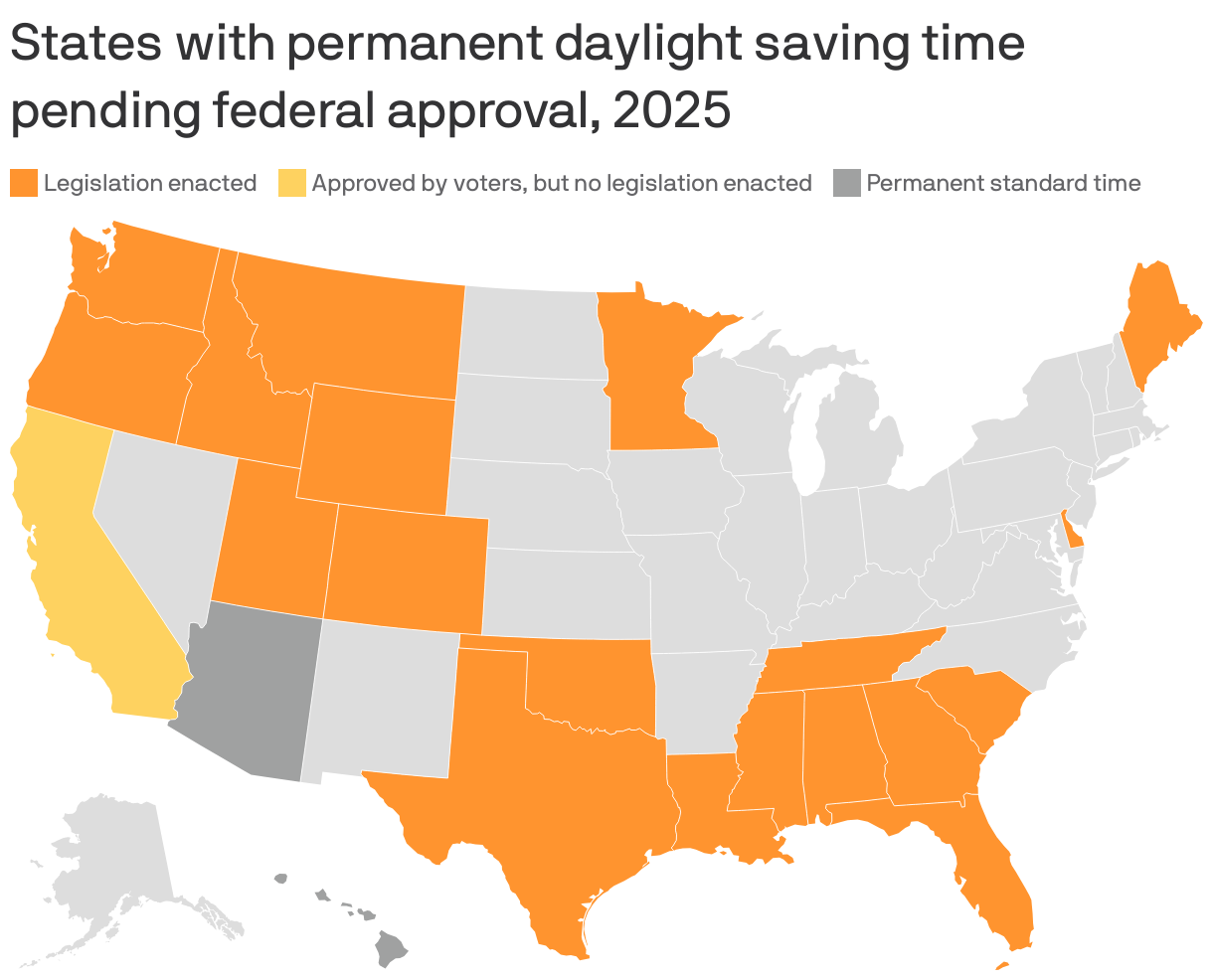
The United States legislative effort to establish permanent daylight saving time remains stalled in Congress, despite frequent public debate and periodic legislative pushes. While various proposals have sought to end the biannual practice of changing clocks, no federal law has successfully transitioned the country to a permanent daylight saving time system. As of early 2024, the United States continues to observe the Uniform Time Act of 1966, which mandates the shift between standard time and daylight saving time, with specific exceptions for states that choose to opt out of the daylight saving period entirely.
Recent legislative activity, such as the Sunshine Protection Act, passed the U.S. Senate via unanimous consent in March 2022, but the bill failed to gain traction in the House of Representatives before the end of that legislative session, according to official records from Congress.gov. Because the bill did not pass both chambers and receive a presidential signature, it did not become law. Consequently, the national requirement for most states to observe daylight saving time from the second Sunday in March to the first Sunday in November remains in effect.
Understanding Current Federal Time Regulations
Under the Uniform Time Act of 1966, administered by the U.S. Department of Transportation, states have the authority to exempt themselves from observing daylight saving time, but they do not have the federal authority to adopt permanent daylight saving time. This means states may choose to stay on standard time year-round, but they cannot unilaterally decide to stay on daylight saving time throughout the year without an act of Congress.
Currently, two states utilize this exemption to remain on standard time permanently: Hawaii and most of Arizona. The Navajo Nation in northeastern Arizona, however, does observe daylight saving time, creating a unique geographic patchwork of time-keeping policies within that state’s borders, as noted by the Time and Date organization. These regions experience a consistent sunrise and sunset schedule relative to the clock throughout the year, avoiding the biannual adjustment that many other Americans undergo.
The Debate Over Daylight Saving and Standard Time
The discussion surrounding time-keeping often centers on the trade-offs between late-afternoon sunlight and morning light. Proponents of permanent daylight saving time argue that extending evening light into the winter months encourages economic activity and improves public health, while critics—including many sleep experts—contend that permanent standard time is more closely aligned with human circadian rhythms. The American Academy of Sleep Medicine has officially advocated for the adoption of permanent standard time, citing the potential for improved sleep health and decreased risks associated with the transition between time systems.
The impact of these shifts is most visible during the winter months. When the U.S. transitions from daylight saving time to standard time in early November, sunsets shift significantly earlier. For instance, locations that experience a sunset at approximately 5:30 p.m. during late autumn will see that time move to roughly 4:30 p.m. once the clocks “fall back.” This shift is a primary driver for the public interest in legislative reform, as many citizens express dissatisfaction with the early onset of darkness during the winter season.
Status of Future Legislative Action
While several states have passed resolutions or legislation signaling their intent to adopt permanent daylight saving time should federal law allow it, these measures remain contingent on Congressional action. As of the current session, no major movement has successfully cleared the House of Representatives to alter the status quo. Legislative tracking services, such as the National Conference of State Legislatures, continue to monitor dozens of bills filed at the state level, but all are effectively sidelined by the federal requirement. Until Congress amends the Uniform Time Act, the biannual clock change remains the standard procedure for the majority of the country.
For citizens tracking potential changes, the most reliable source of information remains the official Congress.gov portal, which provides real-time updates on the status of all pending federal legislation. Readers are encouraged to share their views on this ongoing policy debate in the comments section below.
Keep reading
- Top Irish and International News Stories: Today’s Essential Updates
- Horoscope July 16 2026: Rat Forecasts Career Growth and Goat Gains Wealth
- August 2026 To Feature Total Solar and Partial Lunar Eclipses (archyworldys.com)
- Hawaii’s Flight of Freedom: 133 Years Since the Illegal Overthrow (news-usa.today)