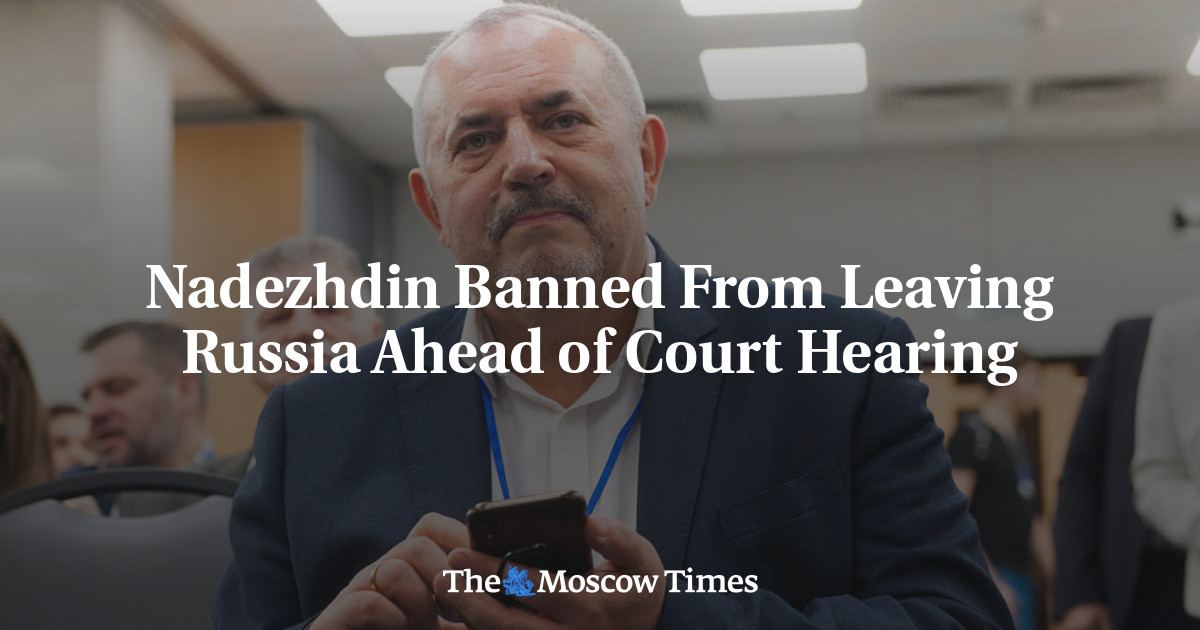
Russian politician Boris Nadezhdin has been barred from leaving the country ahead of a scheduled court hearing regarding his recent designation as a “foreign agent.” The restriction, confirmed by legal representatives, follows the Russian Justice Ministry’s decision to add the former presidential hopeful to its registry of foreign agents on October 25, 2024, as documented by the official Russian Ministry of Justice records.
The travel ban introduces a new layer of legal pressure on Nadezhdin, who gained international attention earlier this year for his attempt to challenge President Vladimir Putin in the 2024 presidential election. His campaign was characterized by a public anti-war platform, which resonated with a segment of the Russian electorate despite his ultimate disqualification by the Central Election Commission. The designation as a foreign agent—a legal status frequently used by the Kremlin to marginalize political dissenters—carries significant administrative burdens and restrictions on public activity.
The Legal Basis for the Foreign Agent Designation
The Russian government’s classification of Nadezhdin as a foreign agent is rooted in the country’s expansive “foreign agent” legislation, which requires individuals and organizations receiving support from abroad or under “foreign influence” to register with the state. According to Reuters, the Justice Ministry cited Nadezhdin’s alleged dissemination of information intended to create a negative image of the Russian army and his opposition to the “special military operation” in Ukraine as primary justifications for the label.

Under the current legal framework, individuals labeled as foreign agents face strict reporting requirements, must label their public content with a specific disclaimer, and are barred from teaching or organizing public events. Nadezhdin has consistently rejected the validity of these claims, maintaining that his political activities are domestic in nature and consistent with his rights as a Russian citizen. The upcoming court hearing is expected to address his formal challenge against the Justice Ministry’s decision, a process that has become a common, though rarely successful, avenue for those seeking to contest the designation.
Political Context and the 2024 Election
Nadezhdin’s prominence grew significantly during the lead-up to the March 2024 presidential election. He successfully gathered tens of thousands of signatures from citizens across Russia to register his candidacy, a process that briefly turned him into a focal point for Russians expressing fatigue with the ongoing conflict in Ukraine. However, the Central Election Commission ultimately rejected his candidacy, citing irregularities in the signature collection process—a move widely interpreted by international observers as a mechanism to prevent an anti-war voice from appearing on the ballot.
The transition from a candidate to a “foreign agent” reflects a broader trend in Russian internal policy, where figures who have previously operated within the narrow bounds of state-sanctioned political discourse are increasingly targeted. By restricting his ability to travel, the authorities have effectively limited his capacity to interact with international media or maintain ties with networks outside of Russia. This strategy mirrors the treatment of other prominent opposition figures who have been forced to choose between domestic legal battles and exile.
Current Legal Status and Next Steps
The travel restriction is a direct consequence of the ongoing administrative proceedings. While the exact date of the court hearing remains subject to judicial scheduling, it serves as the next critical checkpoint in Nadezhdin’s legal efforts to clear his name and regain his public standing. His legal team has indicated that they intend to exhaust all available domestic remedies, though legal analysts note that the success rate for challenging foreign agent designations in Russian courts is statistically negligible.

For the time being, Nadezhdin remains in Russia, subject to the oversight of the Ministry of Justice. The case remains a significant indicator of the current environment for political opposition in the country, where the legal system continues to be used as a tool for restricting the mobility and influence of those deemed to be in opposition to the state’s policies. Updates regarding the specific date of the hearing and any subsequent filings will be monitored through the official registers of the Russian court system.
We invite readers to follow this story as it develops. Please share your thoughts or any verifiable updates in the comments section below.
Related reading