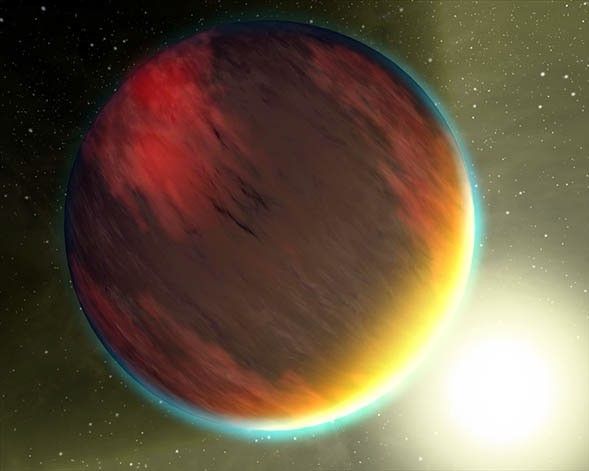
Astronomers have detected helium escaping from the atmosphere of LHS 1140b, a rocky exoplanet located approximately 50 light-years away from Earth. The findings, published in the journal Nature, offer a rare look at how planetary atmospheres evolve over time, revealing that even rocky worlds can experience the loss of light gases as they are subjected to radiation from their host stars. This observation provides a critical data point for understanding the long-term stability of atmospheres on planets outside our solar system.
Understanding Atmospheric Escape on Exoplanets
Most of the gas in the universe consists of hydrogen and helium, the primary components of the primordial envelopes that surround young planets. As planets age, these atmospheres often undergo significant transformations.
Lighter elements like hydrogen and helium are more susceptible to being stripped away by stellar winds and high-energy radiation. On planets closer to their stars, the atmosphere can be heated to the point where it expands, making it easier for gas to overcome the planet’s gravitational pull and escape into space. While hydrogen can sometimes be retained by being incorporated into heavier molecules such as methane or ammonia, helium is a noble gas and does not form such bonds, making its detection a clear indicator of atmospheric dissipation.
The Case of LHS 1140b
This shift mirrors the evolutionary history of our own solar system, where Venus, Earth, and Mars are believed to have lost their primordial atmospheres and developed secondary ones through volcanic activity and chemical processes. By comparing the helium loss rate to models of atmospheric evolution, scientists can infer the density and composition of the gas that remains.
Implications for Future Observations
Understanding how often rocky planets lose their initial atmospheres helps astronomers refine their search for habitable worlds. If a planet loses its hydrogen and helium too quickly, it may become an inhospitable, airless rock. Conversely, if it retains a secondary atmosphere, it may provide the necessary pressure and temperature conditions to support liquid water on its surface. The observation of LHS 1140b confirms that atmospheric loss is not just a theoretical risk but a measurable process occurring in real-time across the galaxy.
As the scientific community continues to analyze the data from this system, researchers are looking toward the next phase of observation, which involves more precise measurements of the planet’s transit depth across multiple wavelengths. These upcoming studies will be essential for distinguishing between a truly secondary atmosphere and the remnants of a primordial one. We encourage our readers to share their thoughts on these findings in the comments section below as we await further updates from the international astronomical community.
Related reading