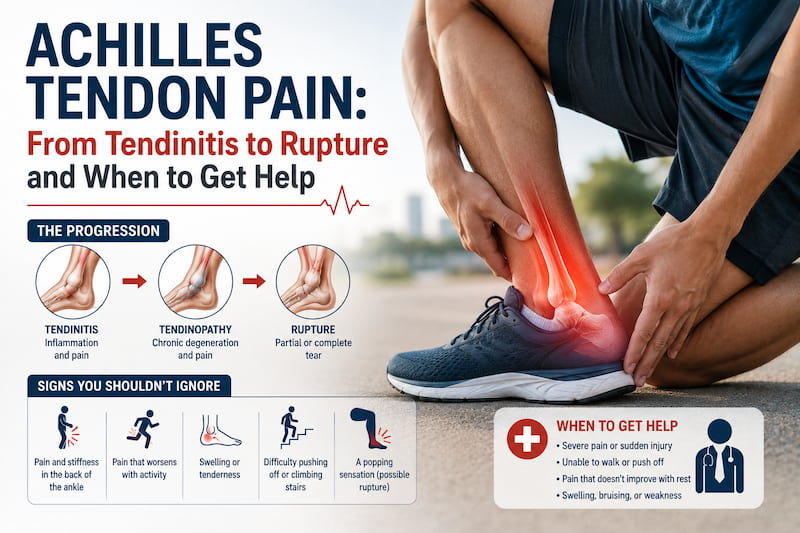
Achilles tendon pain often begins as a subtle, nagging ache, but it can escalate into a severe injury that threatens your mobility. As the strongest tendon in the human body, the Achilles is responsible for the powerful push-off motion required for walking, running, and jumping.
Understanding the spectrum of Achilles health—from minor inflammation to a complete tear—is essential for protecting your long-term function. When pain persists or manifests as a sudden, sharp injury, professional evaluation is the only way to ensure proper recovery and prevent chronic degeneration.
Understanding Achilles Tendinitis: The Overuse Factor
Achilles tendinitis typically presents as a dull, localized ache or stiffness along the back of the heel or a few inches above it. Many patients report that symptoms are most pronounced during their first steps in the morning or at the very start of a workout. This condition is fundamentally an overuse injury, frequently triggered by a sudden increase in activity intensity, such as adding too much mileage to a running routine, introducing new hill training, or wearing footwear that lacks adequate support.
The anatomy of the tendon plays a critical role in its vulnerability. Medical literature indicates that the mid-portion of the Achilles has a relatively limited blood supply, which can hinder the body’s ability to repair micro-tears caused by repetitive stress. If ignored, this inflammation can progress to chronic tendinosis, a condition characterized by the thickening and structural degeneration of the tendon fibers.
Recognizing When Achilles Pain Requires Medical Care
While many mild cases of tendon irritation resolve with conservative home management, certain warning signs indicate that an injury has moved beyond simple inflammation. Persistent pain that does not improve after two to three weeks of rest, noticeable thickening or the development of a palpable nodule in the tendon, and weakness when attempting to stand on your toes are all indicators that you should consult a specialist.
Ignoring these symptoms can lead to instability at the ankle, as the tendon loses its ability to effectively transfer force from the calf muscles to the foot. This professional assessment is vital for creating a recovery plan that moves beyond temporary symptom relief to address the underlying biomechanical issues.
The Clinical Reality of an Achilles Rupture
An Achilles tendon rupture is a distinct, often dramatic event that is typically unmistakable. Patients frequently describe the sensation of being kicked or struck in the back of the ankle, often accompanied by an audible “pop.” Following the injury, the ability to push off or stand on the toes is severely compromised, and significant swelling and bruising often appear rapidly.
This is a medical situation that demands prompt evaluation. Depending on the patient’s age, activity level, and medical history, treatment may involve non-surgical management—typically utilizing an immobilization boot that holds the foot in a specific position—or surgical repair. Surgical intervention is often discussed for active patients, as it may offer a lower rate of re-rupture, though the choice between surgery and conservative care is highly individualized and must be weighed in consultation with a specialist.
Long-Term Tendon Health and Prevention
Protecting the Achilles tendon is largely about consistency and moderation. Incorporating regular calf stretching into your daily routine helps maintain the flexibility of the muscle-tendon unit, while proper footwear ensures that the foot is supported correctly during impact.
When pain lingers or a sudden injury occurs, seeking early care prevents a minor issue from evolving into a long, complex recovery process. The goal for any treatment—whether rehabilitative or surgical—is not merely to return to walking, but to restore the full, functional power of the push-off. If you are experiencing persistent ankle pain or suspect a serious injury, schedule an appointment with a board-certified foot and ankle specialist to develop a clear, evidence-based plan for your recovery.
This article provides general health information and does not replace professional medical advice. If you have concerns about your health, please consult a qualified physician.
Keep reading