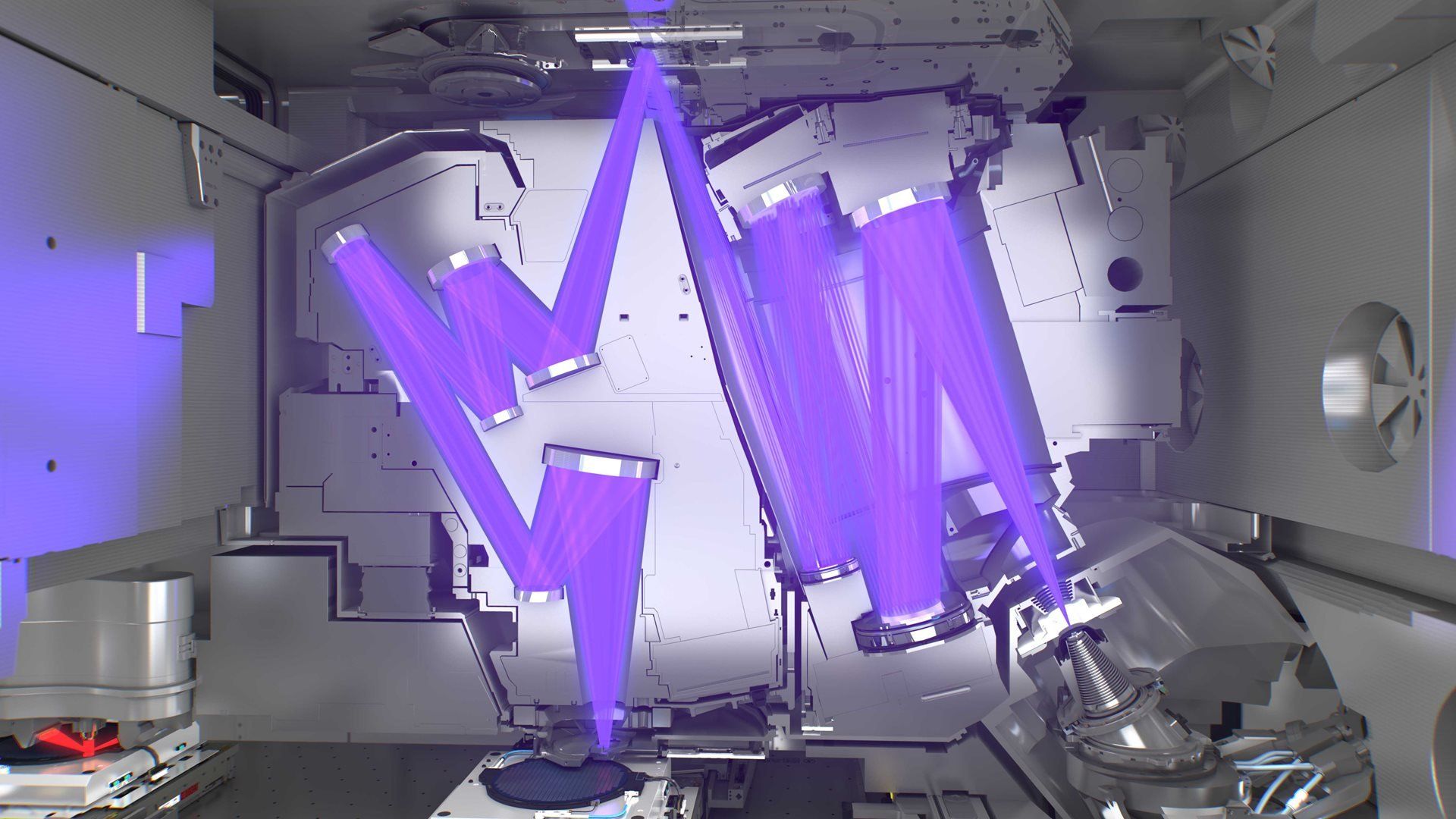
ASML, the Dutch manufacturer that holds a global monopoly on extreme ultraviolet (EUV) lithography systems, is reportedly moving to increase the pricing of its Low-NA EUV tools, a decision that has drawn friction from its largest customer, TSMC. The proposed cost adjustments reflect ASML’s “value-based pricing” strategy, which ties the price of its scanners to the productivity gains and economic value they provide to chipmakers.
The semiconductor industry relies on ASML’s lithography scanners to manufacture the most advanced processors on the market. According to financial data reported during the company’s second-quarter earnings call for 2026, ASML generated total net sales of €9.326 billion ($10.67 billion) with a net income of €2.918 billion ($3.338 billion). Looking forward, the company has provided guidance for total 2026 net sales in the range of €43 billion ($49.2 billion) to €45 billion ($51.5 billion), signaling sustained market dominance and high demand for its hardware.
ASML’s pricing strategy is built on the premise that as its systems become more complex and productive, their price should increase accordingly. Early Twinscan NXE systems were historically priced between €100 million and €120 million ($115 million–$137 million). Subsequent models, such as the NXE:3400C and NXE:3600D, shifted that range toward €140 million–€170 million ($160 million–$195 million). The latest iterations, including the NXE:3800E and the forthcoming High-NA EXE systems, have pushed costs even higher, with High-NA tools reportedly exceeding €350 million ($400 million) per unit.
Roger Dassen, chief financial officer of ASML, addressed the pricing environment during the company’s recent earnings call, noting that the firm is in a position to leverage the significant value its products provide. “Clearly, the environment that we live in today, with the [substantial] value that our products bring to customer, of course, gives us flexibility on pricing, more so than what you would have seen in the past,” Dassen stated. He added that the company is actively working to ensure it is “rewarded” for improvements in imaging quality and overlay precision, rather than just raw wafer-per-hour productivity.
However, the transition to higher prices is not immediate. Because ASML operates with substantial order backlogs—totaling €38.8 billion as of late 2025—the company cannot retroactively change the prices of machines already under contract. As Dassen observed, “Given the long order lead times that we have, that does not translate into pricing effects tomorrow.” This indicates that existing orders, particularly those slated for delivery through 2027, are likely insulated from these proposed increases. The impact will primarily fall on new orders, specifically those for the latter half of 2028 and beyond.
The reported tension with TSMC stems from the strategic reliance the Taiwanese chipmaker has on Low-NA EUV technology. TSMC has prioritized extracting maximum performance from conventional Low-NA EUV scanners through computational lithography and multi-patterning techniques, a strategy that has allowed it to avoid the substantial costs associated with transitioning to the more expensive High-NA EUV systems. For TSMC, which operates the world’s largest fleet of EUV scanners, a systematic increase in the price of Low-NA machines undermines its mid-term economic roadmap.
Industry observers note that TSMC’s expansion plans for new fabs in Taiwan, the United States, and Japan are heavily dependent on a consistent and predictable supply of these tools. A percentage increase on the cost of dozens of these machines could add billions to the company’s capital expenditure. Furthermore, there is a fundamental disagreement over what constitutes a “price increase.” From TSMC’s perspective, charging more for a machine that is not materially more expensive to manufacture—but simply more productive—is a departure from traditional equipment procurement, effectively forcing the chipmaker to surrender a portion of its own operational gains to its supplier.
The divergence between TSMC and other players like Intel highlights the different paths being taken in the semiconductor industry. While TSMC seeks to delay the adoption of High-NA EUV until its 10A-class (1nm) process nodes, other manufacturers are already integrating the more expensive, higher-resolution High-NA systems into their 14A manufacturing flows. For Intel, the high cost of the hardware is a baked-in component of the process. For TSMC, the ability to choose between complex process steps and expensive hardware is a key competitive lever that ASML’s pricing policy now threatens to tighten.
ASML’s capacity expansion plans further complicate the landscape. The company expects to produce 65 EUV tools this year, with plans to increase that capacity by 30% in 2027 and potentially another 30% by 2028, aiming for an annual output of 110 scanners by that time. As Dassen noted, the company is already “close to being fully covered” with orders for 2027. This high demand effectively grants ASML the market power to dictate terms for the 2028 production cycle and beyond.
As the industry looks toward 2029, the introduction of the next-generation NXE:4200G scanner is expected to set a new benchmark for both performance and price. Whether ASML chooses to implement its “value-based” price adjustments on the existing EXE:3800 series before then remains a point of intense focus for investors and customers alike.
Readers interested in the latest developments in semiconductor manufacturing equipment can monitor official filings from ASML through their investor relations portal. We invite industry analysts and stakeholders to share their perspectives on these evolving supply chain dynamics in the comments section below.
Related reading