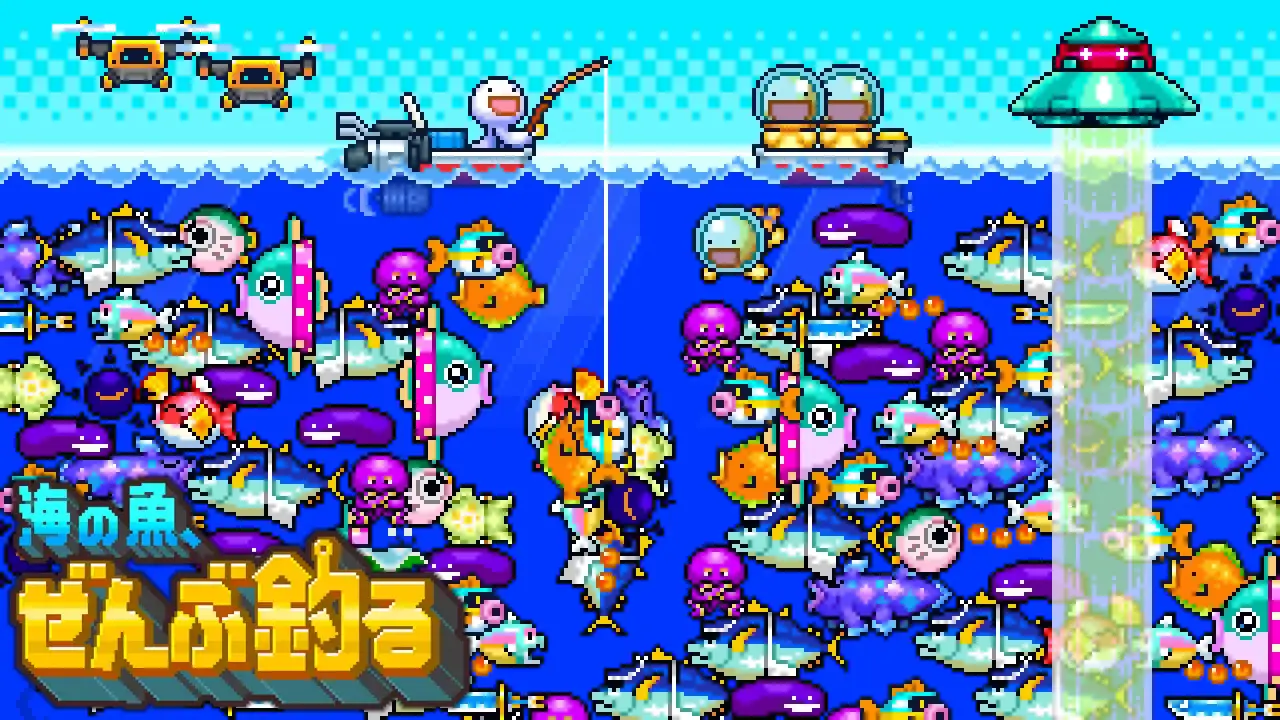
The indie development scene has introduced a new entry in the incremental game genre with the release of Umi no Sakana, Zenbu Tsuru (Catch All the Fish in the Sea). Released on July 20, 2026, to coincide with Japan’s Marine Day, the title challenges players to hook a total of 10 million fish.
The Mechanics of Incremental Fishing
At its core, Umi no Sakana, Zenbu Tsuru is built on a foundation of exponential growth. Players begin with basic equipment but quickly transition into increasingly absurd methods to harvest the sea’s population. Unlike traditional fishing games that emphasize patience or accurate casting, this title rewards the player for upgrading their “tackle” to include tools like explosives and even UFOs to clear the water of its 10 million inhabitants.
The game’s progression loop is designed to provide immediate feedback. As the number of caught fish rises, players earn currency that can be reinvested into automated systems, allowing for the “inflation” of catch rates. This design philosophy is common in incremental games, where the primary goal is to reach higher orders of magnitude in a short, focused play session. By setting a hard cap of 10 million, the developer provides a clear finish line for what is essentially a short-form, high-intensity experience.
Design Philosophy and Genre Trends
The decision to release the game on Marine Day (Umi no Hi) is a deliberate nod to the Japanese holiday, which celebrates the ocean’s bounty. While the title suggests a standard fishing game, the gameplay is intentionally “chaotic.” By incorporating elements that have nothing to do with conventional fishing, the game subverts the player’s expectations, turning a typically relaxing activity into a frantic race against the game’s own internal counters.
In the broader context of mobile and indie gaming, Umi no Sakana, Zenbu Tsuru serves as an example of how developers are increasingly using “short-form” experiences to capture player attention. With the rise of casual gaming, the ability to offer a complete, satisfying arc—from starting with nothing to clearing an entire ocean—within a limited time frame has become a valuable design strategy. It avoids the “live service” trap of endless maintenance, instead offering a concise, high-energy loop that concludes once the goal is met.
Accessibility and Player Reception
For those interested in the genre, the game is accessible through standard digital storefronts. The barrier to entry is intentionally low, allowing players to engage with the mechanics immediately upon download. Because the game does not require deep tactical knowledge, it functions effectively as a “pick-up-and-play” experience, suitable for short intervals of gameplay.
The reception of such titles often hinges on the balance between the speed of inflation and the player’s sense of agency. If the numbers grow too quickly, the game can feel hollow; if they grow too slowly, the “idle” aspect becomes tedious. Umi no Sakana, Zenbu Tsuru manages this by introducing increasingly ridiculous tools at key milestones, ensuring that the visual and mechanical feedback remains engaging even as the numbers reach the millions.
What Comes Next?
As of late 2026, there have been no official announcements regarding post-launch content or expansions for Umi no Sakana, Zenbu Tsuru. Given that the game is marketed as a short-form, self-contained experience, it is likely that the current version represents the full intended scope of the project. Players looking for updates should monitor official developer channels or store pages for any patches or potential future projects from the development team.
Have you had a chance to test your fishing skills against the 10 million count? Share your thoughts on the game’s chaotic mechanics or your fastest clear times in the comments below. We continue to monitor the indie scene for similar innovative titles that challenge our expectations of classic gaming genres.
Keep reading