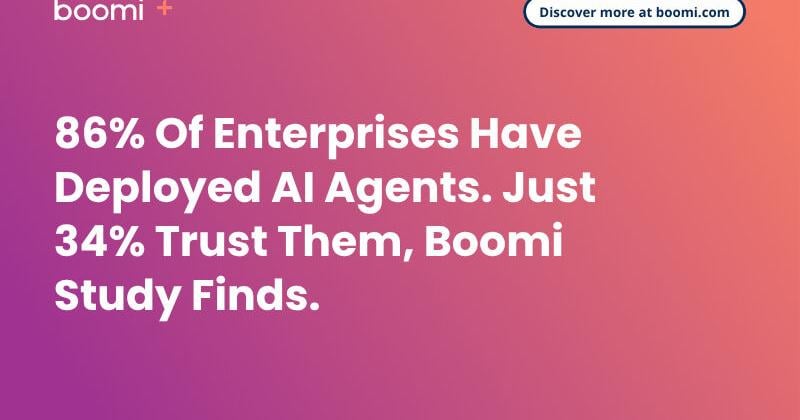
A recent study conducted by Forrester Consulting on behalf of Boomi reveals that 86% of global organizations have already integrated AI agents into their operations. Despite this high rate of adoption, the research highlights a significant divide between the deployment of these technologies and the underlying data maturity required to make them effective. While businesses are rapidly moving to automate tasks, many continue to struggle with fragmented data landscapes that limit the potential impact of their investments.
The findings, based on a survey of decision-makers across various sectors, indicate that while AI agents are now a standard component of enterprise strategy, the “data readiness” of these organizations remains a primary bottleneck. According to the study, companies that fail to unify their data infrastructure before scaling AI initiatives often face diminishing returns, as agents require high-quality, accessible data to perform reliably in real-time business environments.
The Data Maturity Gap in AI Deployment
The transition from experimental AI projects to full-scale enterprise integration has moved faster than many internal data governance frameworks. Forrester Consulting’s analysis suggests that the primary challenge for leadership teams is no longer the acquisition of AI tools, but the synchronization of disparate information silos. Organizations often maintain data across legacy systems, cloud environments, and shadow IT infrastructure, which complicates the ability of AI agents to execute complex, multi-step workflows accurately.
Data activation—the process of making data usable for automated systems—is identified as the critical bridge between adoption and ROI. Businesses that successfully integrate their data ecosystems report higher efficacy in their AI agents, particularly in customer service and supply chain management. Conversely, those operating with siloed data face increased risks of “hallucinations” or errors, where agents act on incomplete or outdated information provided by disconnected backend systems.
Operational Impact and Executive Priorities
For enterprise leaders, the focus is shifting from simple automation to the orchestration of complex agentic workflows. The study underscores that the value of AI is not found in the agents themselves, but in their ability to interact across the entire technology stack. This requires a robust integration strategy that allows agents to pull data from CRM, ERP, and proprietary databases simultaneously.
The urgency to address these infrastructure requirements is growing as competitors leverage AI to reduce operational costs and accelerate time-to-market. According to industry benchmarks from the McKinsey Global Institute, the economic potential of generative AI is concentrated in sectors where data integration is most mature, such as high-tech, retail, and financial services. Organizations that prioritize data cleaning and unified architecture now are positioning themselves to capitalize on future iterations of agentic AI, which are expected to move from simple task completion to autonomous decision-making.
Strategic Considerations for Business Leaders
As companies evaluate their current AI agent strategies, the following areas have emerged as priority checkpoints for IT and business operations teams:

- Data Governance: Establishing clear protocols for data access and security before agents are granted permissions to interact with sensitive systems.
- System Interoperability: Ensuring that legacy hardware and modern cloud platforms can communicate through standardized APIs or integration platforms-as-a-service (iPaaS).
- Human-in-the-Loop Oversight: Maintaining supervisory checkpoints for agents, particularly in high-stakes areas like financial reporting or customer-facing communication.
- Scalability Testing: Moving beyond pilot programs to test how agentic workflows perform under high-volume, real-world conditions.
The disparity between the 86% adoption rate and actual operational efficiency suggests that many firms are currently in a “learning phase.” The next stage of the AI lifecycle will likely be defined by a consolidation of tools, as companies phase out fragmented solutions in favor of unified data management platforms that support cohesive AI agent strategies.
Looking Ahead: The Next Phase of Enterprise AI
Industry analysts expect that the next 12 to 18 months will see a shift in capital expenditure away from the initial procurement of AI agents and toward the infrastructure that supports them. Companies that can demonstrate a clear lineage of data quality and provenance will likely see a higher return on their AI investments compared to those that deploy agents on top of unmanaged, decentralized data sets.

As organizations prepare for upcoming fiscal planning cycles, the focus will increasingly be on measurable outcomes, such as reduced latency in automated workflows and improved accuracy in predictive analytics. For those looking to audit their current readiness, official guidance on AI governance and data ethics is available through the OECD AI Policy Observatory, which provides a framework for responsible innovation in the corporate sector.
The landscape of enterprise technology continues to evolve rapidly. We invite our readers to share their experiences with AI agent integration in the comments section below, or to join our upcoming industry roundtable on data architecture and its role in the future of the digital enterprise.
Keep reading