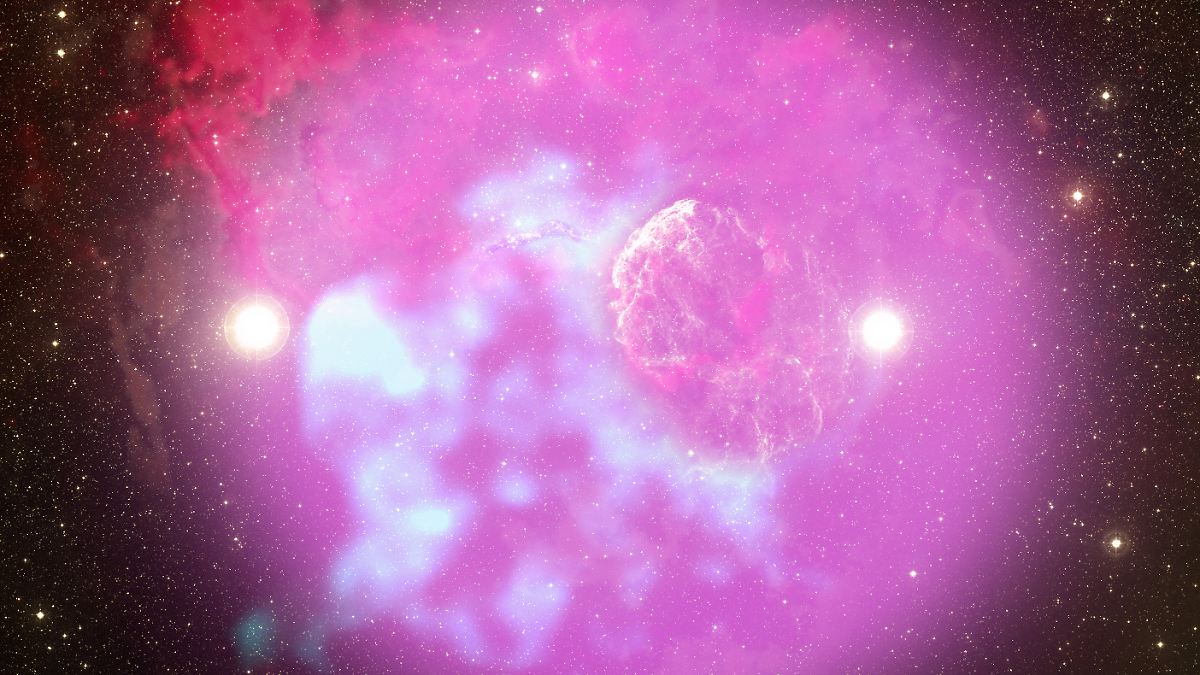
Astronomers have identified a double supernova remnant in the Milky Way, marking the first time two such remnants from a binary star system have been detected together in our galaxy. This rare discovery, detailed in research published by the Nature portfolio, reveals a complex interaction where two massive stars exploded in separate supernova events, leaving behind a shared cloud of expanding gas and debris.
The discovery challenges previous assumptions about how binary star systems evolve and end. While astronomers have observed similar phenomena in distant galaxies, finding a “double remnant” within the Milky Way allows for high-resolution analysis of the chemical composition and shockwaves created by the sequential explosions. This specific system provides a blueprint for understanding how the most massive stars in the universe interact before and after their deaths.
The identification of this structure was made possible through multi-wavelength observations, combining X-ray data with radio and infrared imaging. By mapping the temperature and velocity of the gas, researchers determined that the two remnants are not merely overlapping by chance but are physically linked, originating from a single progenitor binary system.
The Mechanics of a Binary Supernova Event
In a typical binary system, two stars orbit a common center of mass. When these stars are sufficiently massive, both are destined to end their lives as supernovae. According to data from the NASA archives on stellar evolution, the timing of these explosions can vary by millions of years, yet the remnants often merge into a single, complex structure as the shockwaves from the second explosion collide with the expanding shell of the first.
This specific discovery shows a distinct “double-shell” architecture. The first star exploded, creating an initial bubble of enriched material. Later, the companion star underwent its own collapse and explosion. The second shockwave traveled through the medium already altered by the first event, creating a unique signature of compressed gas and intensified X-ray emissions that differs from a single-star supernova remnant.
The interaction between these two events creates a “collision zone” where heavy elements—such as iron, oxygen, and silicon—are mixed and distributed into the interstellar medium. This process is critical for the chemical enrichment of the galaxy, as these elements eventually form the building blocks of new stars and planetary systems.
Technological Breakthroughs in Detection
Detecting a double remnant within the crowded plane of the Milky Way is difficult due to interstellar dust and the sheer volume of galactic emissions. The researchers utilized high-resolution X-ray spectroscopy to differentiate between the two explosion sites. By analyzing the “spectral fingerprints” of the gas, they could distinguish the different ages and energies of the two events.
The use of radio interferometry further allowed the team to map the magnetic fields within the remnants. These fields act as a record of the explosion’s energy, showing how the second supernova’s blast wave was distorted as it hit the remnants of its partner. This level of detail was previously unavailable for objects within our own galaxy, as most known double remnants are located in external galaxies where resolution is limited.
Implications for Galactic Evolution and Black Hole Formation
The existence of this double remnant suggests that binary star interactions are more influential in shaping the Milky Way’s structure than previously modeled. When two massive stars explode in close proximity, they can leave behind a pair of compact objects—such as two neutron stars or two black holes.

According to the European Space Agency (ESA), such binary compact objects are the primary sources of gravitational waves when they eventually merge. By studying the remnants of the original explosions, scientists can better predict the mass and orbital characteristics of the resulting black hole or neutron star binaries. This provides a direct link between the visible remnants of supernovae and the invisible gravitational wave events detected by LIGO and Virgo.
Furthermore, the discovery helps refine the “mass-loss” models of massive stars. The way the first star’s explosion affected the second star’s remaining lifespan is a key variable in stellar physics. The data suggests that the first supernova may have stripped material from the companion or triggered its collapse sooner than it would have occurred in isolation.

Astronomers are now scanning other regions of the Milky Way for similar signatures. The discovery of one such system suggests that others may exist, hidden by galactic dust or mistaken for single-star remnants due to lower-resolution imaging. Future missions, including advanced X-ray observatories, are expected to identify more of these “twin” remnants, providing a larger sample size to test theories of binary evolution.
The next phase of research involves a detailed chemical mapping of the remnant to determine the exact masses of the two progenitor stars. This analysis will likely be published in upcoming astrophysical journals as the team integrates new data from the James Webb Space Telescope to peer through the surrounding dust clouds.
Readers interested in the latest developments in galactic archaeology and stellar evolution are encouraged to follow official updates from the International Astronomical Union (IAU) and NASA’s Chandra X-ray Observatory.
Share your thoughts on this discovery in the comments below or share this article with other space enthusiasts.