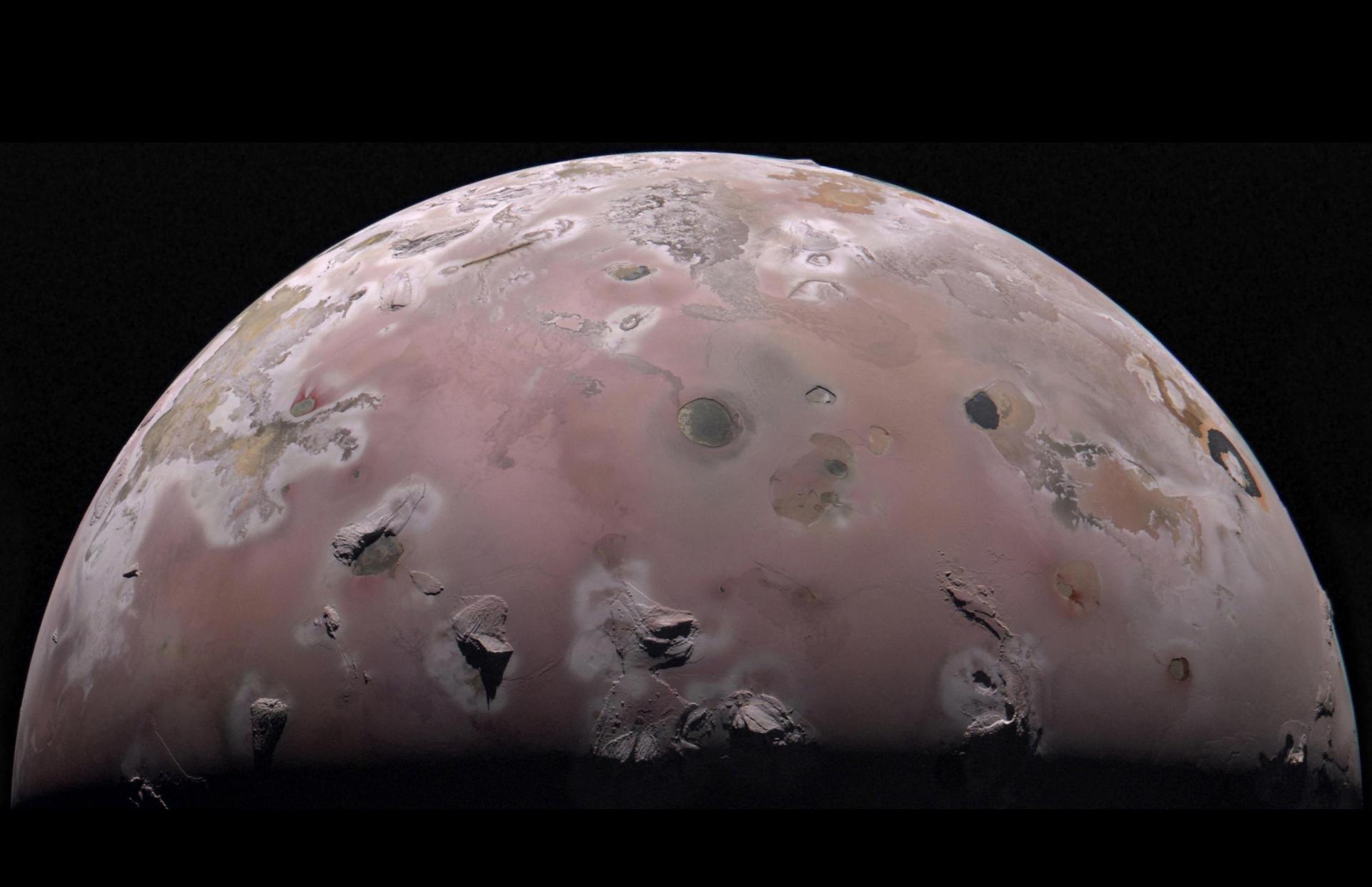
NASA’s Juno spacecraft has provided the first measurements of temperatures beneath the surface of Jupiter’s moon Io. Data collected during flybys in late 2023 and early 2024 reveals a significant subsurface heat gradient, offering new insights into the tidal processes that fuel the most volcanically active world in the solar system.
The Juno mission, a collaborative effort involving NASA, the Jet Propulsion Laboratory (JPL), and the Southwest Research Institute, has successfully probed the crust of Io. Using the Microwave Radiometer (MWR) instrument, researchers analyzed thermal emissions from the moon’s subsurface during two close encounters on December 30, 2023, and February 3, 2024. During these events, the spacecraft approached within about 930 miles of the moon’s surface.
Subsurface Thermal Mapping and the MWR Instrument
The MWR instrument, originally engineered to study the deep atmospheric composition of Jupiter, consists of six antennas that detect microwave radiation across a spectrum from about half an inch to 20 inches. This range allows the instrument to penetrate different depths of a planetary body. While the MWR instrument has provided the opportunity to observe the icy shells of Europa and Ganymede, the ability to probe into the volcanic rock of Io was an unexpected discovery.
“The Juno Microwave Radiometer directly observed Io’s heat output by looking below the surface.”
Scott Bolton, study coauthor and Juno’s principal investigator at Southwest Research Institute in San Antonio
According to NASA’s reporting, the collected data indicates that temperatures rise by more than 40 degrees Fahrenheit just several feet below the surface. This gradient is far steeper than what solar heating alone can explain, confirming that internal processes are driving the thermal output.
Interpreting Io’s Interior Heat Flow
Researchers are currently evaluating two primary models to explain the heat signatures detected by the MWR. The first suggests that heat is rising steadily through a conductive crust. While the measured background heat flow—between 1 and 3 watts per square meter—is relatively gentle on a local scale, the aggregate energy release across the entire moon is estimated to be up to 30 times Earth’s average.
The second possibility involves cooling lava flows. In this scenario, the signals detected by Juno originate from molten material capped by roughly 30 to 35 feet of solidified crust. This model accounts for about 10% of Io’s surface area at any given time. As noted by the mission team, previous infrared observations sensed only the temperature of the top surface.
The sources do not provide the specific quote regarding the sensitivity of the temperature band or the bonfire analogy; however, they note that until now, virtually everything known about Io’s heat came from infrared observations, which sense only the temperature of the top surface.
Implications for Terrestrial and Cosmic Volcanology
The findings regarding Io’s internal heat movement have broader implications for understanding tidal heating, a mechanism that fuels subsurface oceans on moons of giant planets, such as Europa and Ganymede. By characterizing how heat migrates from the interior to the surface, scientists can better model the energy dynamics of worlds far from their parent stars.

The application of this technology may also extend to Earth. Investigators believe that using MWR-type instrumentation to study the subsurface temperature gradients of terrestrial volcanoes could reveal a similar signature, providing new information on how terrestrial volcanoes work.
“The surprising discovery that we could see below a rocky moon’s surface has important implications for studying Earth’s volcanoes. Juno has taught us that if we look with an MWR-type instrument near a volcano on Earth, we might see a similar signature in the subsurface temperature gradient, providing new information on how terrestrial volcanoes work.”
Scott Bolton, study coauthor and Juno’s principal investigator at Southwest Research Institute in San Antonio
The research, published in the Journal of Geophysical Research: Planets, confirms that most of Io’s surface is remarkably smooth and composed of material of very low density.
Keep reading