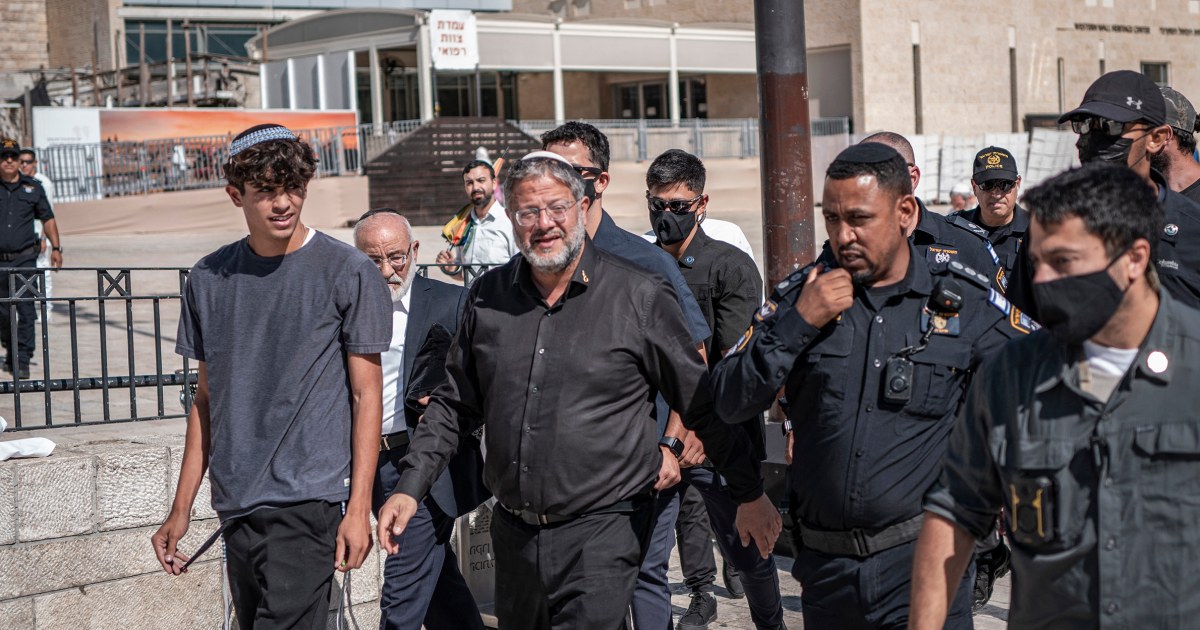
Israeli National Security Minister Itamar Ben-Gvir, along with Likud party lawmaker Amit Halevi and thousands of other Israelis, entered the Al-Aqsa Mosque compound in East Jerusalem on Thursday. The incursions coincided with Tisha B’Av, a Jewish day of fasting and lament commemorating the destruction of the ancient Jewish temples.
The Palestinian Ministry of Endowments and Religious Affairs reported that more than 3,200 Israelis entered the mosque courtyards by 12 p.m. local time. Other reports cited an official from the Islamic Waqf Department and the Jerusalem Governorate stating that more than 2,500 occupiers stormed the compound. These entries were conducted under the protection of heavily armed Israeli police, who the Jerusalem Governorate said allowed the number of people entering in each group to increase to approximately 150.
Violations of the Status Quo
The compound, known to Jews as the Temple Mount, is governed by a decades-old arrangement where the site is administered by a Jordanian religious foundation. Under this status quo, Jews are permitted to visit but are prohibited from praying at the site. However, participants during Thursday’s events were seen raising Israeli flags, singing the national anthem, dancing, and erecting a tent for shade.

The Jerusalem Governorate and the Islamic Waqf reported widespread violations,
including the performance of Talmudic rituals such as wearing tefillin and carrying out full prostrations in the eastern section of the compound. Ben-Gvir praised the activity in a video, stating, Jews praying, feeling like they’re the owners of the place. This has never happened before.
Impact on Palestinian Worshippers
Ahead of the raids, Israeli forces imposed tight restrictions at the mosque’s gates and across the Old City. According to the Jerusalem Governorate, these measures prevented many Palestinians from reaching the site for pre-dawn prayers, forcing some to pray in nearby streets. The governorate further alleged that Israeli forces assaulted several worshippers and residents among the limited number of Palestinians who managed to reach the mosque for dawn prayers.

Regional and Political Reactions
The visit drew immediate condemnation from several entities:
- Jordan: The foreign ministry described the visit as a “barbaric act,” an “unacceptable provocation,” and a “desecration of the sanctity of the mosque.”
- Palestinian Authorities: The Palestinian religious affairs ministry called the incursion a “flagrant violation” of the historical and legal status quo, asserting that the 144-dunam area is an exclusive right of Muslims.
- Peace Now: The Israeli NGO warned that the mass Jewish prayer service in the plaza directly violates the fragile status quo and could “ignite a religious war.”
The Jerusalem Governorate characterized Ben-Gvir’s participation as a dangerous shift,
suggesting that the Israeli government has officially adopted actions previously carried out by extremist groups. These groups, which advocate for replacing the mosque with a Third Jewish Temple, had reportedly urged supporters to join the raid with a goal of attracting 5,000 participants.
Context and Administration
The Al-Aqsa Mosque compound is Islam’s third-holiest site and the most sacred site in Judaism. While the Jerusalem Islamic Waqf is responsible for maintenance, access, and excavations, Israel has seized control over access since occupying East Jerusalem in 1967. Israel later annexed the city in 1980, a move not recognized by the international community.
While there was no immediate comment from the office of Prime Minister Netanyahu following Ben-Gvir’s visit, previous statements from the office have maintained that there is no change in Israel’s policy regarding the status quo.
Worth a look