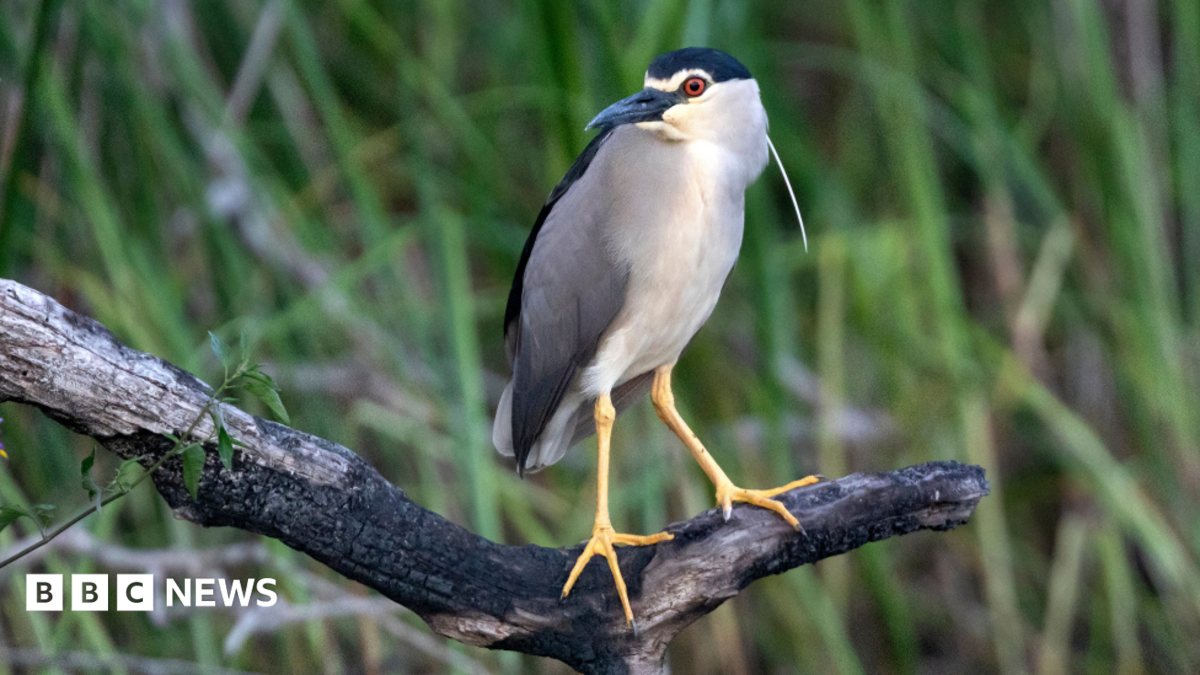
Conservationists have captured images of a rare black-crowned night heron on the National Trust’s Holnicote Estate in Somerset, highlighting the impact of aggressive freshwater habitat restoration. The sighting follows targeted hydrological engineering, including beaver reintroductions designed to reverse decades of agricultural drainage and provide vital refuges for declining wetland species.
A remarkably rare visitor to British shores has turned up on camera in Somerset, providing what conservationists describe as empirical proof that large-scale wetland restoration can draw elusive wildlife back to degraded British landscapes. The black-crowned night heron, a stocky waterbird widespread across Africa, Asia, the Americas, and Europe, was documented on remote cameras at the National Trust’s Holnicote Estate near Minehead.
While the species is globally common, it remains an exceptionally scarce visitor in the United Kingdom. Ornithologists note that sightings have seen a slight uptick since the first confirmed British breeding pair was documented in Somerset in 2017. Because the bird hunts almost exclusively at night, preying on frogs, small fish, and aquatic insects, daytime human encounters are nearly impossible, making camera trapping the primary tool for monitoring its movements.
Hydrological Engineering and the Beaver Effect at Holnicote
The arrival of the night heron is not a random migratory occurrence. It is the direct result of deliberate hydrological restructuring aimed at reversing centuries of agricultural drainage that have devastated local ecosystems.
According to project data, the UK has lost over 97% of its wetlands through drainage and changes in land management. To combat this loss, conservation teams at Holnicote have reintroduced Eurasian beavers, allowing the animals to organically dam streams, flood meadows, and create the deep, stagnant pools essential for nocturnal hunters.
“We are continuing to focus on wetland creation through our project work, as well as letting beavers modify and produce these habitats at scale.”
Jack Siviter, Holnicote Estate beaver and wetlands project officer
This reliance on keystone species allows land managers to achieve a level of habitat complexity that traditional heavy machinery cannot replicate. Ben Eardley, project manager for Somerset Coast and Countryside, emphasized the significance of the sighting for regional biodiversity.
“It’s rare to see this wetland species in the UK and so exciting that we have observed one on our estate cameras.”
Ben Eardley, project manager for Somerset Coast and Countryside
Broader Ecological Rebound Across Somerset Wetlands
The night heron is far from the only beneficiary of the estate’s renewed hydrological network. Conservationists report that the restored freshwater mosaic has rapidly welcomed surging populations of water voles, otters, pine martens, and white-tailed eagles.
Ecologists interpret the northward drift of Mediterranean and African wetland species as part of a wider climate-driven pattern. As southern Europe faces severe droughts that erode traditional feeding grounds, highly mobile avian species are increasingly probing northern latitudes for cooler, wetter refuges.
Renewing existing wetlands and identifying opportunities to create new areas does more than attract rare birds. According to estate officials, these efforts help wildlife thrive, improve water quality, reduce flood risk, and construct more resilient landscapes for future generations.
Related reading