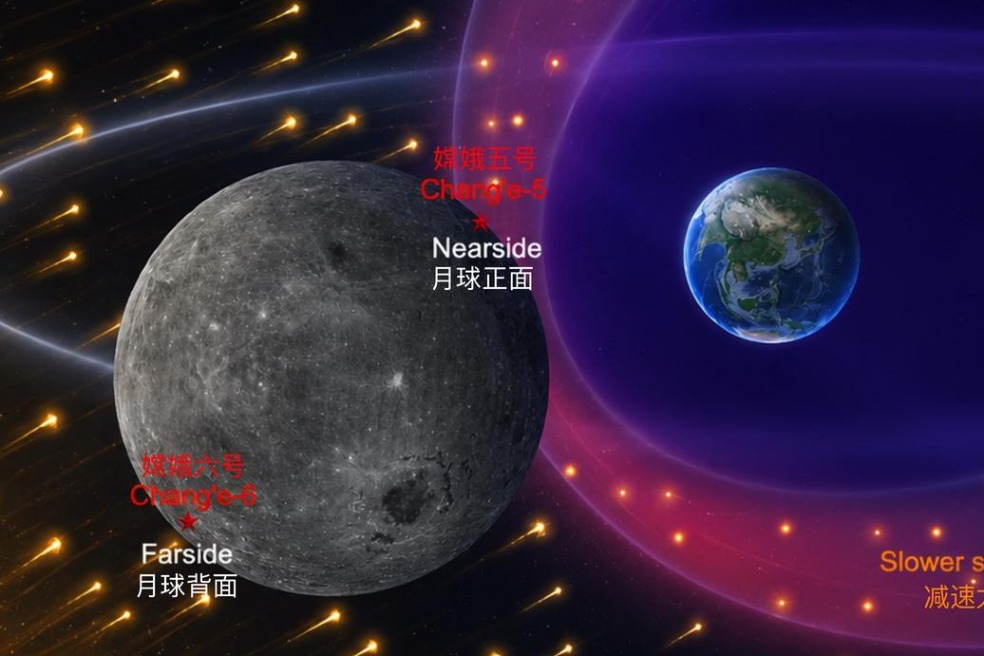
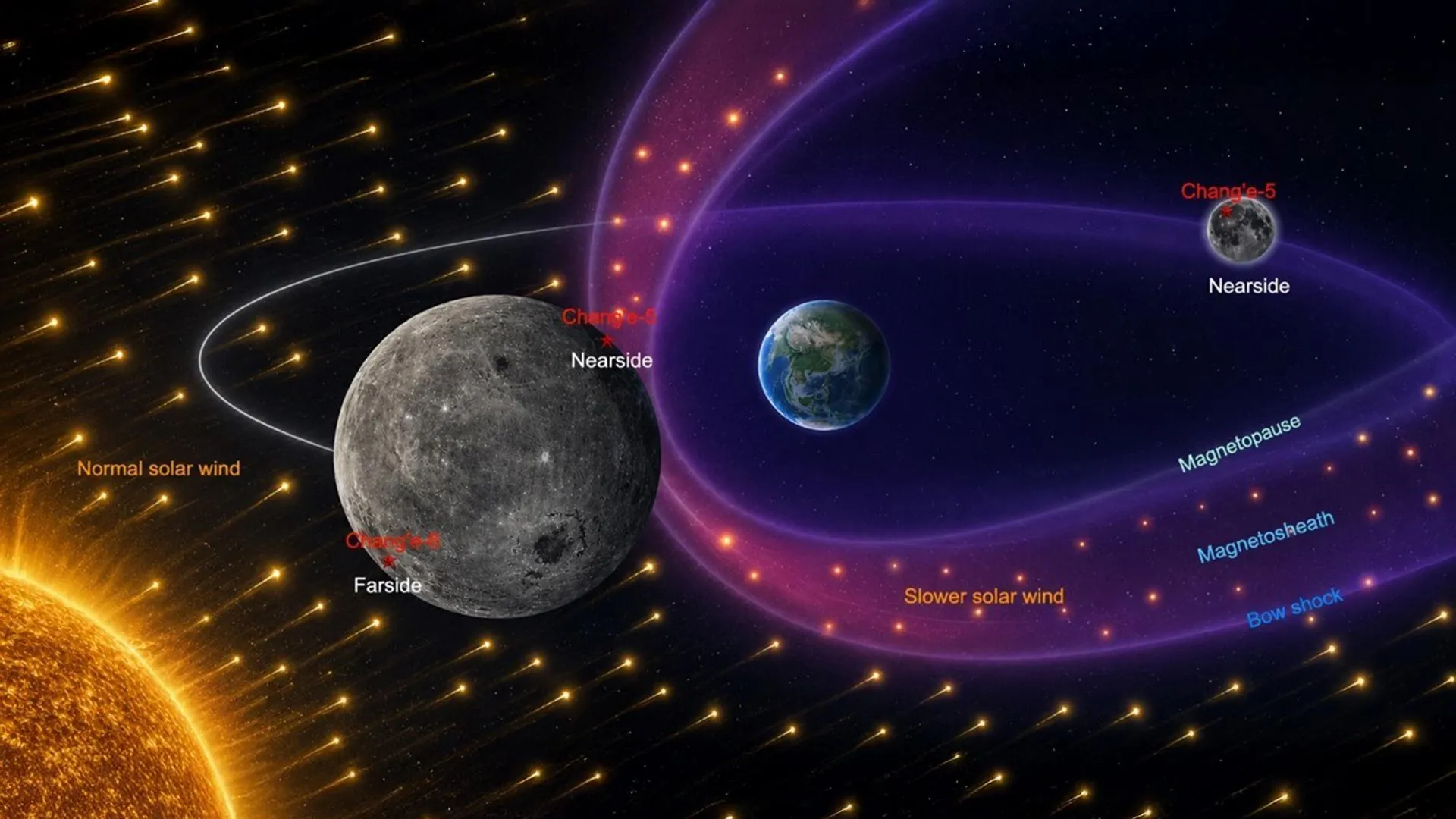
New scientific evidence indicates that the Moon’s two hemispheres experience solar wind bombardment differently, according to a study published in Chinadaily. While the farside receives solar wind particles at nearly full speed, the Earth-facing nearside is struck by the same wind after it has been slowed by nearly half. This discovery stems from a noble gas analysis of lunar farside samples returned by China’s Chang’e 6 mission in 2024.
Chang’e 6 Farside Samples Reveal Hemispheric Contrast
The mission retrieved soil from the South Pole-Aitken Basin, the oldest and largest impact basin on the lunar farside. Researchers analyzed five noble gases—helium, neon, argon, krypton, and xenon—within the returned material. Because these elements are chemically inert, they preserve a physical record of how solar wind particles entered and accumulated in the lunar regolith over billions of years.
Earth’s Magnetosphere Acting as a Speed Governor
The research team found that Earth’s magnetosphere functions as a natural speed governor,
deflecting and decelerating solar wind before it reaches the lunar nearside, an effect permanently locked into the soil’s noble gas record. When the Moon passes through the magnetosheath—the turbulent outer layer of Earth’s magnetic shield—normal solar wind slows from roughly 400 kilometers per second down to about 200 km per second.
At the landing site of the earlier Chang’e 5 mission on the nearside, this slower wind accounts for approximately 25 percent of total solar wind exposure. By contrast, the farside is never exposed to this protective deceleration effect and receives undisturbed solar wind.
Isotopic Signatures and Deeper Implantation
Comparisons between the farside samples and previous nearside records at nearly identical latitudes revealed distinct isotopic and thermal release patterns. The Chang’e 6 regolith showed an average 20Ne/22Ne neon isotope ratio of 11.34 ± 0.22, which is lower than previously studied nearside samples and matches theoretical solar wind fractionation. Additionally, krypton and xenon in the farside samples were released almost exclusively at high temperatures in a single-peak pattern, whereas nearside samples exhibited a bimodal pattern featuring both low- and high-temperature peaks.
Krypton and xenon are heavy noble gases that hardly diffuse once trapped in regolith grains,
said Zhang Xuhang, first author of the study and a postdoctoral researcher at the Institute of Geology and Geophysics of the Chinese Academy of Sciences. He explained that these release temperatures directly reflect original implantation depths, indicating that full-speed solar wind particles penetrated far deeper into farside soil, while the nearside received a substantial fraction of decelerated, shallower-penetrating wind components.
Reconstructing Earth’s Magnetic Past
The findings challenge the assumption that Earth’s magnetic field simply blocks solar wind entirely. Instead, the data provide direct physical evidence that the magnetosphere controls particle speeds reaching different parts of the Moon. Corresponding author He Huaiyu noted that by analyzing heavy noble gases in older nearside drill core samples, scientists could theoretically reconstruct how the boundary between Earth’s magnetosphere and the solar wind shifted over deep geological time.