International experts have established a new evidence-based framework for adult orthodontic care through three consensus articles published in the International Journal of Oral Science between February 01, 2025, and March 25, 2026. The guidelines address alveolar ridge augmentation, clear aligner strategies, and the treatment of protrusive facial deformities for adult patients.
The rise in adults seeking orthodontic treatment has created a complex clinical environment where clinicians must balance skeletal relationships, periodontal health, and facial aesthetics. According to News Medical, these challenges are particularly acute for patients presenting with alveolar bone defects or protrusive facial deformities, both of which can increase the risk of further complications.
The growing demand for adult orthodontic treatment has highlighted critical challenges,
says Dr. Li Xu, one of the lead authors, via News Medical.
Total-Element Diagnosis for Protrusive Facial Deformities
Correcting protrusive facial deformities in adults requires a shift away from focusing solely on tooth alignment. The consensus guidelines, published on February 01, 2025, advocate for a total-element diagnosis that evaluates the patient as a whole entity rather than a collection of dental issues.
The diagnosis of protrusive facial deformities should follow the principle of total-element diagnosis,
says Dr. Chenchen Zhou, via News Medical.
This multidimensional analysis requires clinicians to evaluate sagittal, vertical, and transverse relationships, as well as the patient’s growth potential. Multidimensional analysis is defined as the comprehensive evaluation of sagittal, vertical, and horizontal dimensions, as well as growth potential in the diagnosing and decision-making process of orthodontic cases. By integrating these skeletal and facial assessments with functional and periodontal considerations, orthodontists can set realistic objectives before selecting a specific treatment approach.
Digital Precision and Clear Aligner Strategies
Predictable tooth movement depends on the quality of initial data. A consensus article published March 13, 2025, emphasizes that digital technology must complement clinical judgment through meticulous mapping of every treatment stage.
The precise initial position of the teeth requires complete and accurate patients' data,
says Dr. Wenli Lai, via News Medical.
The following data sources are used to develop an accurate digital treatment strategy:
- Cone beam computed tomography (CBCT) scans
- Digital dental models
- Radiographic examinations
- Facial and intraoral photographs
The guidelines specify that the success of clear aligner therapy hinges on three critical keys: the initial, intermediate, and final positions of the teeth. Designing these transitions allows orthodontists to guide movement in a predictable sequence that respects biomechanical principles.
Alveolar Bone Support and Ridge Augmentation
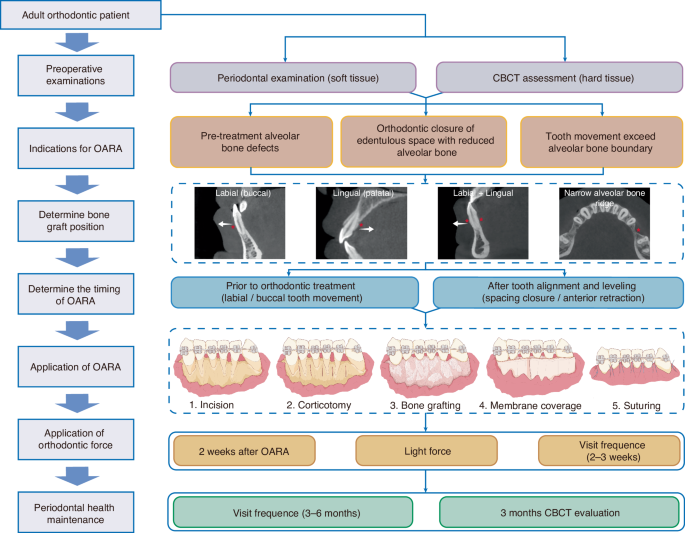
Biological limits of supporting tissues present a significant risk for adult patients, who often have reduced alveolar bone support. The most recent of the three consensus papers, published March 25, 2026, focuses on orthodontic-associated alveolar ridge augmentation to mitigate periodontal complications.
The consensus strongly recommends the use of CBCT imaging for a comprehensive assessment of alveolar bone, especially when extensive tooth movement is planned. This is critical because tooth movement must respect the biological limits of the supporting tissues to avoid further defects.
Research cited in the framework highlights the prevalence of bone issues in specific malocclusions. For example, Evangelista, K. et al. (2010) in Am. J. Orthod. Dentofac. Orthop. assessed dehiscence and fenestration in patients with Class I and Class II division 1 malocclusion using CBCT, while Sun, L. et al. (2022) in Clin. Oral Investig. studied dehiscence and fenestration of Class I individuals with normality patterns in the anterior region. Other verified research, such as Guo, Q. Y. et al. (2011) in J. Zhejiang Univ. Sci. B, has examined the three-dimensional evaluation of upper anterior alveolar bone dehiscence after incisor retraction and intrusion in adult patients with bimaxillary protrusion malocclusion.
The framework also incorporates evidence on bone remodeling and grafting. Guo, R. et al. (2023) in Prog. Orthod. conducted a prospective follow-up study on long-term bone remodeling of maxillary anterior teeth with post-treatment alveolar bone defect in adult patients with maxillary protrusion. Additionally, the evidence includes research on bone graft materials for alveolar bone defects (Lu, J. et al., 2022, Tissue Eng. Part B Rev.) and the impact of frontier development of alveolar bone grafting on orthodontic tooth movement (Miao, Y. et al., 2022, Front. Bioeng. Biotechnol.).
Evidence-Based Framework Summary
The three consensus articles provide a tiered approach to adult care, moving from broad facial diagnosis to specific tool application and biological preservation.
| Consensus Topic | Publication Date | Primary Focus |
|---|---|---|
| Protrusive Facial Deformities | February 01, 2025 | Total-element diagnosis and multidimensional analysis |
| Clear Aligner Strategies | March 13, 2025 | Digital data accuracy and transitional tooth positioning |
| Alveolar Ridge Augmentation | March 25, 2026 | Periodontal health and bone support assessment via CBCT |
By synthesizing systematic evidence reviews with multidisciplinary expert input, this framework seeks to standardize how orthodontists manage the heightened risks associated with adult skeletal and periodontal discrepancies. Readers should consult with qualified orthodontic and periodontal professionals to determine the appropriate treatment strategy for their specific clinical needs.