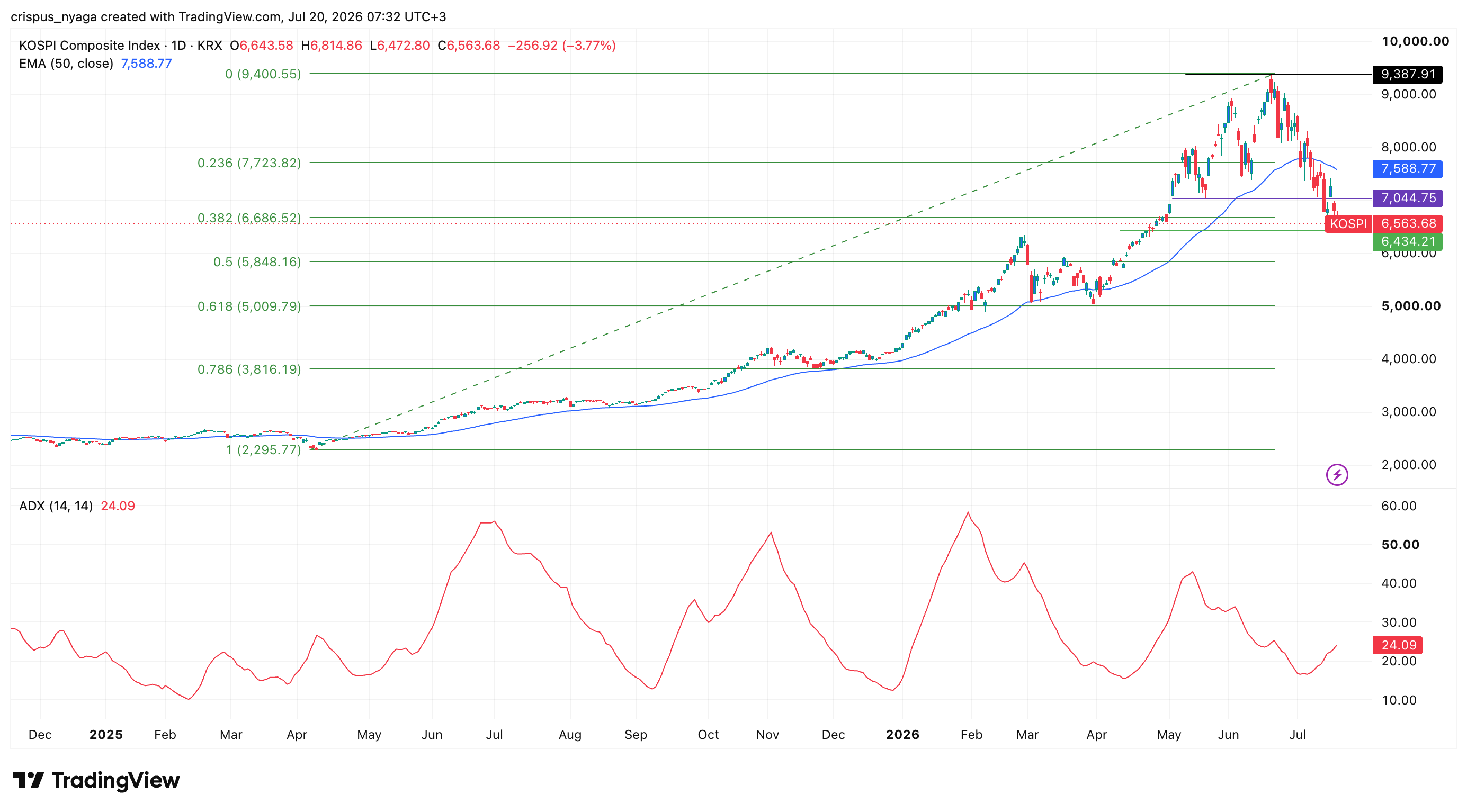
South Korea’s benchmark Kospi index surged 18% in a record single-day rebound on Friday, tracking Wall Street gains and a recovery in artificial intelligence stocks. Despite the sharp bounce, the index experienced a volatile July where it plunged more than 33% at its lowest point, driven by retail leverage, Chinese chip competition, and earnings pressures.
Trading desks across Asia experienced a dramatic reversal of fortune as South Korea’s Kospi index jumped nearly 18% to close at 6,695.45. The single-day surge marked the largest advance in the index’s history, eclipsing an October 2008 gain recorded during the global financial crisis. Technology heavyweights powered the advance, with Samsung Electronics surging 28% and memory chipmaker SK Hynix soaring 30%, according to apnews.com.
The sudden relief rally arrived after a punishing three-day slide where the Kospi sank more than 17% as investors dumped technology shares over fears of an artificial intelligence bubble and mounting competition from Chinese chipmakers. Stephen Innes of SPI Asset Management noted that the market had gone from throwing AI stocks overboard to fighting for the remaining seats before most traders had finished writing the obituary, as cited by apnews.com.
July Volatility Eclipses Historic Crises
Even with Friday’s record gains, the Kospi remains well below the peak of over 9,000 that it hit in June. At its lowest point during the month, the benchmark plunged more than 33%, making July the worst month in the index’s history. That drawdown surpassed the 27% loss recorded during the October 1997 IMF crisis and the 23% slide during the October 2008 global financial crisis.
The intensity of the sell-off triggered circuit breakers on July 28 and 29—marking the first time trading halts were fired on consecutive sessions. The back-to-back sessions erased 864.5 trillion won and forced an emergency gathering of South Korea’s top financial authorities. Finance Minister Koo Yun-cheol acknowledged that leveraged retail products required closer regulatory scrutiny, noting that they had already put in place a package of measures, but if it was needed they would introduce additional steps to help normalise the market.
Leverage, Earnings Misses, and the China Chip Shock
Market analysts traced the July turbulence to a collision of structural vulnerabilities and external shocks. In the first half of 2026, the Kospi more than doubled, gaining 116% at its peak to hit an all-time high of 9,385.59 in June. That climb was heavily fueled by retail investors piling into leveraged single-stock exchange-traded funds tied to Samsung Electronics and SK Hynix. Outstanding leveraged bets reached a record 29.2 trillion won, equivalent to approximately $19.7 billion, in early July.
When global sentiment turned against stretched AI valuations, those leveraged instruments mechanically accelerated the sell-off by forcing portfolio rebalancing into falling markets. Compounding the pressure, reports emerged that Chinese companies were developing domestic deep ultraviolet lithography equipment. Beijing’s broader push for self-sufficiency—backed by a $295 billion nationwide AI buildout plan—threatened the global dominance of South Korean memory producers.
Earnings reports also failed to satisfy lofty market expectations. Although SK Hynix posted record second-quarter revenue of 79.3 trillion won, the figure missed LSEG consensus estimates of 84 trillion won.
Economic Dependency on Semiconductors and Trade Pressures
The market correction underscored South Korea’s heavy economic reliance on the semiconductor sector. Chipmaking accounted for more than 10% of the nation’s manufacturing output in 2024, positioning it as the country’s largest manufacturing industry ahead of steelmaking and oil refining, as detailed by thediplomat.com. By June 2026, South Korean semiconductor exports climbed 199.5% year-on-year to reach $44.8 billion, representing 43.8% of total exports.

Yet that concentration leaves the index exposed to geopolitical friction. Major producers like Samsung and SK Hynix operate manufacturing plants in China that depend on software and equipment governed by United States export controls. Recovery in the Kospi remains tied to navigating U.S.-China trade regulations and stabilizing domestic monetary policy after the Bank of Korea delivered its first interest rate hike since 2023.
Wall Street Earnings Propel Regional Rebound
Friday’s broader Asian market recovery drew direct momentum from Wall Street, where Microsoft reported stronger-than-expected quarterly profits. Microsoft shares jumped 15.5% in their best single-day performance in nearly 18 years, signaling to investors that heavy corporate expenditures on artificial intelligence infrastructure are successfully generating revenue.
Regional indices shared in the upward momentum on Friday. Tokyo’s Nikkei 225 climbed 4% to 64,362.02, aided by a 14.2% jump in SoftBank Group shares. In Taiwan, the Taiex surged 8% as chipmaker TSMC gained 10%.
Worth a look